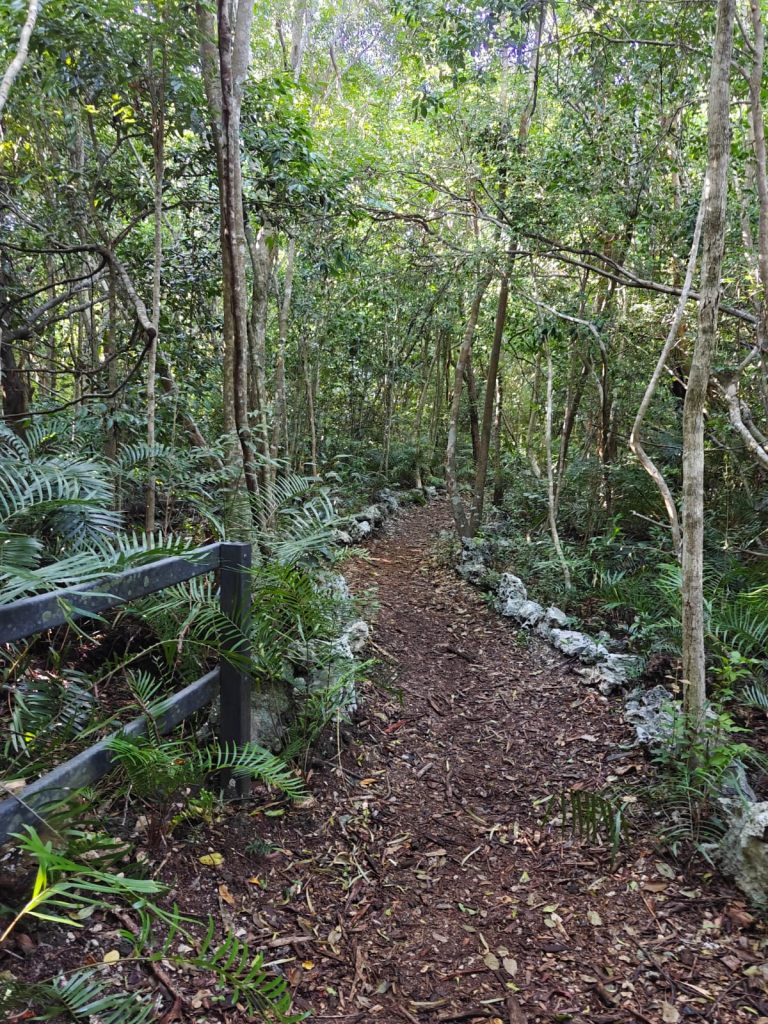
Punta Cana is often spoken of in the language of beaches—turquoise waters, powdered-sugar sands, coconut groves bending into Caribbean winds. Yet, just a short distance from the familiar rhythm of surf and sun lies a quieter, older heartbeat: a 15,000-acre subtropical forest that the sea breezes seem to guard like a secret. Known today as the Indigenous Eyes Ecological Reserve, this is one of the rare privately protected forests in the world, entrusted by Grupo Punta Cana to the Punta Cana Foundation to nourish, study, and preserve nature.
If Punta Cana’s coastline dazzles with colour, the reserve reveals its magic through contrast. Classified as a subtropical transitional forest, it shelters an astonishing diversity of flora—more than 500 plant species, of which 36% are indigenous—thriving in a landscape where the characteristics of wet and dry ecosystems meet. Towering ceibas and delicate orchids coexist. Sprawling mangroves find companionship in numerous evergreen ferns giving it a distinct character. It is a living gradient of nature, where every step along the well-marked trail feels like passing through a slow-turning kaleidoscope of textures, scents, and shadows

.Yet, it is not the trees, shrubs, and plants alone that define this sanctuary. The true soul of the forest lies in its twelve freshwater lagoons, crystalline pools fed by the underground river Yauya, which journeys unseen beneath the porous limestone foundation of Punta Cana. The Dominican Republic receives generous rainfall—about 1300 millimetres annually—but the land here, made of ancient coral and limestone, drinks it silently. No surface rivers cut across Punta Cana; instead, water seeps deep into hidden chambers, joining subterranean flows that weave their way to the sea.
Where the water rises again, it emerges as luminous pools enclosed by jungle—a blessing, the Taíno people, this island’s original inhabitants, believed, and shaped by forces beyond human understanding. Many of the lagoons bear Taíno names, a linguistic tribute to the original inhabitants of this land who vanished under the weight of European colonisation. The Taínos called the lagoons “eyes” for their elliptical shape and the way their mirrored surfaces seemed to watch the forest. Hence the name Ojos Indígenas—Indigenous Eyes.

Walking through the reserve, the air shifts subtly, taking on the coolness of shaded earth and the faint mineral scent of groundwater. The path winds gently, revealing to those who care to comprehend stories of ecology, geology, and Taíno culture. These stories are whispered by the forest itself—the rustle of a palm frond, the sudden flight of a heron, the hush that settles when the canopy tightens overhead.
Of the twelve lagoons, two—Guamá and Inirirí—are particularly memorable for their size and accessibility. They invite travellers not just to look but to immerse. Slipping into the waters of Guamá is like entering a different element of time. The water is startlingly clear—a blue-green transparency that seems almost unreal—and deliciously cool against sun-warmed skin. Light refracts gently on the limestone bed below, creating wavy mosaics that dance with every stroke. Inirirí, equally serene, feels more enclosed, a small cathedral of water and leaves where one can float and listen to nothing but one’s heartbeat.

The reserve as it fascinates and enchants the visitors, also serve a deeper purpose. The Centre for Sustainability, run by the Punta Cana Foundation, uses it as a living laboratory—conducting research on climate resilience, native species regeneration, and water conservation. Schoolchildren visit regularly, learning that paradise is not accidental but tended through knowledge and care. Scientists, too, come to observe the fragile balance of this transitional forest and gather data that informs broader ecological efforts across the Caribbean.
The Indigenous Eyes Reserve is thus far more than a recreational detour. It is a reminder that even in a region celebrated for beaches and resorts, quieter landscapes hold stories equally compelling. Here is a piece of Punta Cana that does not perform for the camera. It breathes, endures, remembers.
As I emerged from the forest after my swim, I paused by the beach gate where the hidden river Yauya finally meets the sea. Waves folded gently over its unseen mouth. It was easy, in that moment, to feel the layered histories—Taíno, colonial, ecological, and personal—converging in a single line of water. A reminder that travel, at its best, is not only about seeing the world, but about recognising the ancient eyes with which the world watches us back.
 scribo ad LX