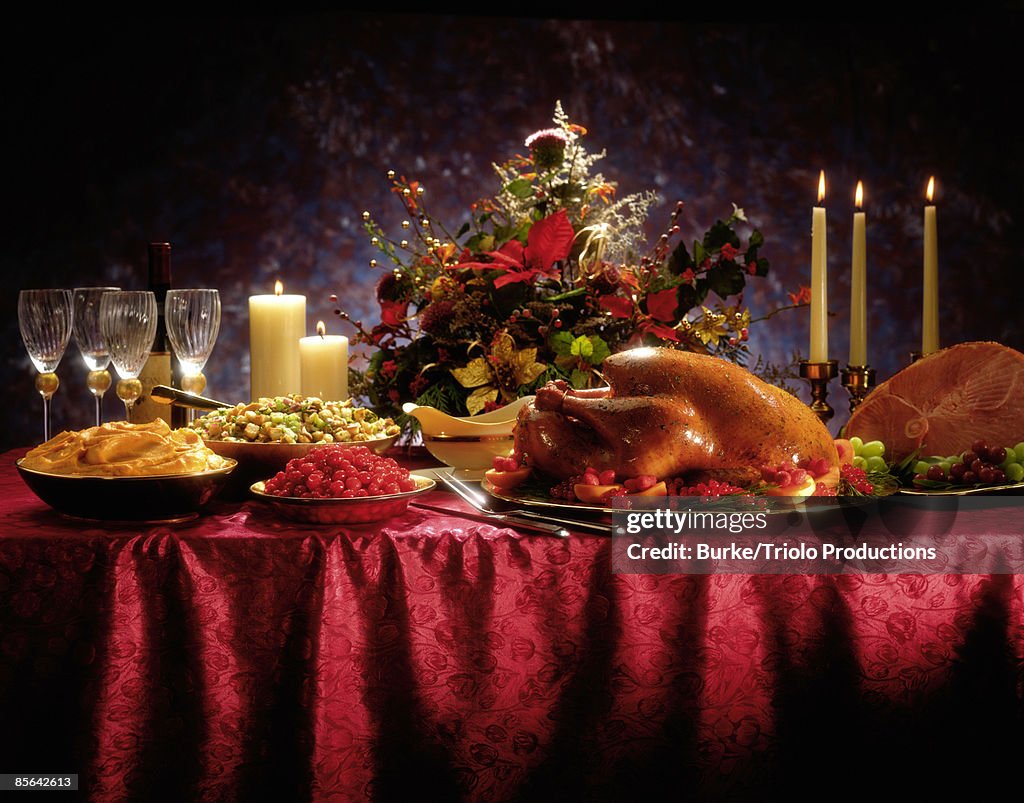
The Thanksgiving spread
Every Thanksgiving, the American table displays a familiar repast- a fetching riot of colour—golden turkey skin crackling in the oven, cranberry sauce glowing like a jewel, cornbread warm enough to melt butter on contact. Yet few of us pause to wonder how these foods arrived here, or whose hands shaped them first. So let’s begin not with the Pilgrims or the parade, but with the bird that has somehow become the emblem of this holiday: the turkey.
The Turkey Tale
Long before the first English foot touched New England soil, Native peoples across the East hunted wild turkeys that roamed in raucous, feathery crowds. They roasted them over open fires, smoked them for winter, and seasoned them with wild herbs. When Europeans arrived, they were astonished not only at the size of the bird but at its abundance—and promptly carried it back across the Atlantic. Within decades, turkey had become a delicacy in England and Spain, appearing at royal feasts and aristocratic tables.
The irony? Turkey became fashionable in Europe before it became central to Thanksgiving in America.
By the 1800s, as Thanksgiving evolved into a national celebration, the turkey—big enough to feed a crowd and unmistakably American—became the obvious centrepiece. But its earliest stewards were Native Americans. Every slice on today’s table carries that heritage, even if it goes unspoken.
And so does almost everything else we eat today.
The Original American Pantry

The Three sisters-Corn, Beans, and Squash
Native American cuisine isn’t a single tradition—it’s hundreds of them. But if there’s one unifying principle, it is this: food came from an intimate conversation with land and season. Imagine a pantry without shelves—only fields, forests, rivers, and skies. Corn grew tall under the sun, beans curled gently around the stalks, and pumpkins and squash sprawled in the shade below. This ingenious trio, known as the Three Sisters, fed entire civilizations across the continent. Corn was roasted, stewed, ground, fermented, or boiled into comforting porridges, while beans lent body and protein to soups and stews. Squash brought sweetness, texture, and long-lasting nourishment.
Beyond these staples, the Native table dazzled with wild rice harvested by canoe in the Great Lakes, maple syrup tapped from northeastern forests, chiles and desert herbs from the Southwest, and berries of every colour—blue, black, and red—eaten fresh or simmered into wójapi, a thick, luxurious pudding. In the Northwest, salmon was roasted on cedar stakes, while across the Plains, bison and deer were roasted, dried, or added to hearty stews. Even the cranberry, that tart and vivid berry so central to Thanksgiving today, was used in sauces, drinks, and drying cakes long before settlers came.
This was a cuisine of adaptation, intuition, and respect. You cooked what was available; you used what you gathered; you wasted nothing.
Stories Simmering in Every Pot
Behind each dish lies a story: elders teaching children to gather berries at dawn, families passing down corn varieties older than many nations, the rhythmic sound of wild rice being harvested in canoes, or the ceremony that greets the season’s first salmon. Every tribe has its own culinary legends; every ingredient its own journey. These are the stories that ripple beneath the American table, even if they are rarely spoken aloud.

Ingenious Kitchens Before Kitchens Existed
Today’s chefs like to talk about “farm-to-table” and “nose-to-tail,” but Indigenous communities practiced both long before such phrases were invented. Corn, for instance, was processed through nixtamalization, a technique of soaking it in an alkaline solution that boosted its nutritional value and made hominy and masa possible—an innovation so clever it remains foundational to tortillas and many modern dishes. Meat was preserved as pemmican, an early form of the energy bar: dried meat and berries bound with fat, portable, durable, and nutrient-rich. Salmon cooked on cedar, now considered a culinary art, was born of both necessity and skill, as cedar infused a sweet smoke while serving as a natural roasting board. And nothing, absolutely nothing, was wasted. Bones became broth, seeds were roasted, hides became storage vessels. Deliciousness and resourcefulness walked hand in hand.
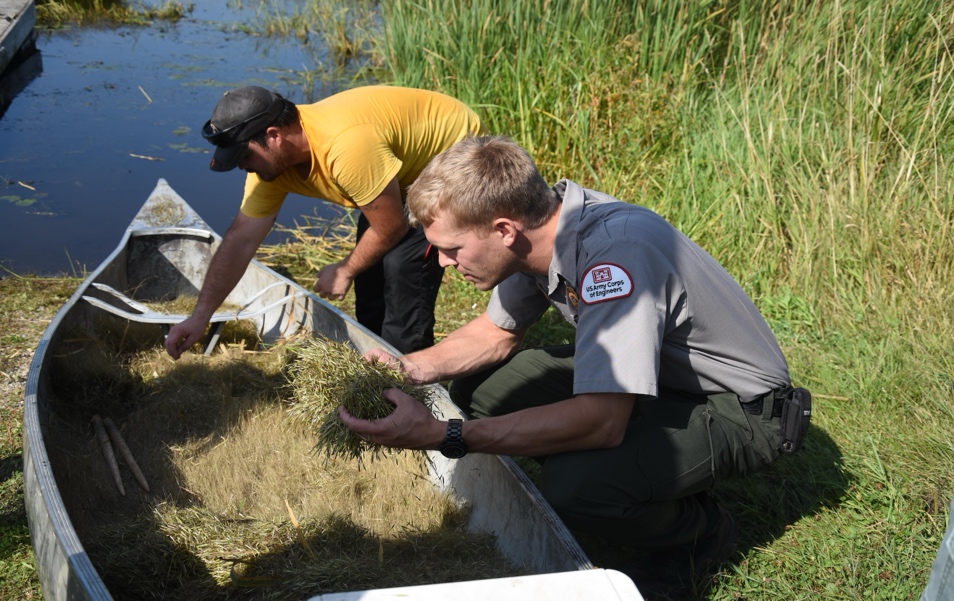
Wild Rice Harvesting
How Native Foods Became American Staples
It is difficult to overstate how deeply Indigenous ingredients and techniques shaped what we now call American cuisine. Cornbread, for instance, traces directly back to Algonquian corn cakes, while grits evolved from hominy made possible only through nixtamalization. That cheerful mix of corn and beans known as succotash was a Native comfort food long before it entered colonial kitchens. Wild rice stuffing, today a holiday favourite, was once an everyday meal for tribes of the northern woodlands. Maple syrup sweetened stews, porridges, and drinks centuries before cane sugar became readily available. Cranberries, now an essential Thanksgiving condiment, were cooked into sauces and dried cakes by Native cooks who understood their tart brilliance. Even jerky, a quintessential American snack, evolved from the Indigenous practice of making pemmican. The very idea of using every part of the animal—now celebrated by modern chefs for its ethics—has its roots in Indigenous tradition.
A Story Interrupted, A Story Revived
The arrival of colonists brought upheaval not just to lands and lives but to food traditions. Forced relocations, loss of ancestral territories, and dependence on government rations eroded the traditional diets of many communities. Some recipes faded away, remembered only in fragments—an ingredient here, a cooking method there. Yet even in hardship, creativity survived. One beloved Native dish, frybread, emerged not from abundance but from necessity, created from government-issued flour, sugar, and lard when Indigenous people were cut off from their ancestral foods. Today it stands as a symbol of resilience: born in deprivation, cherished in culture.
In the last few decades, though, something remarkable has happened. A vibrant culinary revival—part healing, part cultural reclamation—has taken hold across Native America.
The New Indigenous Kitchen
Across the country, Native chefs, foragers, seed keepers, and food historians are recovering old knowledge and shaping it into something simultaneously ancient and modern. Restaurants and community food projects now serve dishes that reimagine traditional ingredients in fresh ways: roasted venison glazed with berry reductions; heirloom corn stews scented with sage; wójapi spooned over warm corn cakes; squash blossoms filled with wild herbs; cedar-braised salmon plated with minimalist elegance; and endless interpretations of the Three Sisters, each honouring its agricultural wisdom.
This movement is not just about taste—it is about sovereignty, memory, health, and connection. It seeks to restore Indigenous communities’ relationship with their lands, to revive heirloom seeds, and to celebrate a cuisine that is both deeply rooted and brilliantly evolving.
A Thanksgiving Reflection
So today, when the turkey emerges in a fragrant cloud of steam and the cranberry sauce gleams beside it, remember that this feast began long before the holiday did. It began with the Native peoples who shaped the continent’s earliest cuisines, who taught others how to survive here, who innovated with corn and beans and squash, who lived in harmony with land and season. To honour Native Americans is not merely to acknowledge history—it is to celebrate the flavours they gifted us, the techniques they mastered, and the stories they carried across generations.
If Thanksgiving has a soul, it is Indigenous. And its flavours—its truest, most enduring flavours—are Native.
It is a fact worth remembering, and celebrating, today and always.
 scribo ad LX