
Not to speak of maples when the world of trees is considered would be a serious omission. But not to speak of them in autumn would be nothing short of a sacrilege. There are trees that announce themselves with grandeur, others that shelter us in silence, and yet a few that live in memory because of a single, dazzling moment. The maple stands apart, for it combines all that a tree stands for.
As summer wanes and the light begins to tilt, the maples of Short Hills ignite into brilliance—leaves turned to red, scarlet, purple, orange, and molten gold. Walking through these neighbourhoods, one feels the air thicken with a quiet anticipation; the tree itself seems aware that it is about to offer its most incandescent gift.
The Botany of a Flame
The maple belongs to the genus Acer, more than a hundred species scattered across the temperate world—from the mountains of Japan and Korea to the woodlands of Europe and the broad forests of North America. In New Jersey, the sugar maple (Acer saccharum), red maple (Acer rubrum), and silver maple (Acer saccharinum) are most common. Each carries its own signature: the sugar maple for its sweetness and steady growth, the red maple for its fiery autumnal display, the silver maple for its quicksilver leaves shimmering in the breeze. The very leaf-shape—five-lobed, delicately veined—is instantly recognizable, etched into our collective imagination as much as into the Canadian flag.

A Tree of Sustenance and Sweetness
Yet scientific description cannot capture what a maple truly is. Its meaning lies in what it evokes. In North America, the sugar maple was once a tree of sustenance. Indigenous peoples tapped its sap long before settlers arrived, boiling it into syrup and sugar that provided nourishment in lean months. The tradition survives in New England’s spring “sugar shacks,” where the ritual of sap-to-syrup still brings communities together. From the veins of the maple flows a sweetness both literal and symbolic—a reminder that generosity often lies hidden, waiting for those who know how to draw it forth.
Maple in Japanese Aesthetics
If North America associates the maple with sustenance, in Japan the tree is a symbol of pure aesthetic delight. The Japanese word momiji refers both to the maple leaf and to the act of viewing it in autumn, much like cherry blossom viewing (hanami) in spring. Families travel to mountain valleys and temple gardens to witness maples blushing into crimson. Poets have long written of the fleeting ache of this beauty, embodying the philosophy of mono no aware—the pathos of things, the tenderness of impermanence. “Even if I were to vanish tomorrow,” wrote a haiku poet, “let me glow tonight like the maple in fall.” – the maple becomes an emblem of the beautiful, brief, wholehearted life.
Maple Wood, and the Music of the World
In Europe, maple wood has carried a different destiny. Valued for its fine grain, it became the timber of choice for violins, cellos, and lutes. Stradivari’s masterpieces, still resonant after centuries, are voiced through the fibres of maple. Thus, the tree sings not only with leaves aflame in the forest but also in the concert halls of the world.

The Paradox of Its Glory
To stand before a maple in autumn is to encounter a paradox. In summer it is generous but unremarkable, a canopy of shade among many. Then, without prelude, it erupts into flame—sudden and startling, as though it had been holding its breath all season for this one moment of spectacle. But its glory is brief; within weeks the leaves wither and fall, carpeting the ground in a crackling mosaic. In this brevity lies its meaning: that endings can be radiant, that decline can be a form of offering.
Childhood’s Companion
Children know the tree in another way—through its seeds. The twin-winged samaras, released in late summer, twirl to the ground like tiny helicopters. Generations have played with them, tossing them into the air and watching their spiralling descent. A tree becomes beloved when it holds memories in its smallest gestures; the maple is one of those companions of childhood whose gifts are as playful as they are profound.
The Maple’s Many Moods
The idiosyncrasies of the maple are many. Its leaves do not all turn at once, so one tree can shimmer in multiple colours—half green, half gold, streaked with crimson. Some maples flare early, others wait for the frost, creating a staggered choreography across the landscape. To drive through Short Hills’ wooded roads in October and November is to witness a slow-motion festival, each maple choosing its own moment to bow to the season.
Writers have often reached for the maple when words falter before change. Herman Melville once wrote of maples as “October’s bright blue weather,” as if the season itself were distilled into its leaves. Longfellow, gazing at autumn leaves, spoke of “the beauty of things that are passing away.” Frost, in his typically wry way, observed that “nothing gold can stay.” These lines, often quoted, capture the maple’s secret: it does not resist transience but adorns it, does not mourn decline but illuminates it.
A Metaphor of Human Life
In the human imagination, the maple has become a metaphor for life’s own passage. In youth it is unnoticed, green and pliant. In maturity it glows with colour, a brief but unforgettable blaze. In old age it sheds what is no longer needed, standing bare but dignified against the winter sky. To live like a maple is to recognize that beauty is not only in commencement but also in culminations.
The Dazzling Departure
Here in Short Hills, where maples line avenues and edge backyards, their presence is more than ornamental. They mark the rhythm of the year, announcing with certainty that summer has ended and a new cycle begins. Each autumn walk becomes a pilgrimage, not to a monument but to a living flame that burns without consuming.
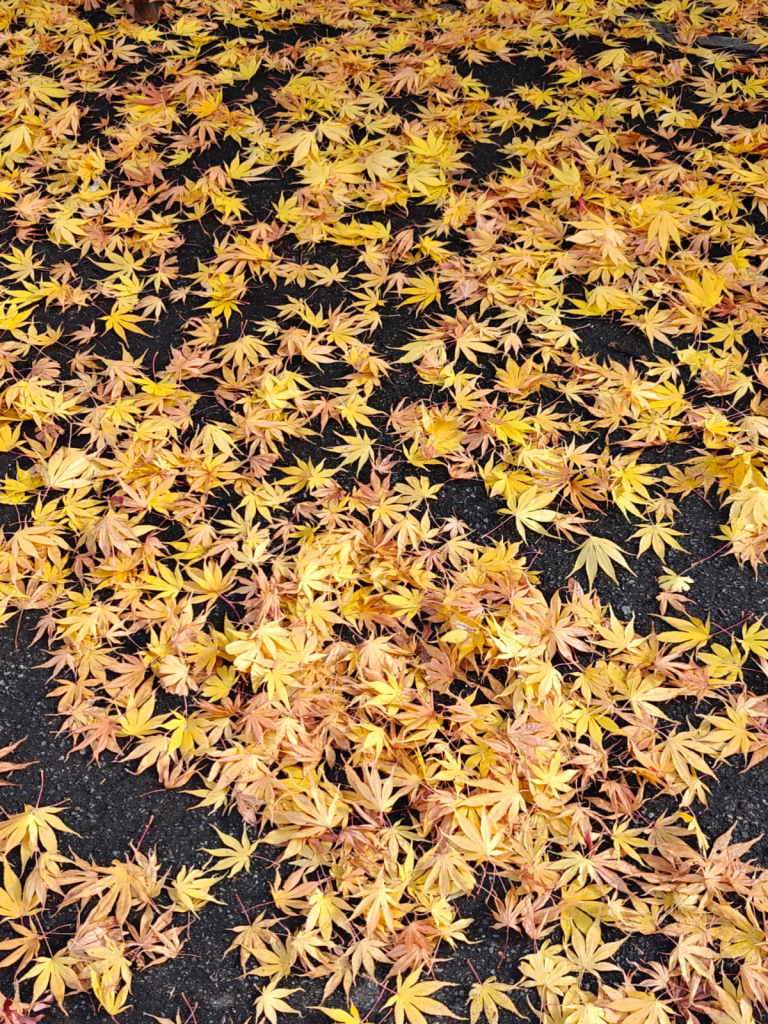
When the leaves finally fall and the branches stand empty, the memory of their colour carries us into winter but lingers in the mind’s eye, a reservoir of brightness carried into the dimming days. For all its brevity, the maple burns long within us.The maple, more than any other tree, reveals that life is not diminished by impermanence but made radiant by it. In its leaves we read the truth that departures, too, can be celebrations.
How much we wish our own departures—our transitions, our endings—might be as radiant?
.
 scribo ad LX