Charleston, arguably the jewel of the South, claims a historic and cultural richness that rivals that of Boston, New York, or even Philadelphia in the North. While on record, it stands shoulder to shoulder in historical stature with these other towns, it perhaps scores over them in offering a synthesis that is both unique and diverse in significant ways. This blending of traditions and histories here not only lends immense richness to its own heritage but also establishes its charm and allure as a pivotal American city.

Founded in 1670, this venerable city trails only Boston and New York in age among the early American settlements. While Boston, established by English Puritans in 1630, blossomed as the largest city in the Atlantic colonies, and New York emerged from a 1625 Dutch trading post to English hands in 1664, Charleston’s narrative began a mere 40 years post-Boston. Known initially as Charles Town to honour King Charles II of England, it adopted its current name in 1783 and swiftly grew to become South Carolina’s largest and oldest city.
Charleston Versus Boston: A Gentle Rivalry
In Charleston, there lingers a genteel rivalry with Boston, rooted in the distinct origins of their founding families. It is an intriguing yet charming complex that surfaces much too often in your interaction with the families of substance here. Charleston’s early settlers were primarily aristocrats from England, contrasting with Boston’s Puritanical exiles. This lineage imbues Charlestonians with a sense of inherited nobility, not worn on their sleeves but subtly expressed even in contemporary times.
Sir Ashley Cooper: The Architect of Charleston’s Destiny
The city’s geography, perched on the Charleston Harbour—an inlet formed by the Ashley and Cooper Rivers—ties directly to its historical narrative. Both rivers are named after Anthony Ashley Cooper, the first Earl of Shaftesbury, a pivotal figure in Charleston’s development. He was an outstanding statesman who held senior political office under both the Commonwealth of England and Charles II, serving as Chancellor of the Exchequer from 1661 to 1672 and Lord Chancellor from 1672 to 1673. In 1675, Cooper was granted 12,000 acres of land along the river after a permanent settlement was made at Albemarle Point in 1670.
Cooper played a crucial role in the city’s early days, securing land and privileges for the settlers. He never came to Charleston but his influence is felt deeply in Charleston, with myths of him inviting Sir Christopher Wren, one of the greatest British architects and city-planner to design the new city’s foundational architecture.
More interestingly, Ashley Cooper is also invoked when they refer to the cultural evolution of this place. His legacy extends to several educational institutions, such as the Ashley College for Women, reputedly among the country’s premier finishing schools with alumnae like former First Lady Barbara Bush. Several others have impacted the local history in dramatic ways.
Charleston: A City of Firsts
Charleston flourished and acquired immense wealth during early years of settlement. The Rice Plantations owned by the aristocracies from England and managed entirely by the slave labour brought untold riches to the families and in turn to the place. Part of it was spent in building palatial mansions and public building in the Charleston town. Charleston soon became one of the wealthiest if not the wealthiest town across an emerging nation.

Charleston’s historical significance is underscored by its many pioneering achievements. It was the fourth largest city in colonial America and boasted the first public college, museum, and playhouse in the U.S. The establishment of America’s first golf club in 1787 and the construction of North America’s longest cable-stayed bridge, the Arthur Ravenel Jr. Bridge, speak to its innovative spirit.
The Siege of Charleston
The city’s affluence, derived from its rice plantations worked by enslaved people, made it a focal point during significant conflicts. For over a century, its progress remained unimpeded and as the War of Independence raged across between armies of Union and Conversationists, this city became a crucible of crucial events.
The British capture of Charleston in May 1780 was one of the worst American defeats of the Revolution. Led by Gen. Henry Clinton, the British, Hessian, and Loyalist forces defeated the American defences held by Ben. Benjamin Lincoln and he surrendered the city of Charleston and his force of 6,000 men at a place presently known as Marion Park. The British occupied Charleston for more than two and a half years, evacuating it on December 14, 1782.
Charmed by History
Charleston is a charmed city, not only on account of its distinct beauty and charm but more evidently because it withstood the ravages of two wars that decimated many Southern cities. In the War of Independence, the British forces spared the town because of their special affinity to this place and also because it remained under their protection. During the Civil War, General Sherman reportedly spared the city from destruction due to a personal connection—his unrequited love, a former student of Ashley College, who hailed from Charleston and who Sherman has courted during his stay in Charleston several years ago. This romantic legend heightens Charleston’s unique charm while establishing its historical resilience.
Antebellum Architecture
Charleston, renowned for its opulent antebellum architecture, showcases a collection of buildings that reflect the city’s historical affluence and cultural grandeur. Among these, the Custom House stands out with its commanding façade, symbolizing Charleston’s rich mercantile past. Equally significant is The Old Exchange & Provost Dungeon, a building steeped in administrative and historical importance, which also served as the city jail. Nearby, a poignant site marks where slaves, brought to Charleston, were once auctioned, reminding us of the city’s complex history.
Many Southern towns boast majestic antebellum structures, yet Charleston’s residential architecture possesses unique characteristics, largely due to its historical ties with Barbados. Distinctive to the area, Charleston homes often open onto a “piazza” – a long, narrow corridor that is covered overhead but open at the sides. This architectural feature provides a communal yet private space before one reaches the main entrance of the home, which is accessed through a gate that leads into this corridor.
These residences typically feature a tripartite design. The front section is where the owner and their family reside, connected by a central corridor to a rear kitchen block. The kitchen block historically housed female servants upstairs, while the very back of the property contained a carriage house for storing carriages and horses, with male servants’ quarters located above.
This architectural style, where homes are deeper than they are wide, can also be attributed to local tax laws that assessed property taxes based on road frontage. This prompted homeowners to construct residences with modest frontages that belie the expansive, often lavish interiors.
Rainbow Row
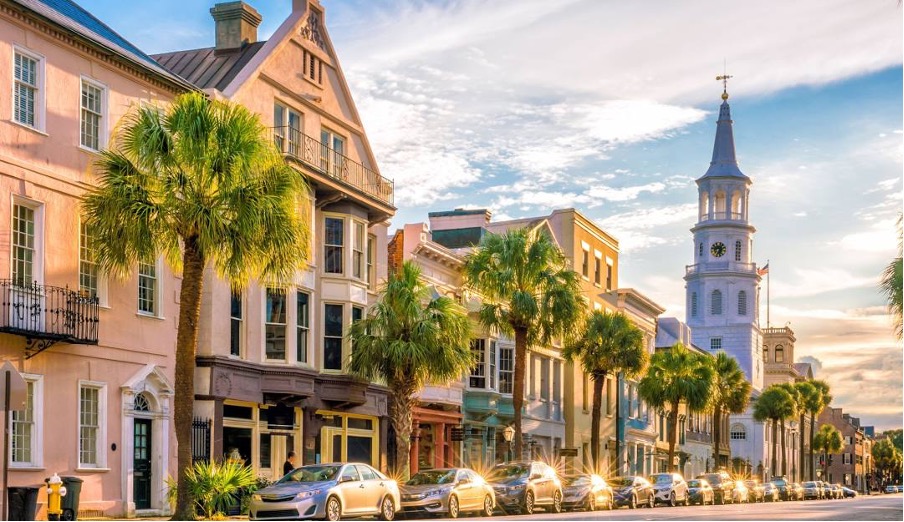
One of Charleston’s most iconic and photographed locales is Rainbow Row. This charming street is famous for its vibrant pastel-coloured houses. The origin of this colourful tradition is shrouded in folklore, including one popular tale suggesting the bright hues helped inebriated sailors remember which house was theirs.

Charleston’s architectural legacy is not just a testament to its past wealth but also a reflection of its cultural synthesis and historical narratives, offering both residents and visitors a window into the soul of this historic city.
The Four Cs of Charleston
Charleston is defined by Class, Culture, Climate, and Customs, priding itself on a richness of culture and tradition that rivals, if not surpasses, that of the northern states. The city’s southern hospitality is legendary, contributing to its status as a top destination for weddings, second only to Nashville in Tennessee.
With its virtually crime-free streets, its history- soaked locales, its once famous and sprawling plantations, and a people with palpable warmth and pride, Charleston remains not just a historical treasure, but a living testament to the grace and charm of the South.
 scribo ad LX