The Unravelling: Power, Loss, And The Shift In Destiny
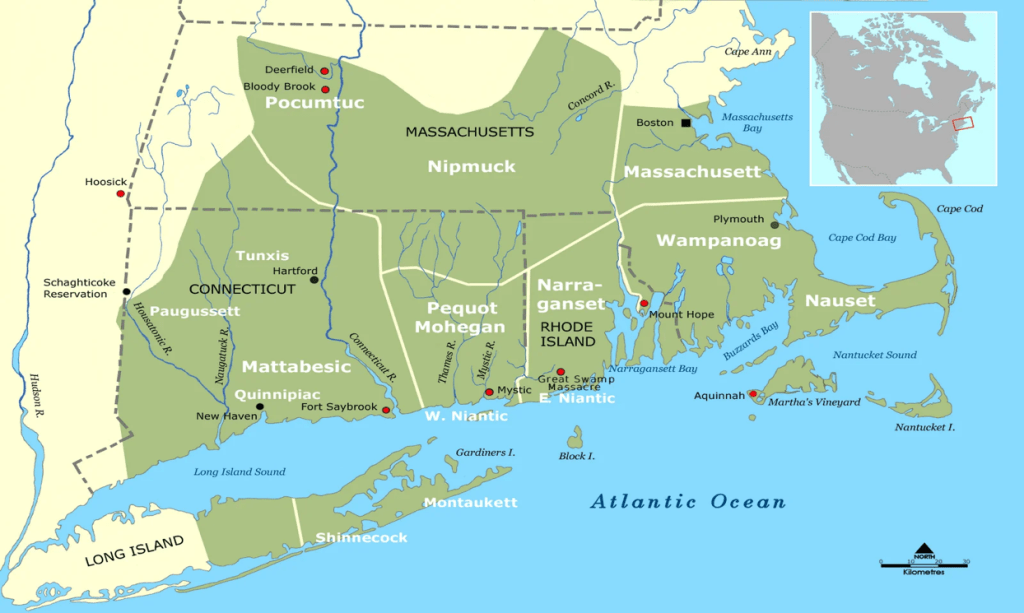
Map of Shrinking Indigenous Territories in New England, 1620–1700
The early years of coexistence between the Wampanoag and the Pilgrims were held together by two forces—mutual dependence and the strategic wisdom of Massasoit. But no equilibrium between unequal powers lasts forever. Once the first terrible winter was past and the Pilgrims had learned to cultivate maize and navigate the land, the dynamic slowly changed. Coexistence gave way to encroachment; partnership to asymmetry. What began as a fragile experiment in shared survival gradually transformed into a decisive shift in destiny.
The most profound fracture, however, began long before muskets were raised or treaties contested. It began with disease—invisible, unintentional, devastating. Smallpox, influenza, and measles swept across New England in the years before and after the Pilgrims arrived. Entire villages vanished; populations fell by 70 to 90 percent in some regions. Elders—the keepers of diplomacy, memory, and seasonal knowledge—were lost in staggering numbers.
One English observer, struck by the scale, recorded with chilling certitude:
“God hath cleared our title to this land, by taking away the natives.”
It was a cruel misinterpretation of tragedy, but it foreshadowed the moral logic that would come.
Land: From Stewardship to Commodity
After the first harvests, the Pilgrims survived—and once they survived, they multiplied. Ship after ship crossed the Atlantic. Salem, Boston, Roxbury, Cambridge, Dedham—all sprang up within decades. Land, which in Wampanoag tradition could be used or shared but not alienated forever, was increasingly claimed as private property under English law. Fences, deeds, courts, and surveys redrew the physical and legal landscape.
This was not merely cultural misunderstanding. It was the beginning of existential dispossession. Forests were cut, waterways diverted, hunting grounds destroyed. European livestock roamed freely, trampling Native fields and burial sites. To negotiate or sell land under English terms was to lose it irreversibly.
Yet Indigenous diplomacy in this era was not passive. Wampanoag, Narragansett, Pequot, Nipmuck, and other nations adapted with remarkable agility—forming alliances, negotiating terms, and weighing English goods against future risks. But demographic collapse and relentless immigration created an imbalance no strategy could fully redress.
As English numbers grew, their confidence hardened into ideology. Sermons proclaimed New England “a city upon a hill,” divinely ordained. Indigenous peoples were recast as heathens in need of salvation—or impediments to divine mission.
Insert Image: 17th-Century English Map of “New England”
Amid this tightening grip, tragic ironies abounded. Tisquantum (Squanto), whose translation and agricultural knowledge were vital to the Pilgrims’ early survival, died in 1622. Bradford recorded his final request—asking the Governor to pray that he might “go to the Englishmen’s God in Heaven.” The tone is poignant, but the context is heartbreaking: a man who had lost his home, his clan, his freedom, seeking grace from those who now shaped his destiny.
A Tenuous Peace Breaks
For nearly forty years, Massasoit’s diplomacy kept the peace. But by the time his sons—Wamsutta and Metacom—assumed leadership, the geopolitical landscape had utterly shifted. English towns expanded with confidence; colonial courts assumed authority over Native disputes; missionaries pressed for conversion with social and political pressure.
When Wamsutta died under mysterious circumstances while in Plymouth custody, suspicion gave way to fury. Metacom, known to the English as King Philip, saw clearly that peace no longer guaranteed survival.
A Wampanoag oral tradition from the period conveys the anguish of encroachment:
“We guarded the land as we guard the fire. But the fire was taken from our hands.”
King Philip’s War: The Great Fracture
In 1675, conflict erupted. King Philip’s War became one of the bloodiest per-capita wars in North American history. The Wampanoag, Narragansett, and their allies fought to protect their homelands; the English fought with a sense of divine entitlement.
Metacom’s words, preserved through English chroniclers, still resonate:
“The English have come to possess our land by fraud or force. I am determined not to live until I have no country.”
Villages burned on both sides, but the outcome was decisive. Thousands of Native people were killed; many were sold into slavery in the Caribbean. The English suffered losses, but replenishment from Europe ensured rapid recovery.
This war marked the end of meaningful Indigenous autonomy in southern New England. Colonial governments now imposed taxes, dictated movement, and confined surviving Native communities to “praying towns” or restricted tracts. The fragile moral fabric of early coexistence had unravelled completely.
The Machinery of Dispossession: Law, Courts, and “Purchase”
With military resistance weakened, a different battlefront emerged—the courts. The eighteenth century saw land loss increasingly formalized through legal instruments: deeds, debt settlements, coerced treaties, and fraudulent “purchases.”
The notorious Walking Purchase (1737) in Pennsylvania became emblematic: a colonial government manipulated an old agreement into a land seizure three times larger than what Lenape leaders believed they had ceded. Their protests were met with a chilling refrain: “If you are unhappy, move west.” It was a phrase that would echo for generations.
Thomas Jefferson, both admiring and paternalistic, captured the ideological shift:
“We shall push our settlements… and the Indians will either incorporate with us as citizens or remove beyond the Mississippi.”
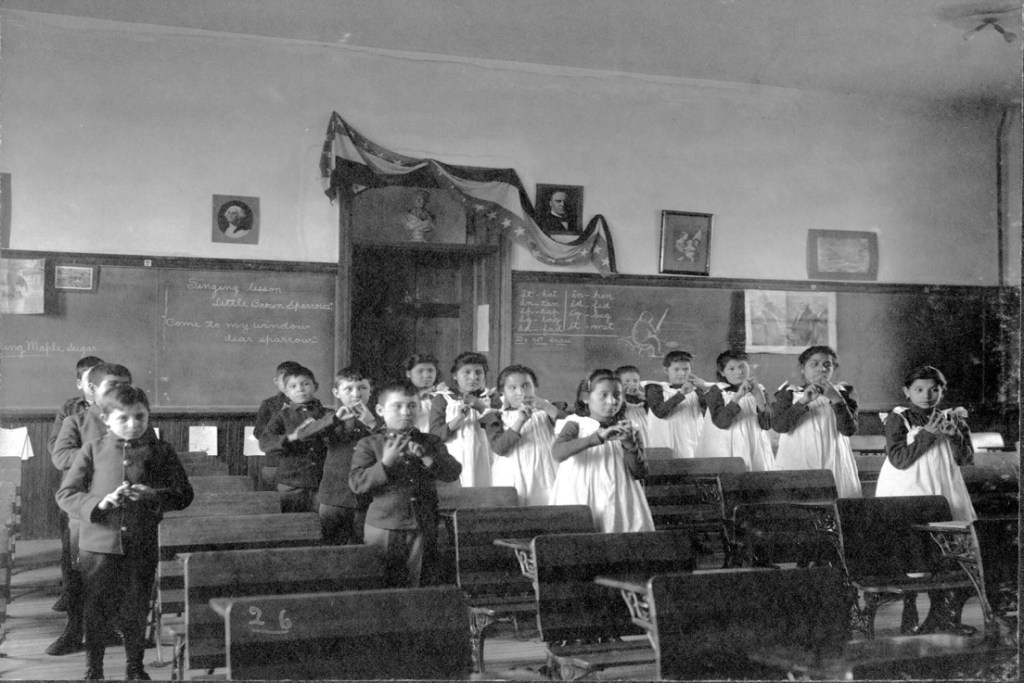
Native American Boarding School, 19th Century
A Moral Landscape in Turbulence
The frontier was not simply a line on a map; it was a moral and cultural crucible. Settlers and Native communities traded, intermarried, and exchanged techniques of farming and warfare—yet lived in constant tension. Frontier families feared raids; Native communities feared encirclement by farms and militias.
The Seven Years’ War (the French and Indian War) intensified the turmoil: empires battled, alliances shifted, and Indigenous leverage narrowed further.
An Iroquois diplomat, weary from broken promises, observed:
“You English are never content. The land you say is yours today will be yours no more tomorrow, for tomorrow you will ask for more.”
The Twilight of an Era
By the dawn of the American Revolution, the map of eastern North America bore little resemblance to the world of 1600. Indigenous nations remained—resilient, adaptive, deeply rooted—but their control over territory and diplomacy had changed irrevocably.
Thanksgiving, meanwhile, evolved into a colonial and later national celebration of unity, abundance, and providence. Its Indigenous origins receded into myth even as Native societies were pushed to the margins. When Abraham Lincoln proclaimed Thanksgiving a national holiday in 1863, the nation was at war with itself—and the original hosts of the first feast were largely absent from the story.
A Reflection Before Turning to the Present
History must be approached with honesty and empathy.
The English were products of their time—driven by fear, scarcity, and religious conviction. The Indigenous peoples were shaped by their deep stewardship of land and centuries of political tradition. But the scales were never equal.
Part II tells a difficult truth: the path from the first Thanksgiving to the American nation was paved with both hope and heartbreak. The generosity that marked the beginning was overshadowed—but not erased—by the long arc of dispossession.
And yet the story does not end here.
Part III will explore how Indigenous nations endured, adapted, resisted, reclaimed their voice, and how Thanksgiving today carries both sorrow and possibility.
 scribo ad LX