Birds of Short Hills
In the Quiet Days of Late Autumn
Morning in late October arrive softly beginning to wear its winter hush. The air thins, the light sharpens, and the woods grow spare. What was once a chorus has become a quiet ensemble — fewer voices, but each one distinct, resonant, enduring. The leaves that remain hang like faded notes of an old song. Yet among the bareness, the birds are still there — gentler, closer, more trusting. They are the last poems of autumn, written in feathers.
At first, there is only a soft flutter — a sudden lift from the fence post, a blur of beige and blue-grey. Then comes that sound: the low, plaintive coo, deep and tremulous, as though the earth itself were sighing. The Mourning Dove is both ordinary and otherworldly, a familiar silhouette in suburban skies yet ancient in its stillness.
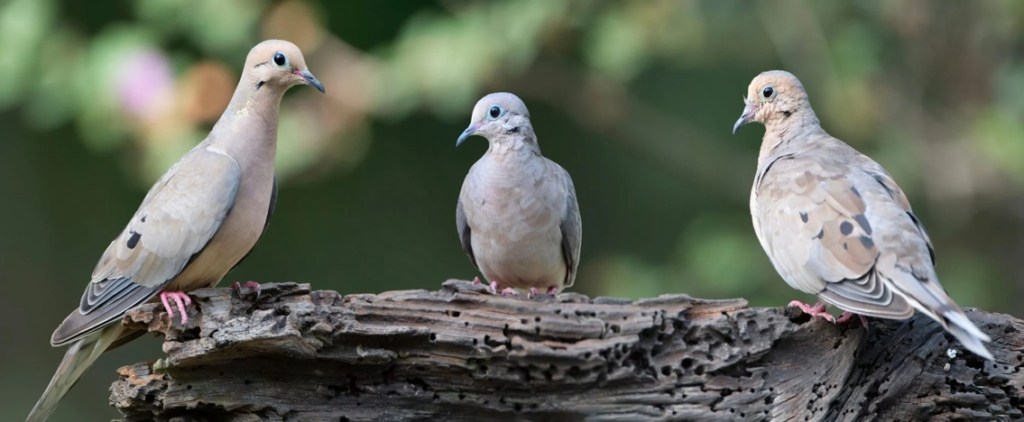
Mourning Doves
Pale as early light, it sits motionless, eyes half-closed, the air around it seeming to hush in sympathy.
Its call has always struck me as more than sound — almost a memory. In ancient times, the dove was the emblem of peace and devotion, sacred to Aphrodite and Venus, symbols of enduring love. Native lore, too, regarded its mournful song as the echo of departed souls, and in Christian imagery, it carries the spirit of divine gentleness.
Ornithologically, they are among the most widespread birds of North America, present through all seasons in New Jersey. They mate for life, often returning to the same nesting site year after year. To watch them feed in pairs on the cold ground is to glimpse something tender and resolute — a quiet, enduring companionship amid the turning world.
They peck at fallen seeds, flick their tails, and then rest.
Their name misleads: there is no grief here, only gentleness.
In the falling light of Short Hills, their soft forms are a reminder that serenity, too, has wings.
Beneath the bramble and the oak leaves, a small flicker of brown and gold stirs. Then, a note rises — clear, sweet, and trembling: — Oh-sweet-Canada-Canada-Canada — as though the north wind itself were humming. The White-throated Sparrow has arrived. from its summer home in Canada’s
Boreal forests.

The White Throated Sparrow
This is one of the first true migrants of winter, seeking the milder woods and gardens of Short Hills. Its distinctive white throat and yellow lores (those tiny patches before the eyes) lend it a dignified, almost clerical appearance.
To naturalists, it is a marvel of endurance, traveling hundreds of miles each autumn. To poets, its song has long been a melancholy anthem of longing — the sound of distance made beautiful. Standing there, I think of Bashō’s haiku:
“The autumn wind— / I hear my name / in the white-throated sparrow.”
Even as frost edges the grass, its voice makes the season feel kind.
They arrive in late autumn, often staying through the first snows. Their white throat glows like a patch of light in the dim undergrowth. I watch as one hops briskly among the twigs, scratching for seeds, its song a solitary hymn to persistence.
In its fragile call lies something of the season itself — wistful, but not sad; resilient, but not loud.
In a bare patch of the garden, a flicker of bright yellow catches the light — a Goldfinch, tiny and radiant, like a fragment of sunlight refusing to fade. By autumn, the males have shed their brilliant summer plumage for a softer olive hue, yet even so, they carry the memory of radiance.
The Goldfinch is among the few finches that breed late in summer, waiting for the thistles and milkweed to ripen. They weave their nests with down from those same plants — nature’s exquisite symmetry. In medieval Christian art, the goldfinch symbolized Christ’s resurrection, its red-capped head said to have been stained while trying to remove thorns from His crown.
They are partial migrants, some moving southward as winter nears, others staying if the seeds last. I watch one sway on a dried coneflower stalk, feeding with delicate persistence. Around him, the world seems to fade into sepia, yet he glows faintly — as if summer had left a candle burning just for him.
And their flight is still unmistakable: a bounding rhythm, wave-like and joyful. They chatter in small groups, nibbling on thistles or coneflower seeds that linger in the meadow’s edge. Even in their muted plumage, there’s a kind of quiet radiance about them — a cheerfulness undimmed by the season’s retreat.
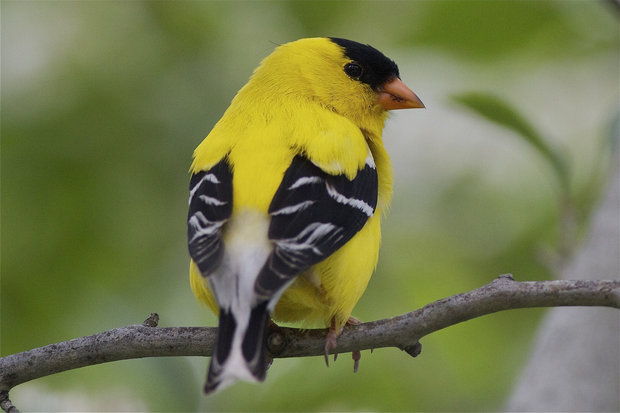
American Goldfinch
In folklore, the goldfinch symbolizes endurance of spirit, joy that doesn’t need applause. As I watch them rise and fall against a pale November sky, I think of how beauty need not always blaze; sometimes it glows softly, like memory.
And then, on a windless afternoon, I see what feels like a blessing — an Eastern Bluebird perched on a fencepost, the sunlight making its chest glow like polished copper. Yes, The Eastern Bluebird, with its russet chest and sky-blue wings, looks like a promise that spring still remembers us.
Their blue is not pigment but reflected light, a trick of structure and sky — a reminder that some beauty depends entirely on how it is seen. In folklore across America, the bluebird is the harbinger of happiness, the bluebird of hope that inspired poems, songs, even the dreams of settlers who saw in it the promise of home.
Though many migrate, a few stay back in sheltered groves and open yards of Short Hills, feeding on berries, guarding hollow trunks. Their call is a liquid whistle, brief but bright, as if to reassure the world that joy persists.

Eastern Bluebird
Once called the “bird of happiness,” the bluebird has long symbolized hope and renewal. Thoreau wrote that its return marked the “first hour of spring.” But here, in late autumn, I see it differently: as a keeper of warmth through the cold. The bluebird does not flee the fading light; it carries a fragment of the sky within.
And this one clearly prefers wetland though sighting it in the woods is not entirely unusual. One notices it as a sudden trill bursts forth — liquid, musical, startling.
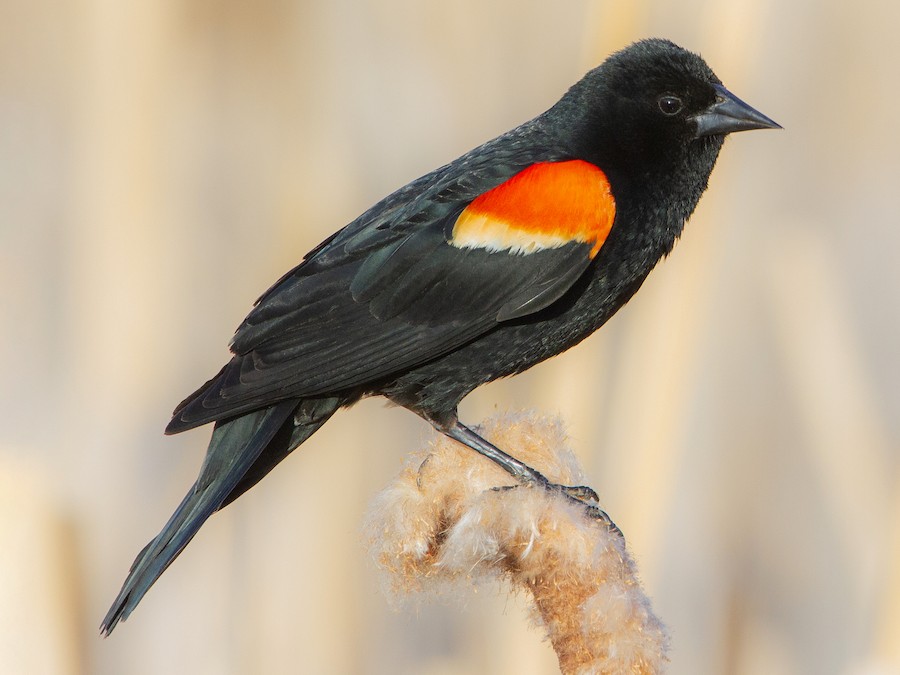
Red-winged Blackbird
A Red-winged Blackbird, glossy and dark, flares his crimson-and-gold shoulder patches like tiny embers.
Through most of spring and summer, their songs dominate New Jersey’s marshes, but by autumn, only a few remain — mostly males keeping to the cattails.
To early tribes of the Northeast, the red-wing was the herald of planting and harvest, a messenger between earth and sky. Some legends said its red epaulets were gifts of the setting sun.
They are partially migratory, many moving southward by late October, yet a few hardy souls remain when the marshes freeze. Watching him now, half-hidden among reeds that whisper in the cold wind, I sense in his song a brave defiance — a voice remembering warmth even in the edge of frost.
Late in the afternoon, as the sun dips and the woods glow bronze, a dark silhouette glides high above Short Hills — wings stretched wide, motion slow and assured. It is the Bald Eagle, sovereign of the open sky. The white head and tail flash briefly in the light, a glint of purity against the fading day. Its cry is distant yet commanding, like a sound carved into air.

The Bald Eagle
Whether it is a Bald Eagle or another raptor, I cannot always tell from the ground — but the feeling is unmistakable. To see an eagle is to remember the vastness of things, the magnitude of life beyond our sight.
Once nearly lost to this region, the eagle has returned — a quiet triumph of conservation and resilience. To watch it now, circling above suburban treetops and winding streams, is to witness the meeting of myth and miracle. In Native traditions, the eagle is the messenger between the earth and the heavens, carrying human prayers upward. Here, it feels like the spirit of autumn itself — vast, composed, eternal.
In the lore of nations, the eagle is power, vision, freedom. Yet here, above Short Hills, it feels more like grace — a meditation on height and stillness. It moves without hurry, surveys without possession. As I watch, a hush settles over me. The world below grows smaller, simpler, more coherent.
It turns once more, catches a thermal, and rises until it is only a speck against the dimming sky. In its vanishing, silence speaks – a feeling that something immense and ancient has just passed over.
Natural Notes for Reference
| Bird | Key Traits | Seasonal Notes | Symbolic / Narrative Cues |
| Mourning Dove | Pale beige-grey, soft coo | Common in open areas | Serenity, acceptance |
| American Goldfinch | Bright yellow in summer, olive in fall | Feeds on seedheads; partial migrant | Transformation, gratitude |
| White-throated Sparrow | White throat, yellow lores | Winter visitor to NJ | Longing, migration |
| Red-winged Blackbird | Glossy black male with red epaulets | Departs south in fall | Departure, freedom |
| Eastern Bluebird | Bright blue back, reddish breast | Some overwinter; symbol of recovery | Hope, renewal |
| Bald Eagle | Large raptor, white head and tail, piercing gaze | Occasional sight over ridges and wetlands; expanding range in NJ | Majesty, endurance, transcendence |
Epilogue: Of Feathers and Light
By evening, the woods of Short Hills fall silent again. The air is scented with pine and the faint musk of decay. Yet somewhere in the quiet, a sparrow still sings, a dove still coos, a bluebird still gleams — faint but unmistakable signs that life persists beneath the hush.
Together, these eleven birds — residents and travellers, singers and sentinels — form a cycle of the season, a living testament to the continuity of grace. They remind me that beauty is not only in the bloom of spring but in the resilience of autumn, in the courage to stay, to sing, to endure.
Standing under a crimson maple, I realise that to watch birds in fall is to watch time itself: fleeting, brilliant, tender. The forest will empty, yes, but it will also remember — and when spring returns, so will the songs.
 scribo ad LX