The Birds of Short Hills
Introduction
There is a quiet miracle that unfolds each autumn in Short Hills, New Jersey.
As the maples turn to flame and the air grows frigid with chill, the woods and gardens become a threshold between abundance and exhaustion. The human world rushes on, yet in the rustling leaves and thinning light, the birds still sing — sometimes loudly, sometimes in whispers. But the music is unmistakable.
This two-part reflection is born of many unhurried mornings and dusks spent watching these winged neighbours. Some are steadfast residents; others are travellers passing through. Together they form a living calendar of the season — of colour, song, migration, and quiet endurance.
What follows is not field biology but something more intimate: brief stories, encounters, and musings inspired by ten birds who lend the Short Hill autumn its voice. Through them, one senses how life persists in gentleness, how even as leaves fall, the world continues to sing.
Part I
In the Autumn Woods of Short Hills
The crisp air of late October in Short Hills carries a soft hush of change. The oaks and maples along the woodland edge have begun their turning; leaves drift like quiet confetti to the forest floor. In that stillness, the birds are both conspicuous and subtle, each performing its seasonal ritual, each a living flicker of colour and song before the winter hush descends.
The first that catches my eye is the Northern Cardinal, that magnificent burst of scarlet against the bronze-gold leaves. Perched on a bare branch like a living flame, the male’s scarlet plumage is startling. The female sits close by, her crest raised, her colouring gently tawny with red accents with a presence quiet but equally regal.
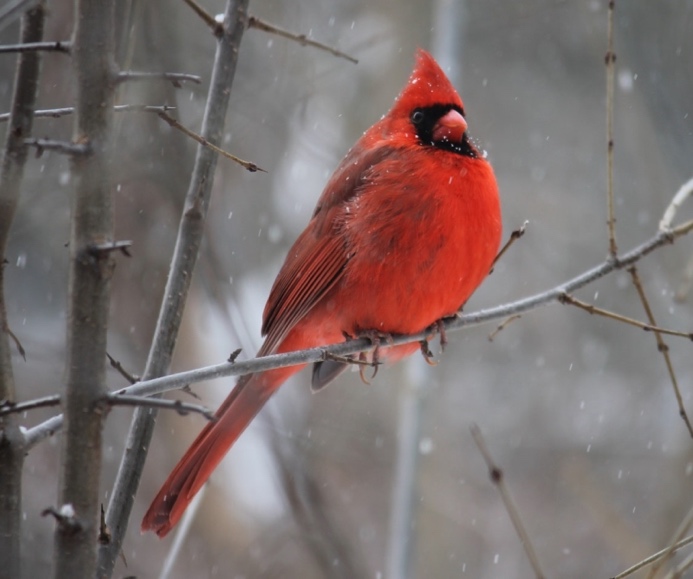
Northern Cardinal
As I watch, the male pushes aside a fallen seed-shell with his strong orange bill, then flips his crest and flashes a sharp ‘chip-chip’ call across the brush. He seems to survey the woodland edge, the feeder visible beyond, the last of the asters still blooming. In the half-light of late afternoon he looks like a monarch of this place — unhurried yet alert.
Cardinals are year-round residents, refusing migration even when the snow falls thick. Their persistence has long made them a symbol of hope and constancy, and in many Christian-influenced traditions the cardinal’s flash of red is taken as a symbol of life, of hope, of a visitation from a loved one who has passed. “When cardinals visit, angels are close,” goes a saying in parts of the American South.
Watching him feed, seed by seed, his crest sharp against the fading day, I see in him the spirit of steadfast flame — a guardian of colour in a greying world. As migrants come and go, this bird remains. In autumn his red seems to glow brighter — a remnant of summer’s warmth bridging the coming calm.
And then across the lawn one can notice a different kind of movement: the American Robin hopping along the leaf-litter, pulling at fallen fruits and small worms

American Robin
Robins are so familiar they sometimes go unnoticed, yet in autumn their behaviour shifts. Some depart for warmer climes; some stay behind in New Jersey, slipping into quieter corners. Indeed, many robins in this state live through winter, gathering into flocks in berry-rich wetlands or hollies.
This one pauses, flicks its head, eyes me with a dark bead, then resumes. The last of the crab-apples hang in pale red clusters behind him. He pulls one, navigates through twigs, and flies up to a branch, letting the fruit roll into his beak. I think of roguish wanderers, of journeys begun and rest delayed. The robin’s presence here in autumn makes me aware of the tension between departure and staying.
In early autumn, they still linger here, though by mid-season many join great flocks heading south. The robin is among the first to sing at dawn and the last to hush at night, and in some old folklore, its red breast was said to be scorched by the fire it carried to comfort souls in winter’s cold — a myth that echoes in Native American and European tales alike.
Here in Short Hills, this robin tugs at a worm, pauses, and regards me with one bright, liquid eye. In his stance is something universal — the courage of one about to journey, yet still holding to the familiar earth beneath his feet. A reminder, perhaps, that migration is not only flight — it is faith.
From a nearby oak comes a rhythmic tapping — tat-tat-tat, deliberate and musical. The Downy Woodpecker, smallest of his kind in North America, dances up a trunk with delicate precision. His scarlet nape catches the slanting light, tail spread like a balancing fan, head cocked to one side.
He probes bark crevices, flicks insects out, his tiny body vibrates with purpose, quiet but insistent. In autumn the forest changes: bark splits, insects hide, seeds fall, and the woodpecker adapts. He may double his tapping as autumn winds chill and insects retreat. I imagine the tapping as the heartbeat of the woodland, changing its tempo.
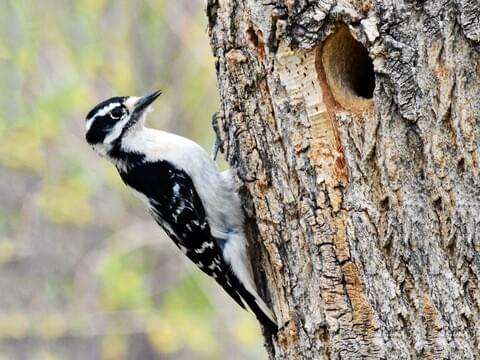
Downy Woodpecker
Woodpeckers have long been seen as keepers of rhythm and rebirth. Among Native American tribes, their drumming was considered the heartbeat of the forest, a bridge between earth and sky. Ornithologically, they are marvels of adaptation: their skulls absorb shock through a unique spongy structure, and their barbed tongues can reach deep crevices for hidden insects.
In autumn, when the bark cracks and insects burrow deep, the Downy persists — methodical, tireless. I sense in his tapping the pulse of the changing woods — the steady persistence of life adjusting, note by note, to the season’s new rhythm.
And then suddenly: a flash of corn-flower blue and white, crest high. The Blue Jay lands atop a beech, gives a sharp “jeer-jeer”, ruffles his wings, and surveys the feeder station, the walnut tree, the edge of the forest.
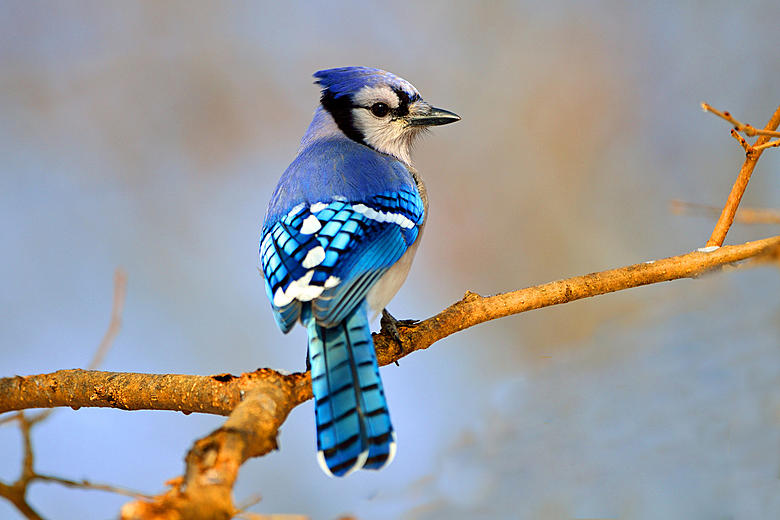
Blue Jay
Blue Jays are among the most visible woodland birds in fall in New Jersey, bold, confident, loud. In folklore the Blue Jay is layered: in Native American myth some tribes regarded them as tricksters — clever, sometimes loud, nimble at mimicry. In modern spiritual symbolism the Blue Jay stands for communication, intelligence and adaptability.
In this moment, I imagine the jay as sentinel and messenger: warning others, storing acorns for future days, preparing for colder nights. His presence at this forest-lawn interface embodies the tension of this season: the brightness of summer giving way to rust and gold of fall. Sitting still, I feel the domestic lawn and the wild woods meet—and the Blue Jay spans that gap. He reminds me of what it takes to guard one’s territory yet stay alert to change; to carry memory of summer even as we lean into autumn.
Finally, close at hand in the undergrowth I spot a Song Sparrow. Brown-streaked, modest, moving quietly among the last golden rays.
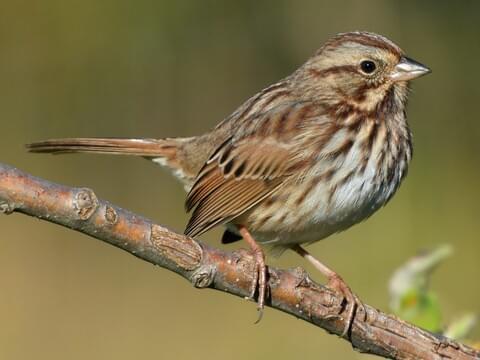
Song Sparrow
Song Sparrows appear frequently in New Jersey backyards and edge habitats—they stay through winter in many places. I see the rust-coloured crown stripe, the scalloped breast, the flirt of a tail as he flicks through fallen leaves, catching tiny seeds. His soft tsip-tsip almost lost in the breeze.
In the autumn half-light he seems to speak of what remains when the bright birds have departed, what endures in the shadowed under-brush. He is the witness: small and subtle, but crucial. His presence reminds me that not all of nature shouts; some of it whispers. Some of it stays hidden until one leans close enough to hear.
Unlike the migratory robins, Song Sparrows are mostly year-round residents in New Jersey. Their endurance is quiet, like the murmur of the season’s end. In some local folklore, the sparrow is the voice of the overlooked, a reminder that beauty need not dazzle to endure.
In Japanese haiku, the sparrow often stands for humility and survival — suzume no koe / hi ga yurete / aki kurete — “the sparrow’s voice / the day flickers / autumn deepens.” Watching him move among the fading asters, I sense that same simplicity: the small, enduring pulse beneath the splendour.
There’s little myth for such an unassuming creature, but perhaps he doesn’t need one. He is the myth of the ordinary — that what is overlooked may yet hold grace. In his modest song, I hear the tender persistence of things that endure.
Closing for Part 1
As the light fades and a cool hush descends over Short Hills, I think of these five birds as companions on this seasonal passage. They inhabit different layers of the wood-edge: the cardinal in the shrubs, the robin on the ground, the woodpecker on bark, the jay in the canopy, the sparrow in the leaf-litter. Each in its way reflects the turning of the year. Tomorrow, and days after tomorrow I’ll walk again and seek new friends — perhaps a Mourning Dove, a Goldfinch, a White-throated Sparrow, a Red-winged Blackbird, and maybe an Eastern Bluebird. But for now I linger here in the golden dusk, watching, listening, thoughtful.
 scribo ad LX