Of Gods and Druids: The Sacred Oak in Myth and Ritual
““The oak is called the king of trees, the pride of the forest, the glory of the landscape.”
— William Gilpin
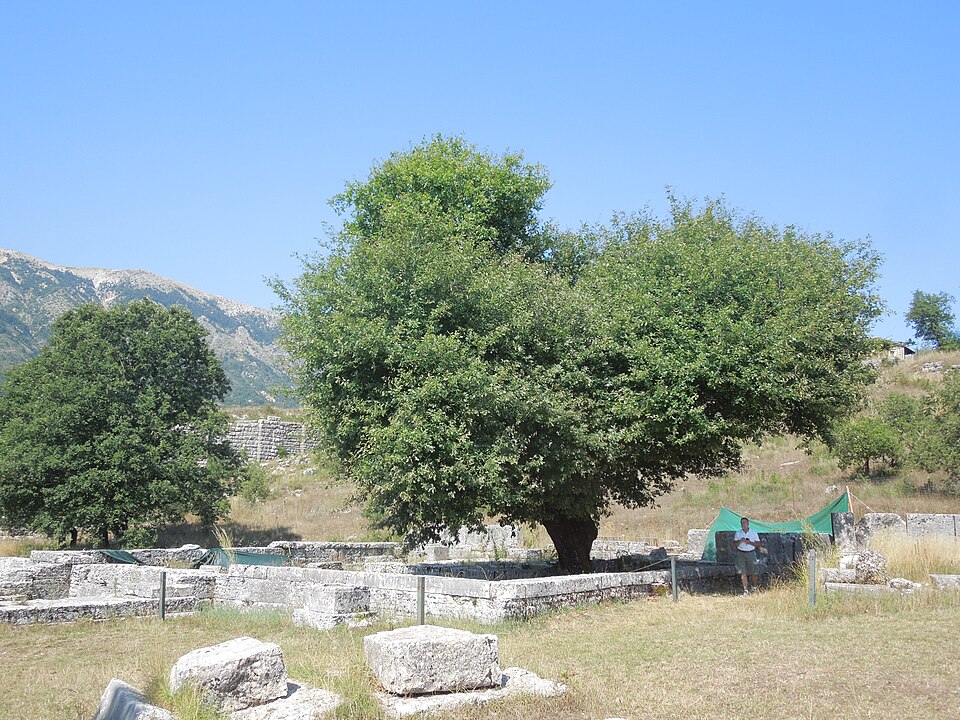
Temple of Zeus at Dodona with oracle Oak
If the oak is the heartbeat of the forest, it is also the pulse of human imagination. No other tree has entered our myths, emblems, and rituals with such majesty. Across continents and centuries, the oak has been more than a plant—it has been a temple, a lawgiver, a witness to vows, and a mirror of strength. In its branches, people have sought the voice of gods; in its acorns, the promise of life; in its trunk, the endurance of nations.
The Tree of Thunder and the Sky-Gods
Among the Indo-European peoples, the oak’s affinity with the divine was nearly universal. Its towering height, its stubborn strength, and above all, its attraction of lightning made it the natural throne of the sky-gods. In Greece, the oak at Dodona was sacred to Zeus, king of the Olympians. There, priests listened to the rustling of oak leaves and the cooing of doves as oracles, translating their murmur into divine decree. The oak was not merely a tree but a medium of speech—an instrument through which the god addressed humanity.
In the Germanic and Norse worlds, it was Thor and Donar—the gods of thunder—who were linked to the oak. To strike the oak with lightning was to show both power and protection, for the tree seemed to endure what would fell others. The Romans, too, honoured the oak: it was sacred to Jupiter, god of the sky and storms, and oak leaves adorned the corona civica—the civic crown awarded to those who saved a Roman life in battle. Thus, the oak became both celestial and civic, a bond between heaven and the republic.
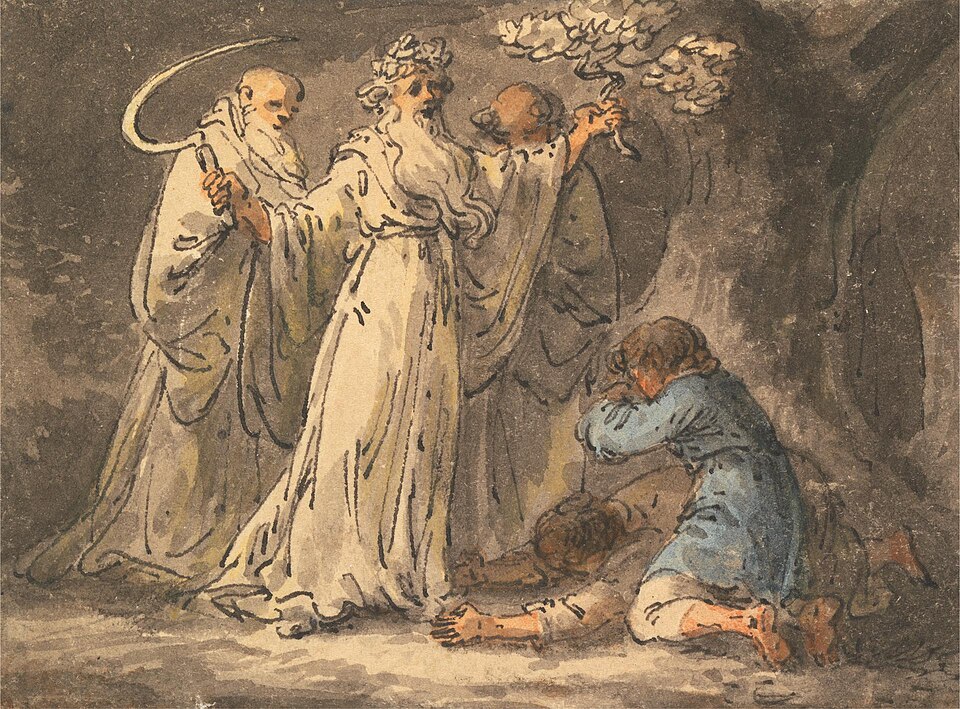
Clad in white, the Druid cuts the mistletoe with a golden sickle
Druids and the Sacred Groves
Perhaps no people are more entwined with the oak than the Druids of ancient Celtic tradition. Indeed, the very word Druid is often linked etymologically to dru-wid—“oak-knower” or “wise of the oak.” For them, oak groves were temples without walls, sanctuaries where the canopy was the roof of the sacred world. Here, rituals were performed, sacrifices made, and the mysterious mistletoe harvested when found growing upon the oak’s boughs.
Pliny the Elder describes with wonder the Druidic ceremony: clad in white, the priest would climb the oak to cut the mistletoe with a golden sickle, letting it fall into a white cloth so it never touched the ground. This was not botany; it was sacrament. For the Druids, the oak embodied a cosmic axis—a meeting of earth and heaven, mortal and divine. To gather beneath its shade was to step into a chamber of the sacred. “They call anything growing on oak trees sent from heaven, and the tree itself they choose for their sacred groves.” he observed.
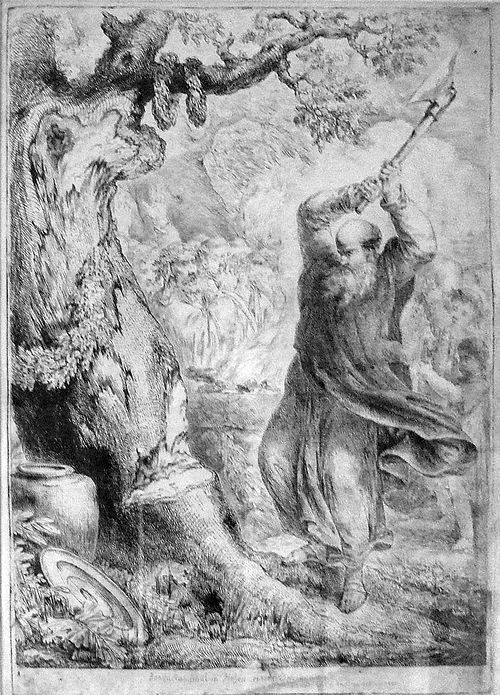
From Thor’s storms to Boniface’s axe, the thunder-oak bridged pantheon and conversion.
The Oak in Christian and Later Symbolism
As Christianity spread through Europe, the oak did not vanish from sacred thought; rather, it was reinterpreted. Missionaries often cut down oak groves to demonstrate the power of the new faith—as St. Boniface did when he felled the Donar Oak in Hesse. Yet the oak endured as a Christian symbol of virtue, endurance, and faith. Churches rose where oak groves once stood, and oak beams upheld the roofs of cathedrals, as though the old sanctity had been repurposed into the architecture of the new.
In folklore, the oak often became a tree of protection and blessing. In England, “Royal Oaks” became living monuments after the Civil War, recalling the oak tree in which the future Charles II hid from his pursuers. Across Europe, oaks were bound with ribbons or carved with initials as trees of vows and fidelity. Their shade was a place to swear oaths, their bark a silent witness to promises that stretched across generations.
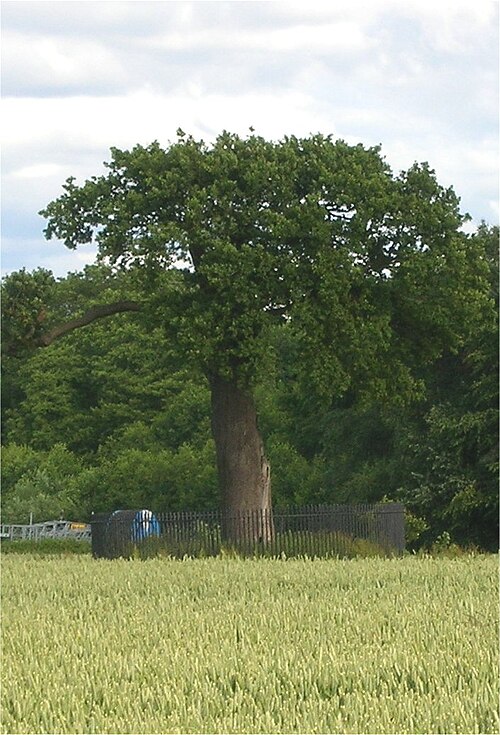
The Royal Oak of Boscobel—where legend says Charles II eluded capture.
Native American Reverence
Across the Atlantic, Indigenous peoples of North America also recognized the oak’s majesty. While different tribes ascribed different meanings, the oak was widely respected for its strength and provision. Acorns, though bitter without careful preparation, were a staple food for many communities, sustaining tribes through lean winters. But nourishment was not the only gift: the oak’s longevity and resilience made it a symbol of endurance and connection to ancestors.
For the Cherokee, the oak was sacred in fire ceremonies, its wood valued for the flame it produced. Among the Algonquin and Iroquois, the oak’s acorns and shade carried a sense of blessing. Even in ritual tobacco offerings, the oak sometimes stood as a witness, much like in Europe, silently bridging human vow and cosmic order.
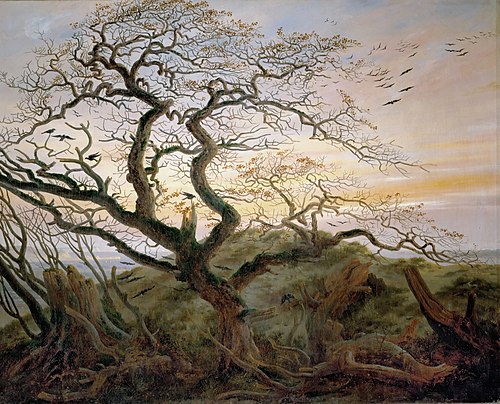
“In Romantic art, the oak becomes a solitary shrine—endurance made visible.”
Painting by Caspar David Friedrich, The Tree of Crows (1822)
National and Civic Emblems
With time, the oak grew from sacred emblem into civic one. Its sturdiness made it the perfect metaphor for nations aspiring to permanence. In France, the oak became a symbol of liberty and endurance. In Germany, it was a national tree, a motif of strength in poetry and statecraft alike. In England, the oak was both royal and common, appearing on coins, crests, and in Shakespeare’s lines. Across the Atlantic, the United States adopted the oak as a national emblem of strength, and several states claimed it as their state tree.
Thus, the oak moved from the groves of gods to the halls of parliaments, its leaves pressed into medals, its image engraved upon seals, its name given to towns, ships, and societies. The sacred became secular, but the reverence remained.
Mythic Patterns
The oak thus crosses from grove to myth, from forest to flag. It is more than biology or wood—it is symbol, sacrament, story. It gathers thunder and fire, feeds the hungry, shelters the weary, and in doing so becomes an axis where human longing and cosmic power converge.
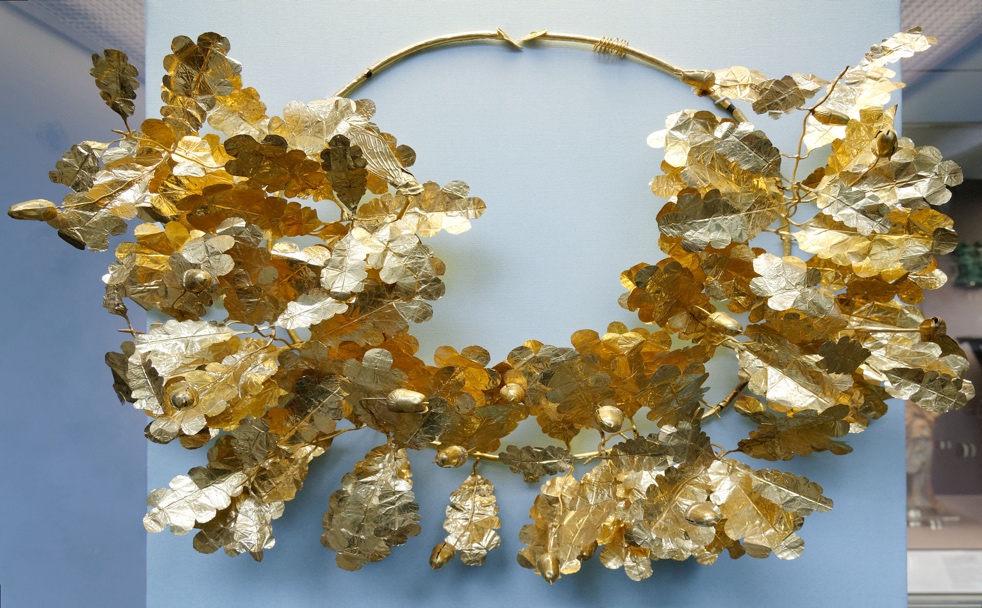
Late 4th-century BC Hellenistic gold oak wreath, including gold cicadas and a bee (British Museum)
What unites these diverse traditions is a pattern: wherever the oak grows, it becomes a mirror of the highest values a community holds. To the Greeks, it was wisdom and divine utterance. To the Celts, it was cosmic knowledge and ritual. To the Romans, it was civic courage. To Christians, it was steadfast faith. To Native Americans, it was endurance and sustenance. To modern nations, it is strength, liberty, and resilience.
The oak does not impose these meanings—it invites them. Its stature, its endurance, its gifts of food, shade, and shelter naturally lend themselves to human imagination. In its rootedness and reach, people have seen an image of themselves at their best: firmly grounded, yet aspiring toward the heavens.
And yet, myth is never still. Each culture reshapes the oak’s silhouette to its own imagination. For the warrior, it is valor; for the mystic, wisdom; for the farmer, providence; for the ruler, legitimacy. The oak has been sung as altar, as crown, as staff, as shield. In its bark, people have carved prayers; beneath its shade, they have sworn oaths that bound communities for generations.
Closing Note
In this part, we have followed the oak into the realm of gods and Druids, kings and nations, where it stood not just as a tree but as a vessel of meaning. The oak has been Zeus’s oracle, Thor’s thunderbolt, a Druid’s altar, a Christian’s virtue, a nation’s emblem. It is the sacred tree that human cultures, across space and time, have found impossible to ignore.
In the next part, we shall turn from the collective imagination to the personal. Beyond myth and nation, the oak also enters poetry, literature, and the intimate chambers of memory. We will trace how writers, poets, and storytellers have seated the oak within language itself, letting its shadow fall across verse, prose, and song—reminding us that the oak is not only in our landscapes but in our very thoughts, writing, and speech.
 scribo ad LX