“Large-leaved and low-bent, trailing immense,
Magnolias…”
— Alfred Lord Tennyson, “The Princess”(1847)
The Flowering of Memory and Myth
Two splendid Sycamores stand like sentinels in my backyard—tall, stately, unshakeable. They frame the rear of my son’s New Jersey home with a quiet majesty. But it is the Magnolia trees in the forecourt that currently command all attention. Fortuitously, they are flowering. And what a spectacle they offer: large, creamy-white blossoms, luminous as moonlit porcelain, opening like celestial chalices against their dark, glossy foliage. One does not simply observe a Magnolia in bloom—one becomes spellbound, drawn into reverie by a beauty both ancient and unassuming.
I find myself returning to them morning after morning, caught in their gentle thrall. There is something ceremonious about their flowering, as if they unfold not merely for pollinators or sun, but for memory itself. The

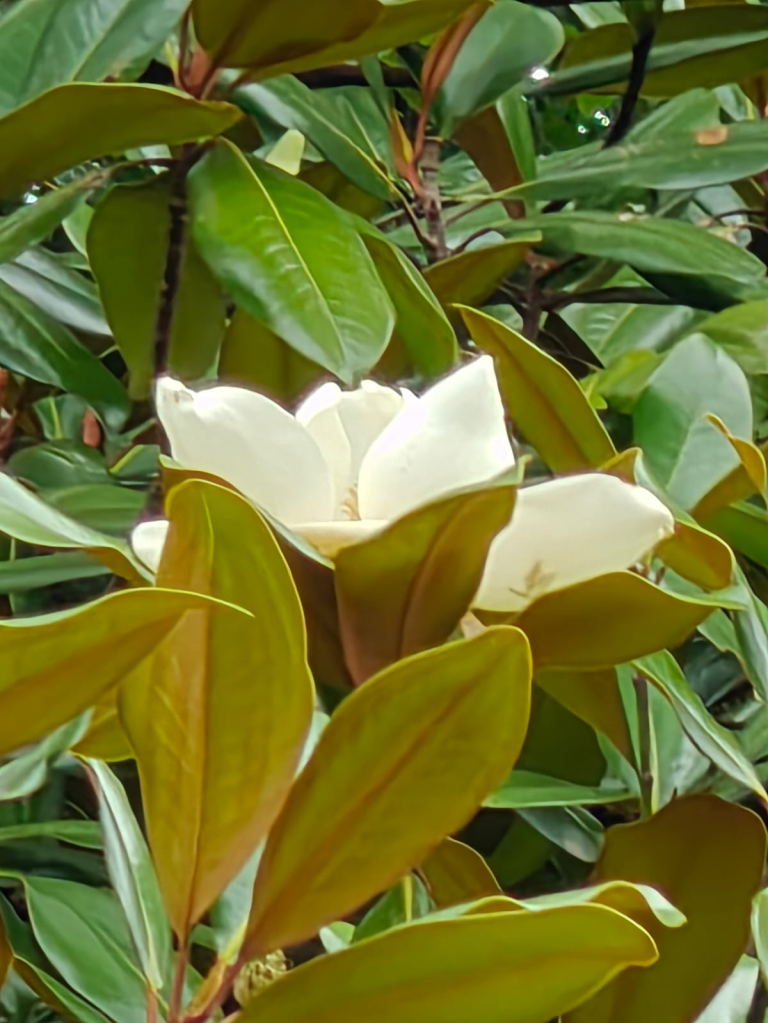
A Manicured young Magnolia Tree
Magnolia, I have come to realise, is not merely a flower—it persists, it haunts, it recurs. It is a presence, a rhythm, a memory that lingers long after the last petal falls.
A Tree of Primeval Origins
The Magnolia is among the oldest flowering plants on Earth, its lineage stretching back nearly a hundred million years, to a time when even bees had not yet appeared. Instead, beetles—clumsy, ancient creatures—served as the tree’s first pollinators. The Magnolia adapted accordingly, evolving thick, leathery petals to withstand their rough visitation. Unlike many modern flowers, it produces no nectar. Its beauty is not coaxed with sweetness, but asserted with dignity.
In the eastern United States, especially in places like New Jersey, several species of Magnolia thrive. Magnolia grandiflora, with its immense evergreen leaves and plate-sized blooms, is a Southern icon, while Magnolia stellata, the star magnolia, is a common and delightful presence in the North, blooming in early spring with white petals splayed like fingers of light. Each variant carries its own aura, but all Magnolias seem to partake of something older than landscape—older even than language. Something indescribable yet exquisite.
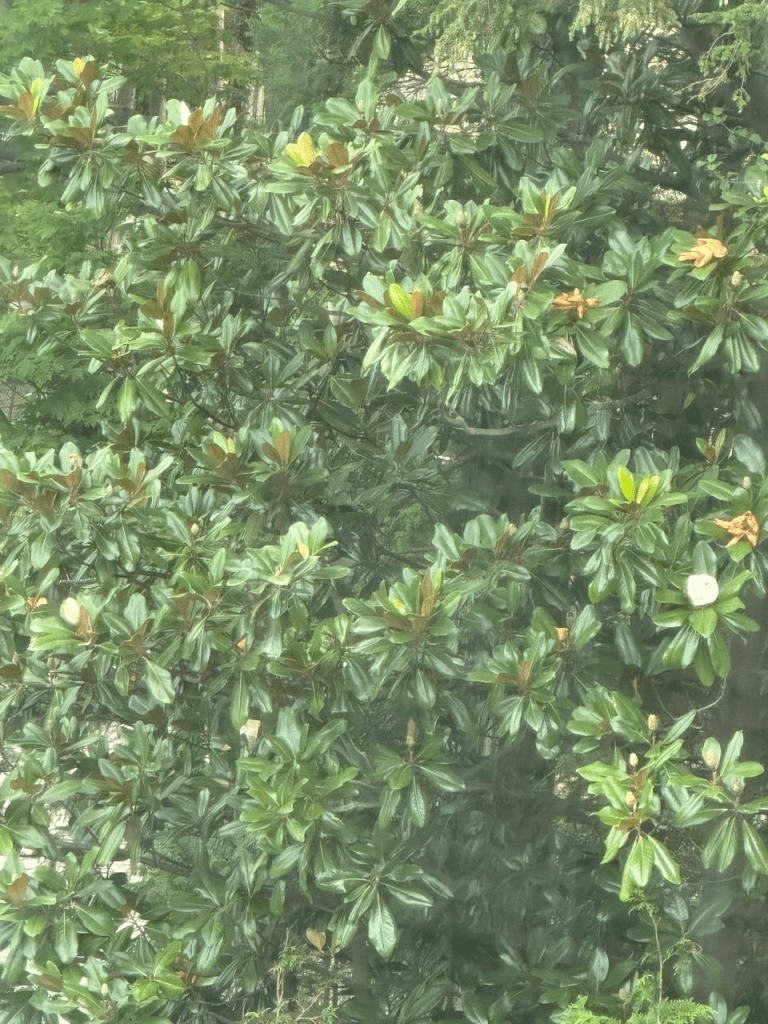
A Close -up of the Tree
Although not native to India, Magnolia trees are found in Himalayan gardens, the Shivalik foothills, and cultivated expanses of Uttarakhand and Sikkim. Their fragrant, moon-like blossoms find kinship with Indian floral traditions that venerate the sacred through scent, seasonality, and silence. In Assam and parts of Bengal, Magnolia champaca (formerly Michelia champaca),commonly known as Champa or Champaka remarkable for its intense and exquisite redolence are an integral part of not only temple rituals but also extensive poetic references.
In the Cultural Imagination
How and when Magnolia flowers became associated with feminine grace and fragile beauty remains a fetching conundrum. But across civilisations, the Magnolia has been revered for the symbolic meanings it evokes. In ancient Chinese culture, the tree represented nobility, feminine strength, and inner composure. Paintings from the Song and Tang dynasties often depict women and magnolia blossoms together—not as decoration, but as mutual embodiments of serenity and resilience. In Japan, the Magnolia appears in haiku and tea gardens, emblematic of seasonal impermanence and spiritual stillness.
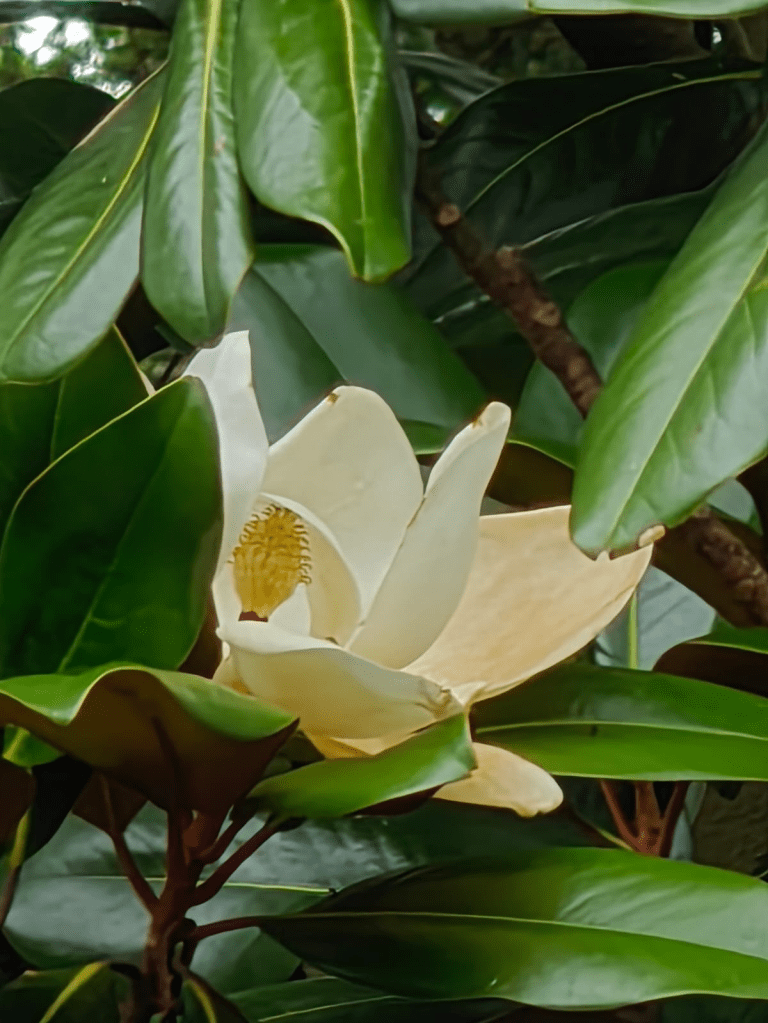
The bright elegance and the lush green
Among Indigenous North American tribes, the Magnolia virginiana (Sweetbay Magnolia) bore medicinal and ceremonial value. Its bark was used for respiratory and digestive relief, and its fragrance was believed to usher healing and rebirth.
In the American South, the Magnolia—especially the grandiflora—became a symbol of grace, rooted tradition, and layered nostalgia. It lined avenues of antebellum estates, marked the seasons of memory in small-town cemeteries, and featured in wedding wreaths and funeral sprays alike. In civic memory, it adorned Confederate monuments, town plazas, and courthouse lawns. It continues to appear in memorial services and graduation ceremonies, a botanical expression of dignity and passage. On summer porches, magnolia blossoms float in shallow bowls—a gesture of Southern hospitality and poise.
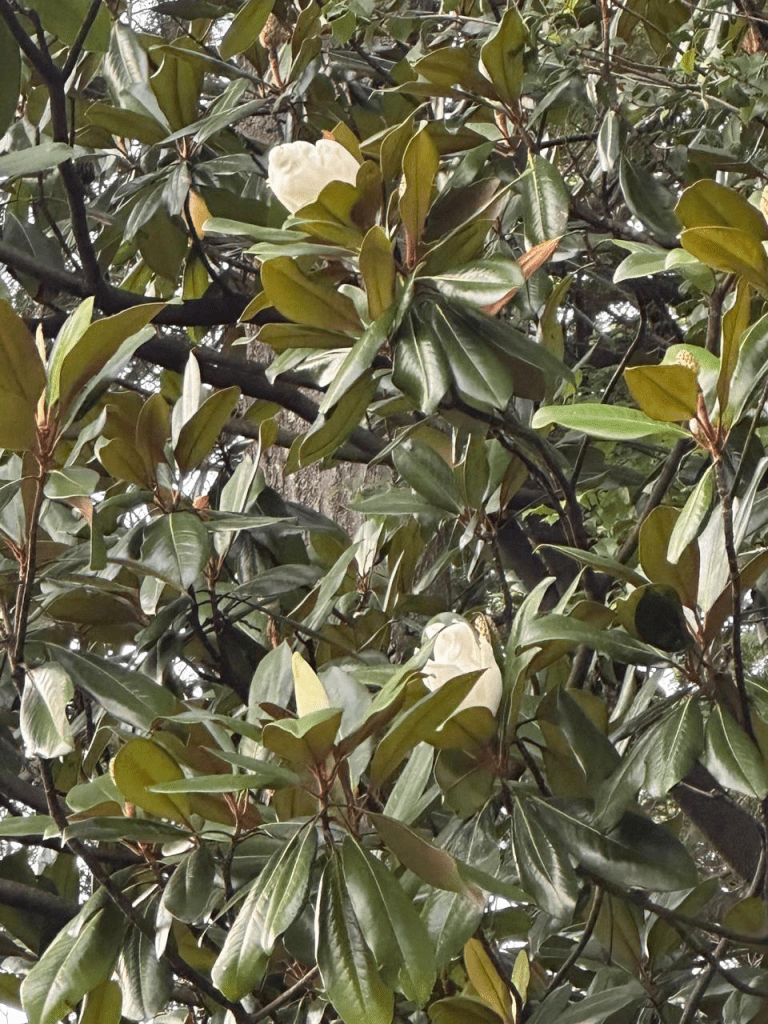
The White Buds in the morning sun
Magnolia in Literature and Lore
Writers and poets have long turned to the Magnolia to express what evades articulation—beauty that refuses sentimentality, stillness charged with meaning.
While Alfred Lord Tennyson gave us an image of their trailing magnificence, in William Faulkner’s mythic South, the Magnolia serves not just as backdrop but as a companion to time’s slow corrosion. Toni Morrison’s Beloved gives us a searing image of “the soft furred leaves of a magnolia tree” offering shelter and maternal solace during trauma. The tree becomes a vessel of protection, of memory, and of unspoken pain.
In a darker register, Hart Crane invokes Magnolia in his modernist lyric Voyages II:
“And memory, struck
with magnolia bells,
sings in the tears
of our farewell.”
Here, the bloom becomes an instrument of parting—half-ritual, half-longing.
Mary Oliver, ever attuned to the world’s sacred hush, in Blue Horses(2014) includes it in her quiet litany of soul-bearing blooms:
“The soul of the rose is everywhere.
And magnolia…”
In Eastern poetic traditions, the Magnolia evokes purity and quiet nobility. A Japanese haiku by Masaoka Shiki offers:
“Magnolia blossom—
white as the moon it opens,
stillness in the air.”
Here, the flower becomes a still point in a turning world.
Curiously, Shakespeare makes no mention of the Magnolia. This silence is not poetic oversight but botanical fact: the tree, native to Asia and the Americas, had yet to arrive in 16th-century England. And yet, one imagines the metaphors Magnolia might have lent to his pen—of beauty, grace, resilience, and the frailty of time.
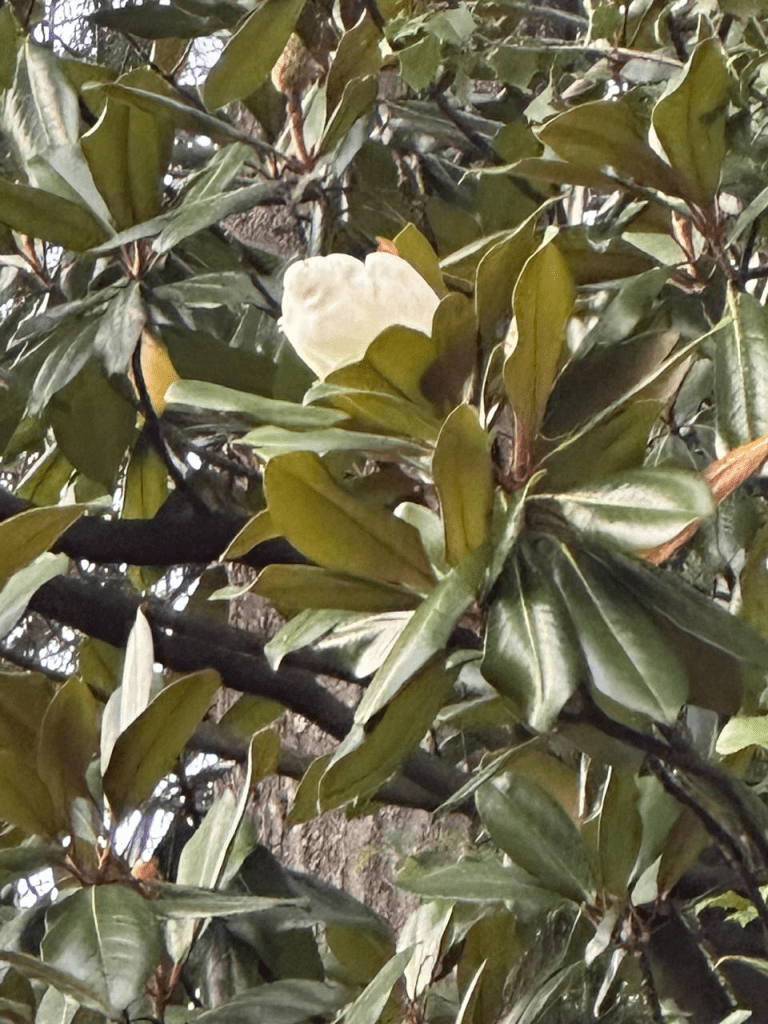
A lone splendour in Hiding
A Symbol Rooted in Paradox
What makes the Magnolia so captivating may be its very contradictions. It is ancient, yet seasonal. Its form is delicate, yet its structure is vigorous. It seduces without flamboyance and endures without fanfare. It withholds drama yet contains a gravity that draws us into ourselves.
As a symbol, the Magnolia has come to represent dignity, perseverance, and inner strength. It embodies a femininity that is not ornamental but archetypal—more Gaia than girl. In today’s increasingly fragmented world, there is something grounding about a tree that has watched the continents drift, survived ice ages, and still flowers with such quiet majesty.
The Tree Outside My Door
Now, as I watch the Magnolias through my window—blooming, brimming, breathing—I marvel not only at their present splendour, but at the invisible inheritance they carry. These trees, in flowering, enact a kind of soft miracle: a return to rhythm, a reaffirmation of grace, a reminder of the enduring.
I do not know if I shall see them bloom again. Time and seasons flow as they will, indifferent to our hopes. But this moment—this flowering—feels like a benediction, offered without proclamation and received in silent awe and gratitude.
 scribo ad LX