
In the Shadow of the Sycamore
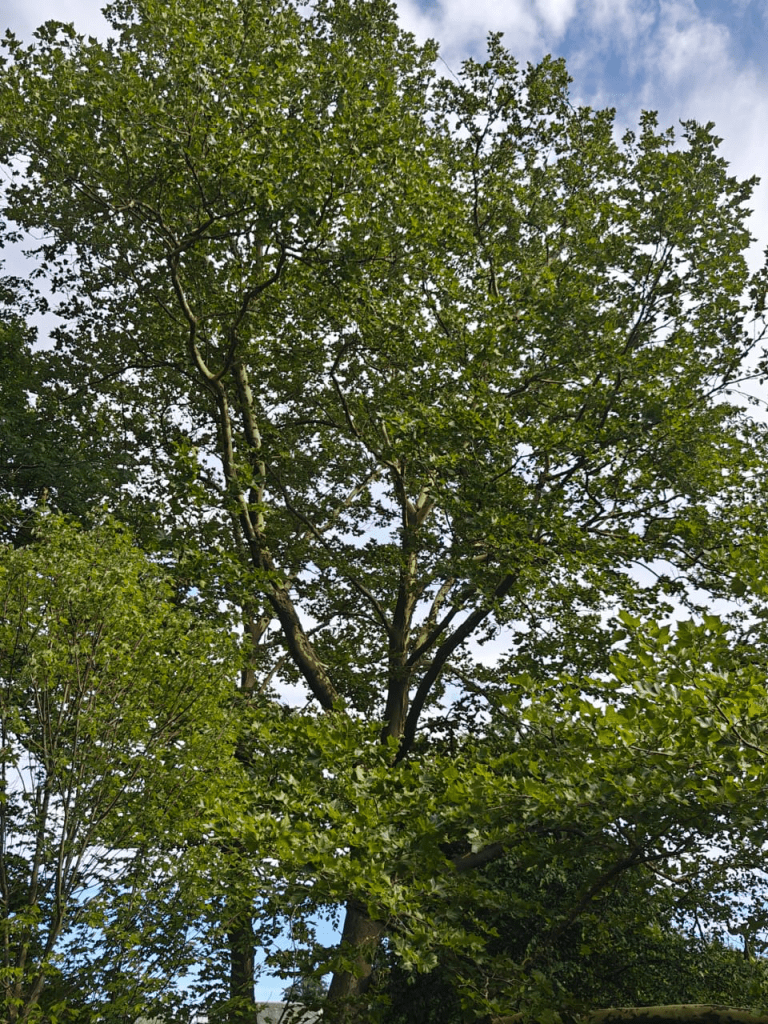
Two tall and stately Sycamore trees stand magnificently at the far end of the lawn in my son’s opulent home — guardians of grace, stretching skyward in noble stillness. They are unlike any tree I had encountered up close: pale-barked, broad-limbed, with a silvery elegance that seems to hold both serenity and majesty. Their quiet presence — so rare, so regal — spurred me to look deeper into the world of the Sycamore, a tree of uncommon beauty and even rarer tradition.
Months ago, I came across the tragic news of the felling of the lone Sycamore Gap tree in Northumberland, England. It had stood for centuries — a solitary figure cradled between two rolling hills along Hadrian’s Wall — etched into the cultural and emotional landscape of the region. Its sudden, senseless destruction by an irreverent hand caused a wave of mourning across the world. Millions felt wounded, as if something sacred had been destroyed. That grief, that quiet rage, became the soil from which this reflection grew.
Bark and Benevolence
The Sycamore is not a rare tree, but it is one that commands reverence. Whether as Platanus occidentalis in North America or Acer pseudoplatanus across Europe, it stands broad-shouldered, dignified, and generous in shade. Its bark peels like old paint, revealing creamy-white patches beneath, as if the tree were constantly rewriting itself. The leaves — palmate and open — flutter like green hands, welcoming the wind. And yet, beyond its botany lies its greater identity — a tree not only of the earth, but of memory and myth.
A Witness to Civilizations:
In Ancient Egypt, the Sycamore was considered sacred. The goddess Nut was believed to dwell in it, offering shade and nourishment to souls on their journey to the afterlife. In the after world papyri, the tree appears not as mere flora but as a divine being — a portal between realms. In the Bible, too, the Sycamore appears with quiet dignity: Zacchaeus, eager to glimpse Jesus, climbs one to rise above the crowd. The tree becomes a vantage point — literal and spiritual — offering not just sight, but insight.
What moved me even more was how the Sycamore reflects the deep emotional bond between people and trees. Unlike those admired for timber or fruit, the Sycamore is loved for its presence. It is a tree that dwells among us. In parks, courtyards, riverbanks, and ancient avenues, it stands as a public companion — not ornamental, but essential. The felling of the Sycamore Gap tree was thus not just ecological vandalism, but a symbolic violence — the silencing of a long, silent sentinel of time.
Sacredness Across Cultures
And here, a compelling parallel with India arises. For us, the most sacred of trees is the Peepal (Ficus religiosa), venerated since time immemorial. The Peepal does not merely grow — it abides. It dwells in the heart of villages, on temple grounds, at roadside shrines, and beneath vast skies where no man-made roof exists. Worshipped as a living embodiment of the divine, it is where Lord Vishnu is believed to reside, where the Buddha attained enlightenment, where sages have meditated for centuries. Generations have tied red threads, lit lamps, and circled its trunk in quiet devotion. Like the Sycamore in distant lands, the Peepal too is a cosmic bridge — spanning heaven and earth, mortality and moksha.
Much like the Sycamore, the Peepal represents continuity, breath, and the sanctity of life itself. As the Rig Veda proclaims, ashvatthaḥ sarva-vṛkṣāṇām — “Among all trees, the Peepal is supreme.”
Despite cultural distances, both trees share a singular essence: they are more than trees. They are witnesses — to history, to longing, to the slow rituals of life. They offer not just shade, but shelter from forgetting. Their roots go deeper than soil — into belief, memory, and imagination.
In European folklore, the Sycamore is revered for protection and endurance. Its spreading arms shelter birds and humans alike. It is linked with love, longevity, and sometimes mourning. In North American Indigenous traditions, it is seen as a riverbank guardian, binding soil with roots, whispering to water. In every culture that knows it, the Sycamore is not merely botanical — it is spiritual, communal, personal.

Sycamore Gap tree in Northumberland, England
The Cry of a People
And what a symbol it became — that lone tree at Sycamore Gap. Framed by hills, by history, and by human affection, it stood like a poem pinned against the sky.
Kahlil Gibran once wrote, “Trees are poems that the earth writes upon the sky.” The Sycamore was such a poem — composed not in haste, but slowly, lovingly, over the years. Its fall was a stanza torn out, a silence where music once stood. But perhaps in that loss, something essential is revealed: the fragile, irreplaceable sanctity of trees that dwell not just in forests, but in our memory.
Perhaps in that break lies a message. Trees are not the background of life. They are the quiet foreground — present, patient, powerful. When we harm them, we wound something of ourselves. And when we honour them — as the Peepal has been honoured for millennia — we honour our own continuity.
The Majesty Within
Both the Sycamore and the Peepal are vessels of wisdom, memory, and spiritual presence — one rooted in the ancient lands of Egypt, Europe, and the Middle East; the other in the soul of the Indian subcontinent, where tree worship has never faded, only deepened.
Today, I look again at those two Sycamores in my son’s garden with new eyes. They are not merely beautiful. They are keepers of silence, bearers of meaning, sentinels of stillness. And I wonder: how many children will grow up under their watchful arms? What stories will unfold in their shade? What truths will be whispered in the language of leaves?
In the years to come, these Sycamores shall remain — guardians of the house, pillars of remembrance. They will not merely adorn the land. They will hallow it. In their long shadow will dwell the assurance that in a world of flux and forgetting, something still holds. Something still stands.
 scribo ad LX