“There are always flowers for those who want to see them.” — Henri Matisse
A Flame Among Leaves
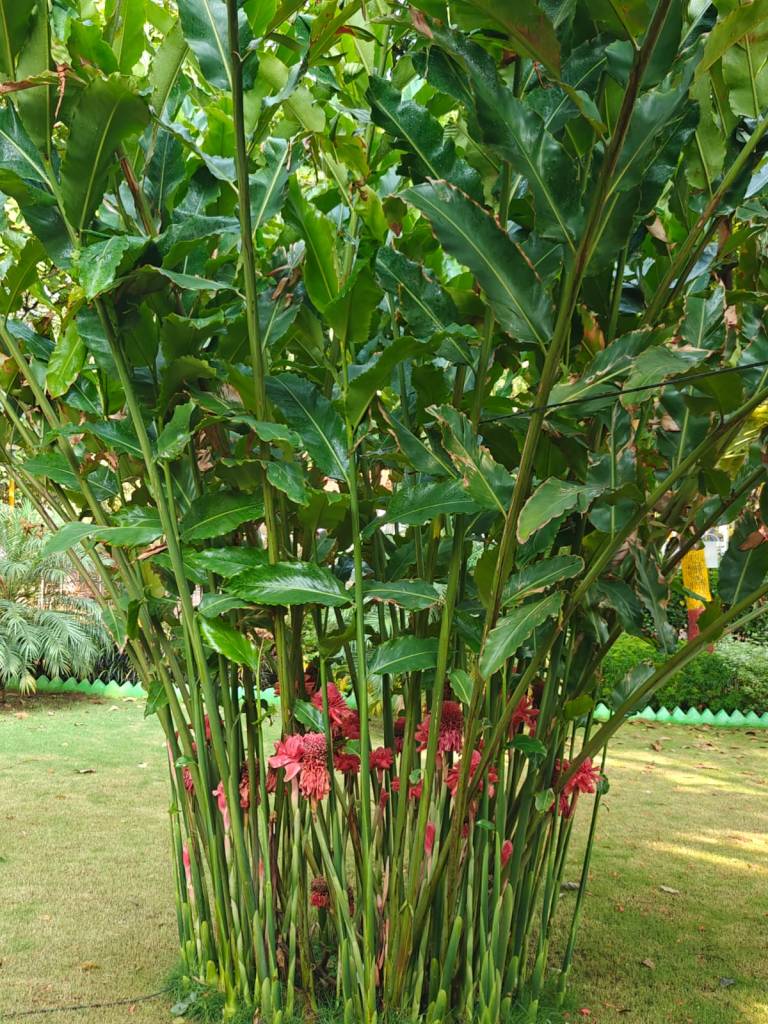
It was during a quiet morning walk—the kind where the world slows and the soul listens—that I first encountered it: a towering flame among leaves. Rising silently from a bed of earth, its tall stem shimmered with an almost sculptural grace. Atop this green pillar bloomed a flower so intricate, so startlingly sensual, that the morning light itself seemed to pause in reverence.
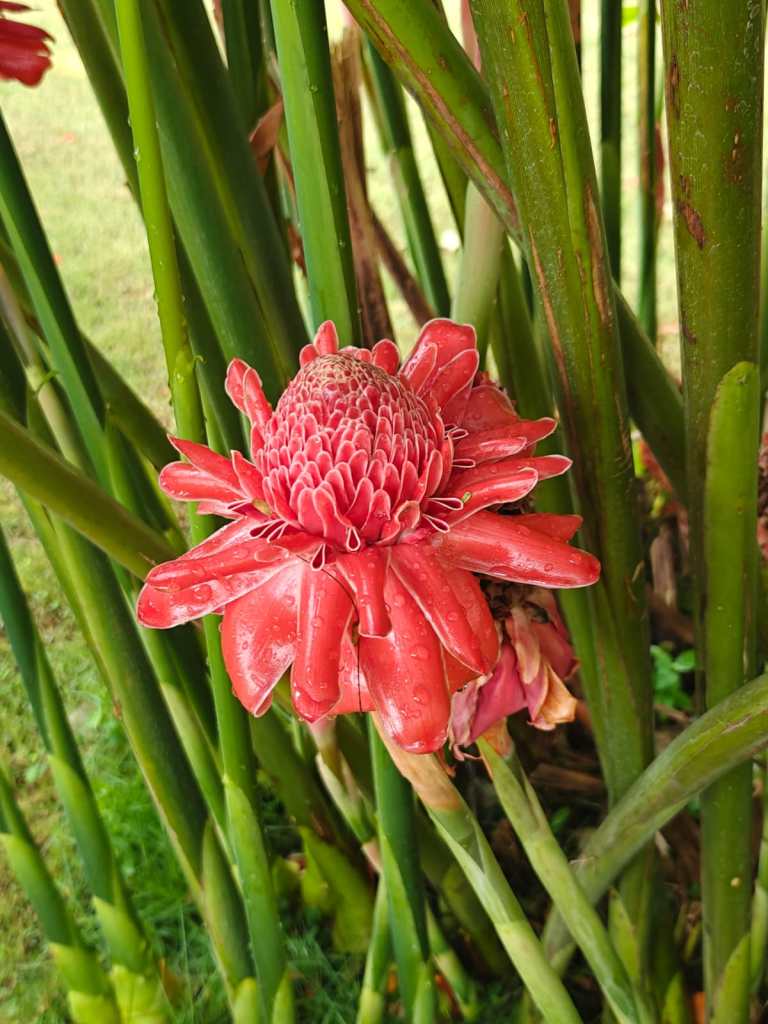
This was no fleeting bloom, no modest passerby in the garden’s pageant. It stood—no, it held court—with a bold poise, layered in bracts of blush and crimson, its centre tight with secrets, its edges curled like ancient scrolls. The Torch Ginger, they call it—Etlingera elatior. And in that moment, the name felt wholly inadequate. This wasn’t merely a flower. It was a revelation.

From Rhizome to Radiance
To understand its quiet majesty, one must begin underground. Like its culinary cousin, the common ginger, Torch Ginger springs from rhizomes—those knotted, humble reservoirs of energy hidden beneath the soil. From these earthy origins, long, smooth stems unfurl and ascend—ten, sometimes twelve feet high—bearing elongated leaves in alternate harmony, each leaf poised as if in a carefully choreographed dance.
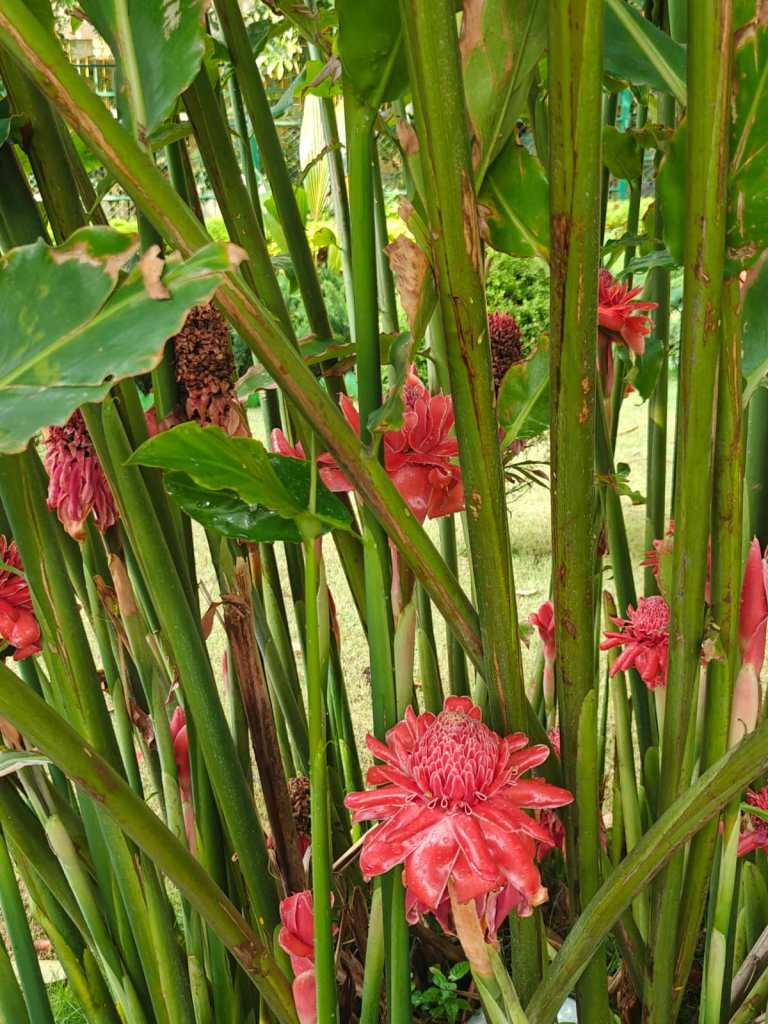
The foliage is lush yet disciplined, architectural in its form. And from the base—not the crown—emerges the true marvel: the inflorescence. Tapering and upright, it rises apart from the leafy stem, like an oracle summoned from silence. Its flame-like bloom carries not just colour, but command.
The Name and the Flame
The name “Torch Ginger” suggests metaphor, but this is no mere semblance. The blossom tapers like a flame, yes—but it also burns, in a way that leaves no ash. It burns through memory, through monotony, through our numbed gaze, asking us to see again.
Native to Southeast Asia—Indonesia, Malaysia, Thailand, and New Guinea—it thrives in humid forests and temple gardens alike. It is called bunga kantan, combrang, dala, or the romantic rose de porcelaine. Each name is a poem, and each region, a verse in the flower’s wide and whispered story.
A Culinary Bloom
Yet this fiery bloom is no aloof beauty. It is grounded in utility, revered not only in gardens but kitchens. In Malaysia, its unopened buds lend floral sharpness to the famed asam laksa. In Bali, it spices sambals. Among the Karo of Sumatra, the tangy seed pods enrich sour fish stews with a depth that tastes of tradition.
Thus, it occupies a rare position—both at altar and in hearth. It feeds the body as it stirs the spirit. It reminds us that the beautiful need not be separate from the useful, nor the sacred from the mundane.
A Myth Awaiting Its Bard
Despite its dramatic appearance and symbolic fire, the Torch Ginger is curiously absent from the well-trodden paths of myth and literature. The rose has its sonnets. The lotus, its scriptures. The lily, its dirges. But this flower remains unwritten—a myth not yet made, a legend waiting for breath.
One imagines forest priestesses twining it into their hair before invoking forgotten gods, or women lighting pathways not with fire, but with these blossoms—petal by petal, step by step. The flower invites such visions. It is not myth less. It is myth in waiting. “Each flower is a soul opening out to nature.” said Gérard de Nerval, Waiting to be reached out.
The Feminine Flame
There is something fiercely feminine in the Torch Ginger—not in fragility, but in flame. It is not coy, but commanding. Not delicate, but deliberate. It stands vibrant and radiant, without apology—like a matriarch in full regalia.
Its ascending bracts curve with the quiet rhythm of classical dance. One thinks of Bharatanatyam or Balinese temple performances—grace layered upon grace, motion held in pause. It is not a flower that pleads. It declares. And in its declaration is a sanctity—of self, of strength, of still beauty.
Beyond Botany
Science offers names, compounds, classifications—chlorogenic acids, flavonoids, and essential oils. Botany may trace its genus, chefs its gastronomy. But to name is not to know. The Torch Ginger resists the reduction of definition. It is not a specimen. It is an experience.
To truly know it, one must stand before it—not to analyse, but to behold. To surrender the gaze. To feel that subtle ignition within—a small, sure flicker in the chest where wonder once lived.
A Poem Held in Flame
In an age addicted to speed and spectacle, the Torch Ginger teaches slow astonishment. It asks for attention, not acclaim. It teaches us that not all flames consume—some simply illuminate.
It stands, not to dazzle but to deepen. Not to entertain but to evoke. And in doing so, it brings us back to something primal and precious: the capacity to marvel.
So let us not hurry past. Let us read this flower as we would a poem—line by line, bract by bract. For in its silence burns a music, and in its stillness, a story. The poem is already written. We have only to turn the page.
 scribo ad LX