“Some flowers bloom where silence dwells,
In night’s soft breath, their secret swells.”
A Chance Encounter
It was not an evening meant for miracles. The day had folded into dusk without flourish—no omens, no signs. I stepped out into the softened hush, led only by the hand of a cooling breeze. And there it was.
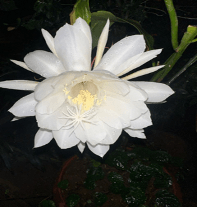
Beneath the sleepy canopy of stars, cradled by the jagged edge of a cactus leaf, a white bloom gleamed—quiet, otherworldly, still. It looked as though the moon had stooped to kiss the garden.
No scent, no rustle, no fanfare—only presence.
A secret that did not want to be told, only witnessed.
I stood, breath stilled. This was not a flower.
It was a revelation.
Its whiteness was not just a colour. It was light, prayer, breath. A hundred satiny petals layered with celestial precision spiralled outwards in divine geometry, as if the flower itself had been designed by a higher hand. Not loud, not fragrant—but profoundly present. A presence so graceful, it silenced all noise within and without.
This was not just a flower. It was an experience.
And so, I would later learn, it was Brahma Kamal—Epiphyllum oxypetalum—one of the most enigmatic and revered flowers known to the Indian subcontinent and beyond.
The Botanical Enigma
To science, it is Epiphyllum oxypetalum, a cactus that defies our sunlit expectations. It is an epiphyte, living not in soil but upon other plants, drawing sustenance from air, mist, and mystery.

By day, its tangled, leaf-like stems seem unruly and wild, half-forgotten in the shade. But come nightfall, when temperature and moisture conspire in silence, it births a flower like no other.
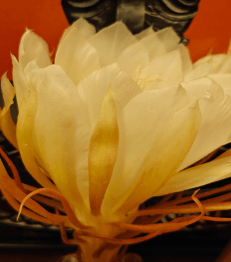
The bloom opens slowly, with a monk’s deliberate grace. Petal by petal, it unfolds like a ritual, exhaling a whisper of sweetness—so faint you might miss it unless you lean in with your soul.
And before the sun dares rise, it is gone.
The Science of the Spectacle
What makes this flower’s blooming so special is not just its rarity, but its biological precision. The plant uses environmental cues—temperature, humidity, and the length of daylight—to trigger the exact moment of bloom. Once activated, the bud swells rapidly and unfurls in a mesmerizing spiral of movement, its petals gradually spreading into a full celestial disc.
Pollination is largely done by nocturnal pollinators—moths or bats—although in cultivated environments, it often remains unfertilized, blooming purely as an act of beauty.
The flower emits a faint, sweet fragrance during its bloom—light enough to escape immediate notice, but intoxicating if breathed deeply. Some describe it as the scent of sanctity, of calm before the dawn.
Sacred Names, Sacred Nights
In Indian lore, it bears the name Brahma Kamal, the Lotus of the Creator. Though botanically distinct from the high Himalayan Saussurea obvallata, it has become, in the minds of many, a spiritual twin.
To glimpse its blooming is to be touched by something rare. In cities, where mystery often hides in plain sight, families keep vigil for its arrival—watching, waiting, whispering wishes. Cameras click. Prayers rise.
And yet the flower remains unbothered by reverence. It opens not for worship, but because it must—because it is time.
Even in the concrete heart of the city, it reminds us: divinity doesn’t always descend. Sometimes, it blooms quietly at our doorstep.
A Living Metaphor
The Brahma Kamal is more than botanical marvel. It is symbol and metaphor, poem and prayer.
It speaks to transience—the fragile brevity of beauty, the elusive nature of grace. It is the muse that arrives unannounced, offers a single line of truth, and disappears before you can say thank you.
It is solitude without sorrow.
It is presence without demand.
It is the reminder that some things, to remain sacred, must remain brief.
Writers have reached for it, mystics have meditated upon it, and lovers have likened its vanishing act to the ache of a fleeting embrace.
The Moment I Let Be
That night, I did not pluck the flower.
Though my hands trembled with longing, something deeper—quieter—urged stillness.
The bloom was never mine to claim.
It was not a keepsake, but a moment—brief, luminous, complete unto itself. A hush made visible.

In that fragile glow, I found no possession—only presence.
A blessing I could not carry home, only carry within.
And so I walked away, leaving it to the dark,
where it shimmered softly, as if the stars had loaned it their light.
Some beauty is not meant to be held.
It must remain ungrasped to stay whole—
like a truth whispered only once,
like a flower that blooms unseen,
like grace that finds you when you are not looking.
 scribo ad LX