“How I love to touch you, lad,
Make mill go through me, make me glad,
You’re so strong and good and tine— Gentle as a little dove,
St. Bernard, ’tis you I love.”
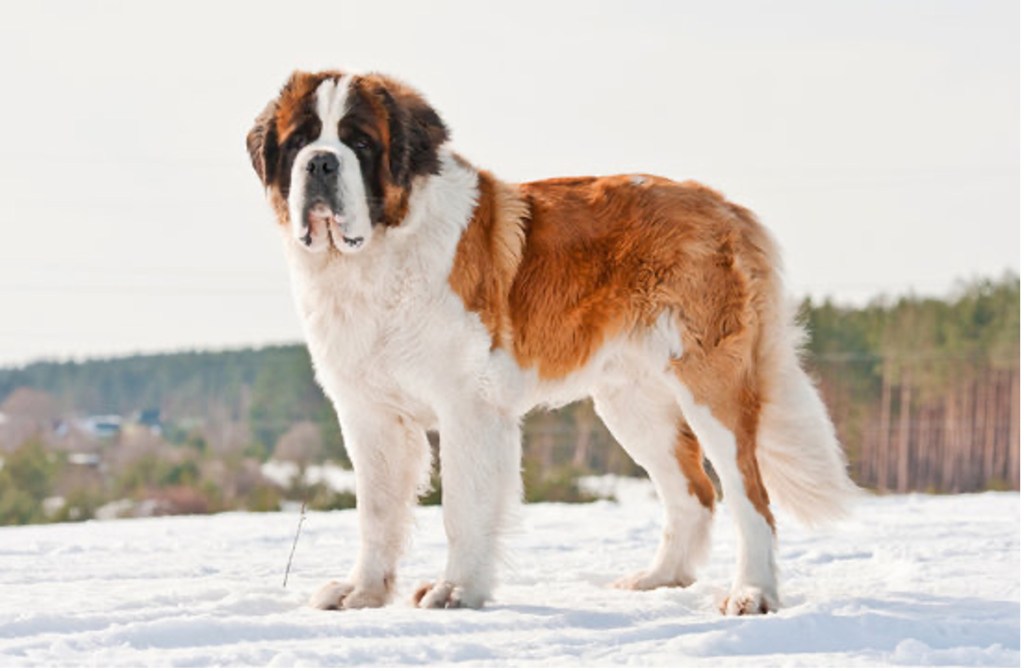
The ‘saint’ in St. Bernard is more than an appellation of appreciation. The honorific is its very identity that defines this rare canine whose frame pulsates with selfless service and unrelenting altruism, its name etched into the annals of heroism and companionship.
This special breed of dog calls the quiet expanses of the Western Alps home, where amidst the snow-laden mountains and pristine valleys of Italy and Switzerland its tales of intrepid bravery echoes and resonates, and has found its way from there to the remotest corners of the world.
A Legacy of Rescue and Loyalty
The origins of the St. Bernard trace back to the hospice founded by St. Bernard of Aosta, nestled in the treacherous Great St. Bernard Pass. Here, in the heart of the Alps, these dogs were bred for a singular noble purpose: to rescue stranded travellers and guide them to safety. Over 300 years, they saved more than 2,000 lives with their powerful build and keen sense of direction proving invaluable in the harsh Alpine conditions.
Among the most storied of these dogs was Barry, who, according to legend, saved over forty people during his lifetime. One well-known anecdote tells of Barry finding a young boy trapped in the snow – Barry licked the boy’s face to keep him awake and warm until help arrived, a testament to the breed’s intuitive sense of care.
Barry’s legacy is a poignant reminder of the breed’s heroism, dedication and courage, qualities that remain deeply embedded in the St. Bernard’s genetic makeup. The poem “Barry of the Great St. Bernard” by Eleanor Farjeon, commemorates this legendary dog thus:
“He saved the lives of forty men,
And twice as many more,
Through blinding storms and icy winds,
And drifts of snow before.”
Physical Majesty and Gentle Disposition
‘Very powerful’, ‘extraordinarily muscular’, ‘imposing’, and ‘massive’ are some of the adjectives commonly used for this breed, words reflecting both genuine admiration and grateful acknowledgement. Standing 26 to 30 inches tall and weighing between 120 to 180 pounds, their physical appearance is both imperious and imposing. And yet, despite their formidable size and strength, the expression they carry is one of profound gentleness and intelligence, their very sight comforting and reassuring.
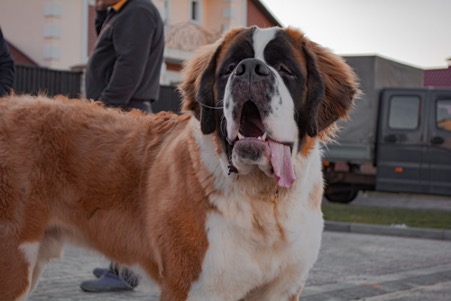
Its coat is red-brown and white or brindle and white and ranges from either short and dense or medium-long. The long-haired variety of St. Bernard was produced by crosses with the Newfoundland dog in the early 19th century.
Their huge heads feature wrinkled brows, a short muzzle, and dark eyes, combining to convey a serene and friendly demeanour that is a welcome sight to both stranded travellers and proud owners. Their special features and traits have made them beloved companions, especially for families with children.
The Gentle Guardian
St. Bernards are watchful and patient companions with a fondness for children. Beneath their massive exterior lies a temperament of unparalleled calm and patience. They form deep bonds with their families, offering steadfast companionship. While not the most vigilant of watchdogs, their sheer size and deep bark are enough to deter potential intruders.
St. Bernards are also known for their easy-going nature and low-energy disposition. These dogs are incredibly affectionate, displaying a level of demonstrative love that endears them to people of all ages. Their interaction with other household pets is generally amicable, though their interactions with unfamiliar dogs might require supervision due to their size and strength.
Care and Maintenance
Caring for a St. Bernard requires dedication. Their size necessitates ample living space and the capability to handle their physical needs, including regular grooming to manage their shedding and drooling. Their coats, whether short and dense or medium-long, require weekly brushing and more frequent attention during shedding seasons.
St. Bernards thrive in cooler climates and need air-conditioned environments during warmer months to prevent overheating. Their exercise needs are moderate; a daily hour of interactive play or a gentle walk suffices. However, they need to be guarded from strenuous activity, especially in hot weather.
Health and Lifespan
The St. Bernard’s lifespan is relatively short, averaging 8–10 years. They are prone to specific health issues, such as gastric dilatation-volvulus (GDV) and osteosarcoma. Preventative measures such as surgical procedures can be used by owners to prevent GDV and mitigate other risks.
Lore and Legends
Cultural depictions of the St. Bernard often blend myth with reality. Contrary to popular belief, St. Bernards did not carry casks of brandy during their missions to rescue lost travellers. This myth originated from the painting ‘Alpine Mastiffs Reanimating a Distressed Traveller’, painted in 1920 by then 18-year-old British legend Edwin Landseer. The artwork depicts an unconscious avalanche victim with two St. Bernards, one of whom has a brandy cask hanging from its collar. The artist’s invention of this playful detail may have been inspired by the fact that monks were familiar with the effect of alcohol on those suffering from hypothermia.
The breed’s role as a nanny dog has often been depicted in films, most notably in the Beethoven franchise and in Walt Disney’s animated ‘Peter Pan’ (1953), in which a St. Bernard named Nana serves as the nursemaid to the Darling children. Ironically, in Stephen King’s twisted vision, it is a friendly St. Bernard turned rabid than serves as the antagonist in the famous novel ‘Cujo’, the horror being the sheer terror of imagining this gentle protector turning into a murderous monster.

Diminishing Purity: Losing Innocence?
Whether by choice, experimentation or a sense of creativity, the purity of the St. Bernard breed has been seriously compromised over time. Since the late 1800s, the St. Bernard breed has been extensively tinkered with using many different molosser-type breeds, including the Newfoundland, Great Pyrenees, Greater Swiss Mountain Dog, Great Dane, English Mastiff, and possibly even the Tibetan Mastiff and Caucasian Shepherd Dog.
It is open to debate whether their original instincts and prowess in discovering trapped travellers have remained intact but perhaps their gentle nature has been too deeply ingrained to be disturbed by any number of mutations.
Enduring Appeal
Despite all the interference that human ingenuity may have thrust upon them, the St. Bernard continues to be a symbol of gentle strength, unwavering loyalty, and unending altruism, and remain the most lovable of dogs. With every wag of their tail and every gentle nuzzle, St. Bernards remind us of the profound impact of kindness and the timeless value of loyalty.
The American Kennel Club may not rank it very high due to its high maintenance and low expectancy, but the genial giant of the Swiss Alps is nonetheless among the world’s most famous and beloved breeds. More than a mere collection of physical traits, they embody a spirit of altruism and gentle strength that has captivated the hearts of countless many.
Poets, writers, and storytellers for centuries have found inspiration and strength of spirit, from their heroic deeds in the Alps to their loving roles in families. They embody a blend of strength, loyalty, and gentleness that continues to captivate and inspire literary and popular culture, perhaps succinctly summed up in these poetic words:
“With the patience of a saint, I’m steady and gentle,
Qualities that are fundamental,
To my ancestral tales of mountain rescue,
And heroic deeds, that are sure to impress you.
Some folks just can’t believe their eyes,
At my massive head and Herculean size.
I’m powerful and strong, but what really sets me apart,
Is my laid-back love and benevolent heart.”
 scribo ad LX