A Living Legend
A visit to the celebrated New York Public Library (NYPL) was rewarding and revealing in many ways. The iconic building which has been a background setting for many a Hollywood blockbuster, is worth a visit in gold. But more than its architectural splendour, its evolution and the way it is adapting to the new role of public libraries in the age of internet and diminishing interest in reading books set one thinking about how the future libraries in not-so-distant times, are going to look like and function.
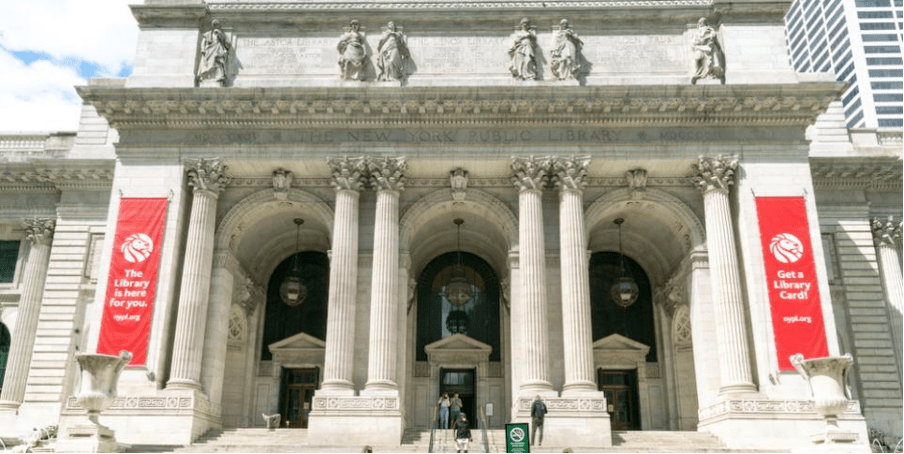
Evolution of the NYPL
The New York Public Library is not confined to a single location. It comprises four major research libraries and 88 branch libraries spread across the Bronx, Manhattan, and Staten Island. Its flagship location, renowned for its Beaux-Arts architecture and historical collections, stands as a beacon of free and equal access to knowledge.
Founding and Early Years
The NYPL was founded in 1895 through the merger of two private libraries: the Astor Library, established by John Jacob Astor in 1849, and the Lenox Library, founded by James Lenox in 1870. Significant funding from the Tilden Trust, created by former New York Governor Samuel J. Tilden’s will, facilitated the establishment of the NYPL.
The iconic main branch, known today as the Stephen A. Schwarzman Building, opened its doors on May 23, 1911. Designed by architects Carrère and Hastings, it quickly became a New York City landmark with its Beaux-Arts architecture and the famous marble lions, “Patience” and “Fortitude,” guarding the entrance.
Expansion and Modernization
Between 1911 and the 1950s, the NYPL expanded rapidly, integrating a network of branch libraries funded by philanthropist Andrew Carnegie. Carnegie’s 1901 donation of $5.2 million enabled the construction of numerous branch libraries, broadening public access to books and information.
In the latter half of the 20th century, the NYPL began embracing modern technologies, introducing computerized catalogues and digital collections. The late 1990s saw the launch of the library’s website, making its catalogue and some resources accessible online. The 2000s brought further expansion of digital collections, including the digitization of rare manuscripts, maps, and other resources.
Current Collections and Services
Today, the NYPL boasts an extensive collection of over 55 million items, including books, e-books, DVDs, research collections, and special archives. Notable collections feature rare books, manuscripts, photographs, and maps. The library is also home to special collections like the Schomburg Centre for Research in Black Culture and the Library for the Performing Arts.
The NYPL offers a wide range of public programs, lectures, exhibitions, and educational workshops catering to diverse interests. From literary discussions to technology training, these events ensure the library remains a vibrant community hub. Comprehensive research and reference services are available, with specialized librarians and archivists on hand to assist scholars and the public.
Adapting to New Realities
The NYPL has modernized its facilities to include tech hubs, makerspaces, and co-working areas equipped with the latest technology. Initiatives like the TechConnect program offer digital literacy classes and technology training, placing the NYPL at the forefront of modern libraries. In response to changing needs, the library has increased its virtual programs, including online story times, virtual book clubs, and webinars.
An Architectural Splendour
The Stephen A. Schwarzman Building, the main branch of the NYPL, is a masterpiece of Beaux-Arts architecture. The exterior, made of Vermont marble, features grand staircases, massive Corinthian columns, and a series of arches. Inside, the Astor Hall, an impressive marble entryway, boasts high vaulted ceilings and sweeping staircases.
Notable Reading Rooms
The building houses several notable reading rooms, with the Rose Main Reading Room being the most famous. This room, which spans two city blocks, is renowned for its grandeur, long oak tables, brass lamps, and intricate woodwork. Other significant rooms include the Bill Blass Public Catalogue Room and the DeWitt Wallace Periodical Room.
The McGraw Rotunda
The McGraw Rotunda stands as the building’s most opulent feature, adorned with exquisite frescoes by Edward Laning. Completed in 1930, these frescoes celebrate the history of the written word and the dissemination of knowledge. The painting “Prometheus Bringing Fire to Man” illustrates the mythological tale of Prometheus, symbolizing the spread of knowledge and enlightenment. The East and West Walls depict scenes from the history of writing, from Egyptian hieroglyphics to Gutenberg’s printing press, and the growth of libraries and education in America.

The Entrance Lions
The statues of two sitting lions, “Patience” and “Fortitude,” are perhaps the most celebrated symbols of the NYPL. Sculpted by Edward Clark Potter and carved by the Piccirilli Brothers from pink Tennessee marble, the lions have stood as iconic guardians since the library’s opening. They have been photographed alongside countless tourists, replicated as bookends, and featured in numerous children’s books. In 2019, after enduring nearly a century of weather and pollution, the lions were professionally cleaned and restored.
Initially named Leo Astor and Leo Lenox, and later Lady Astor and Lord Lenox, the lions were rechristened Patience and Fortitude by Mayor Fiorello LaGuardia during the 1930s. These names have endured, symbolizing the resilience of New Yorkers.
As a tribute to their popularity, the library adopted the lions as its mascots. They are trademarked by the library, represented in its logo, and featured at major occasions.
A significant Cultural and Artistic Landmark
The Stephen A. Schwarzman Building, with its combination of architectural beauty, rich history, and modern adaptations, stands not only as a functional library but also as a significant cultural and artistic landmark. The NYPL’s ability to evolve with the times while preserving its historical essence is a testament to the enduring relevance of public libraries in the digital age.
(To Be Continued…..)
 scribo ad LX