Jaidev, the 12th century poet of exceptional creativity, who composed ‘Geet Govind’, has described spring in a manner few could equal or emulate. With a musicality of expressions and a richness of rhythm, his descriptions encompass trees, plants, creepers, the breeze, the bees and the koel, and of course the young men and women enjoying बसंत -the spring season. The melody and the cadence are exquisitely beautiful.
ललितलवङगलतापरिशीलनकोमलमलयासमीरे।
मधुकर निकर करंबितकोकिलकुजितकुञ्जकुटिरे॥
विहारति हरिरिह सरस वसंते।
नृत्यति युवतिजनेन समं सखी विरहिजनस्य दुरन्ते॥
Mango Blossom is Spring
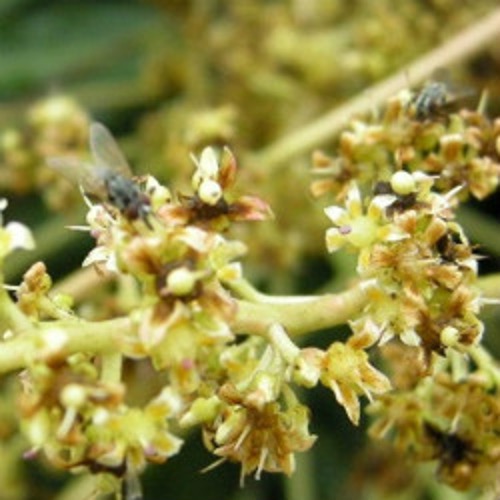
And this spring or Basant is incomplete without the softly inebriating fragrance and the sumptuous sight of mango blossoms. They are evidently pervasive, so much so that on some trees, it’s only these tiny flowers arranged on long stalks that cover their whole being.
These infinitely numerous tiny buds boast of a strong and sweet fragrance that they ooze when they are forced open by the industrious and unrelenting bees as also by the sickle-like beaks of the cuckoos. Showering a yellow pollen from its tiny flowers and – later in the year – proffering a delicious fruit, few trees in the nature can match its magnificence and magic. Fewer still, when it comes to its fruits, whose taste and aroma are beyond compare.
But its glories go far beyond, as it can also inflame and torment the heart. The legend is that when it sways in the southern wind from the मलयगिरि – the Malay Mountains, travellers are forced to close their eyes and cover their noses, though reluctantly, just to save themselves from swooning, or falling into a trance, so intoxicating and strong is its fragrance.
The Melodious Koel and the Intrepid Bee
The bees and the Koel, then are the two accomplices that complete the spell that is the essence of Basant. The endless number of bees ignore every other flower, so lured they are by the nectar (रस) of these flowers.
उन्मीलद्रसबिन्दुगन्धकुसुमावल्लयो वसन्तोदये कान्ताः कोमलपल्लवाः कति कति क्रीडावने सन्ति न।
सौभाग्यैकनिधे रसाल तदपि श्रीमञ्जरीशालिनस्त्वत्तो ऽन्यत्र च कुत्रचिन्मधुकरश्रेणी न विश्राम्यति॥
(As vasanta begins hundreds of lovely tender-budded creeping plants, their flowers exuding a scent from the drops of rasa as they open, dot the pleasure garden. And yet the swathe of bees does not head for any tree other than you, rasāla, resplendent in bloom – for in you resides all beauty.)
But it is the cuckoo or the koel, that true to life, is most associated with the mango; perched upon a mango branch in most of its poetic appearances.

The cuckoo becomes intoxicated by feasting on the mango’s sweet buds. The tenor and texture of its call then varies with the intensity of intoxication, many believe. The relationship between bird and tree, like everything else in this season, is informed and influenced by passion. No wonder the mango is also known as ‘पिक-वल्लभ’- ‘Lover of the cuckoo’.
Kalidas and Spring
Mango blossom is an essential and integral component of any description of Spring-बसंत। And no one has done it so beautifully and elaborately than the one and the only Kalidas. Whether it is रघुवंश or मेघदूत, कुमारसंभव or ऋतुसंहार, description of seasons is a mesmerising aspect of all these immortal epics. The मेघदूत, though essentially devoted to rainy season does not omit to mention other seasons, prominently among them Spring.
रघुवंश contains one of the most elaborate portrayals of carnal intimacy of the last Raghu king अग्निवर्ण. In कुमारसंभव, the most controversial of Kalidas’s epics, the exquisite and intensely amorous description of the love making of Shiv and Parvati is so elaborate and the imagery so vivid and arousing that Kalidas has been severely censored for doing so. The legend is that he was cursed by Parvati for describing her very private moments with such elaborate beauty.
No poet anywhere in the world has created a whole epic presenting the pulchritude of different seasons. ऋतुसंहार is an exceptional epic, whose images relating to diverse seasons defy humanly conceivable talent and ingenuity. The juxtaposition of the amorous acts of man and woman in love against nature’s own display of passion and affection, through flowers, creepers, trees, bees, birds, and animals evolve into an artistic refinement, never ever discerned in the annals of poetry writing.
In this exquisite poetic treasure describing seasons, Spring is the brightest and the most attractive jewel.
द्रुमा सपुष्पा: सलिलं सपदमंस्त्रीय: पवन: सुगंधि:।
सुखा प्रदोषा: दिवासश्च रम्या:सर्वप्रियं चारुतरे वसन्ते॥
Such a pleasing yet soul- touching description of बसंत can come only from Kalidas’s extra-ordinarily facile, fertile and musical creativity.
And can Spring be described without the overpowering presence of Mango blossom? It is the most magnificent manifestation of Spring.
A Feast to Senses
The ebullience and the energy pervading the ambience giving it a gently intoxicating profile, finds greater expression when a variety of birds join these celebrations of joy and enthusiasm. The beautiful canvas of spectacular sights emanating sweet fragrance becomes alive with a music that is at once divine and sensual. If one adds to this redolent landscape, the sonorous and sumptuous music of the countless birds that fills the air, the mesmerising and often intriguing descriptions of Kalidas encompassing the endless sights and sounds of this season enters your soul. They offer both energy and indolence. They completely overawe and overwhelm you, for, the richness and the extraordinary quality of imagery and similes that adorn these descriptions find no equal in the literature anywhere in the world, nor perhaps it ever will.
 scribo ad LX