It may be in order, to briefly describe this charming beauty, though words may not do full justice to its pulchritude. For many of us, who have difficulty conjuring up an image, the shape and size, and the contours of an agile streamlined body, the following may be of some help.
A Biological Account
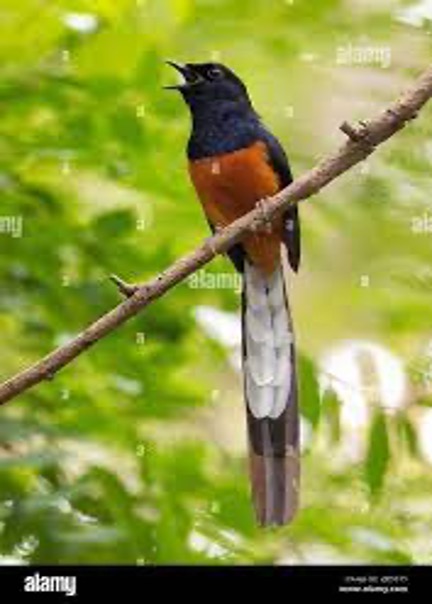
A plain technical description of this beautiful bird will qualify it as White-rumped Shama (Copsychus malabaricus), a small passerine bird of the family Muscicapidae. Native to densely vegetated habitats in the Indian subcontinent and Southeast Asia, its popularity as a cagebird and songster has led to it being introduced elsewhere.
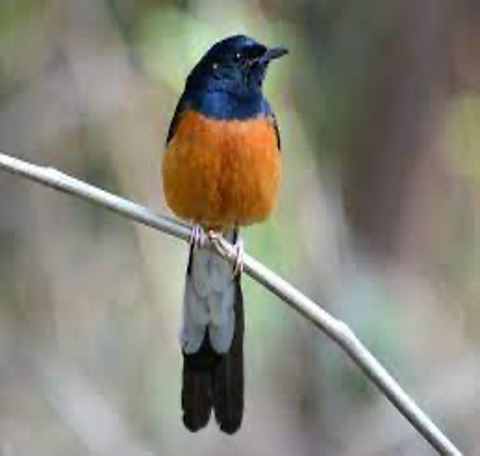
But its beauty is neither plain nor technical. They are petite and delicate. Weighing typicallybetween 28 and 34 g and around 23–28 cm in length, their frame for an admirer like me, appears fragile. With her exquisite plumage, she is a vision of nature’s meticulous artistry. The males, adorned in glossy black with a chestnut belly, boast white feathers on their rump and outer tail, creating a stark contrast against the verdant backdrop of their habitat. The females, though more demure in their greyish-brown attire, carry an elegance that commands the same reverence. Both are equipped with black bills and pink feet, subtle yet significant details that add to their mystique. In their presence, one witnesses the convergence of beauty and survival, each attribute a testament to the evolutionary poetry that has sculpted their frame.
They are shy yet territorial, their days spent in the dense underbrush of bamboo forests or the shadowed canopies of valley woods, where she masterfully blends into her surroundings, a ghostly presence in the lush undergrowth.
An Unmatched Agility
And their agility is unmatched, a characteristic that sees their bodies in constant motion, a restless energy that propels them from branch to branch. This ceaseless activity, particularly the distinctive movement of the tail, reminiscent of the fluttering wings of a butterfly, serves not just as a display of vitality but as a nuanced language of its own. It’s in these subtle gestures that Shama communicates with the world around it, its movements a delicate balance of need and expression, of survival and the sheer joy of being.
Their breeding rituals are, however, a spectacle, underscored by a complexity that mirrors the richness of their songs. The territories they guard during these times are fiercely defended, spaces carved out of the wilderness where life’s most tender dramas unfold. Males, in their quest for companionship, embark on a courtship that is as endearing as it is earnest, their performances a blend of visual spectacle and vocal prowess designed to captivate. The construction of nests, though a task undertaken by the females alone, is a testament to the resilience and ingenuity of these creatures. Built from roots, leaves, and the very essence of the forest, these nests are cradles of life, where the next generation of songsters is nurtured.
Feeding on insects, their diet in the wild showcases their role in the ecosystem, a link in the chain that sustains the delicate balance of their habitats. In captivity, their diet may be supplemented, but it is in the wild that their true nature is revealed, as hunters and gatherers who navigate the complexities of existence with grace.
An Intense Marvel
Notwithstanding their corporal elegance, I stand witness to the flight and the fancy of this exquisite creature, transported to a realm where only beauty prevails, a world where the song of Shama echoes as a beacon of freedom and an ode to the wild, untamed spirit that dwells within us all. Observing Shama, one cannot help but be drawn to her behaviour, a dance of existence that is as captivating as her song. She is a creature of habit, her life a series of meticulously choreographed movements that speak of her innate wildness.
“Be as a bird perched on a frail branch that she feels bending beneath her, still she sings away all the same, knowing she has wings.” said the French author Victor Hugo.As I watch them, I perceive a triumph of confidence and faith- a perfect faith, for, to have faith is to have wings. In the realm where the symphony of nature unfolds in its majestic tranquility, Shama, the white-rumped shama, emerges as the embodiment of wild grace and untamed melodies.
Melody of Melancholy?
In “Il Penseroso,” John Milton extols a bird’s sweet song, which contrasts the noise of human folly with the solace found in natural melody. ‘“Sweet bird, that shun the noise of folly, most musical, most melancholy!” The bird, frisking and frolicking around me leaves me with a touch of sadness as I constantly gaze at her. That she reminds me of that coy but confident girl who while her parents persuaded me to take as my life partner, sweetly but unhesitatingly teased me for my looks, dress, and speech. Perhaps this makes it so special for me.
In Shama, the confluence of beauty, behaviour, and biology is a narrative that speaks of the broader truth of life on this planet. She is not just a bird but a symbol of the wild’s untamed heart, a reminder of the beauty that thrives in the shadows of the world, often unseen but always present. Through her, we are given a glimpse into the intricate dance of existence, a performance that continues unabated, with or without an audience, a song of the earth that endures through time.
A Muse for the Free and Pure
Shama, in her ethereal beauty and her wild song, is more than just a bird; she is a muse, a symbol of all that is pure and free in this world. Her story is a woven tapestry of light and shadow, a narrative that speaks of the beauty of existence and the sorrow of its constraints. Through her, I am reminded of the delicate balance of life, the ephemeral nature of beauty, and the enduring power of song.
The beauty of Shama’s song is a double-edged sword, for it is this very gift that makes her a target for captivity. In the folly of human desire to possess and to control, we often forget that the most beautiful things in life are those that remain free. Shama’s song, even from the confines of a cage, is a powerful testament to resilience and the indomitable spirit of nature. It is a reminder, poignant and bittersweet, of the freedom that sings in the heart of every living being, a song of hope that even in the darkest of times, cannot be silenced.
They can never be caged. Their feathers are too bright, their songs too sweet and wild.
 scribo ad LX