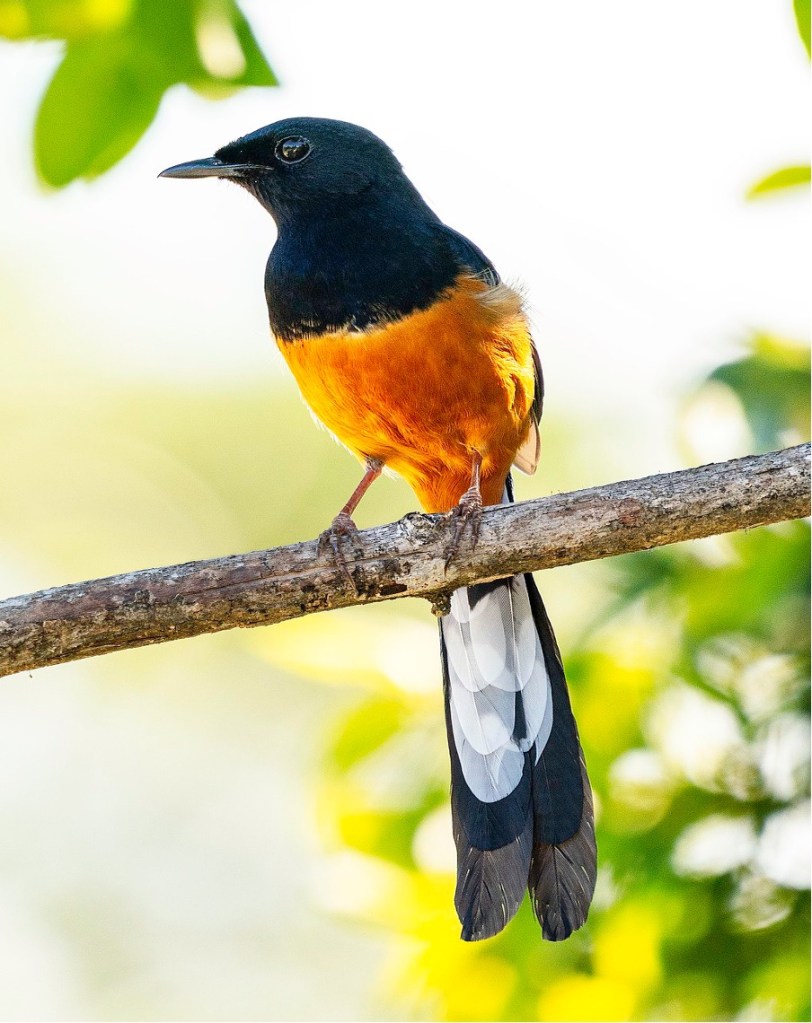
This bird tantalizes me incessantly. Perhaps ‘fascinates’ would be a more suitable term, but its perpetual motion is so captivating and yet so distracting that it effortlessly diverts my attention from any task at hand.
An Enchantress
Exceedingly agile and animated, it incessantly moves its posterior up and down, never pausing for more than a fleeting moment. Once within the scope of my vision, it steadfastly captivates my gaze. It’s the relentless sway of its tail, akin to the fluttering wings of a magnificent butterfly, that consistently enthralls me. Quirky yet inquisitive, persistent yet mesmerizing, sharp yet graceful.
As though under a spell, I abandon all else and sit quietly observing until it decides to take flight, disappearing from my sight.
I find myself spellbound, ensnared not by mundane matters, but by the enchanting dance of the Shama, a creature of the wild that flits and flutters into the recesses of my vision and the depths of my heart. It is more than just a bird to my eyes; it embodies the essence of fascination, a testament to nature’s whimsical allure and a poignant reminder of the freedom that pulses within the soul’s deepest chambers.
Elegance in Motions
Shama moves with a grace that belies the simplicity of its existence. Its agility is unparalleled, a ballet of feathers and air, where each sway and arc of its tail weaves narratives into the softness of the morning light. It’s a dance of the untamed, punctuated by rhythmic bobbing that seems to echo the heartbeat of the earth itself. Its presence is a perpetual flutter, a whisper of wings that speaks of life’s unbridled joy, captivating my gaze and momentarily rendering the world around us inconsequential.
In those moments, time stands still, and I become nothing but a spectator, entranced by the spectacle of its elegance. In ceaseless motion, it creates an illusion of a world far removed from human concerns, inviting me into a realm where only beauty and melody reign supreme. Its antics, a playful torment that ensnares my attention, become a delightful tease, a distraction that I welcome with an open heart and a soul eager to wander.
The Eloquent Silence
It speaks little. For hours, it remains silent, its fleeting movements speaking volumes. And yet, in its silence, the Shama communicates profoundly. Hours may pass in quiet observation, every movement a verse in the poetry of the wild, narrating tales of joy, of exuberance, and the sheer delight of existence. This silence is not empty; it is imbued with the language of life itself, a silent discourse understood not through words but through the depths of the soul.
And When It Sings
But when it decides to sing, it is ethereal, a surreal experience. What range, what melody, what power. It’s like a master musician in his most inspired moments, regaling with a repertoire as uncommon as it is unmatched.
And when it sings, oh, how the world falls into a hush! This melody resonates through the air with a purity and passion that transcends the ordinary. It is a celestial song, a serenade that rivals the compositions of the most accomplished maestros, filling the heart with a longing and a love so profound that it seems to bridge the chasm between the mortal and the divine. In its echoing strains, I hear the echoes of ancient wisdom, a melody that bears the weight of the world yet soars above it, unbound and sublime.
An indefatigable vocalist, perhaps, with much to convey to rivals, admirers, and passers-by; and it expresses all in its song. The thirteenth-century Persian Sufi poet Jalal-ul-Din Rumi alluded to this in his verse:
Birdsong relieves my deepest griefs:
Now I’m just as ecstatic as they,
But with nothing to say!
These songs, mellifluous, rich, and sweet, are performances that captivate all who listen, a repertoire as varied as it is beautiful. It is a voice that carries the stories of ancient forests, of winds whispering through bamboo, and of rains dancing on verdant leaves. In its song, one hears the echo of the eternal, a call that speaks to the soul of those who listen.
A Cursed Talent
Ironically and tragically, it is this singing talent and virtuosity that ensnares it within the cages crafted by humans, the only species on earth that enslaves others. And while humans sadistically enjoy the string of melodies from caged birds, they never cease to sing, despite their incarceration and confinement. In the words of Maya Angelou, “A bird does not sing because it has an answer, it sings because it has a song.” Despite the pain and helplessness of the captive bird, God has granted it both the forbearance and fortitude to sing. And as it sings, the melody is as resonant, stirring, and soul-searing as ever. “I know why the caged bird sings, ah me, when his wing is bruised and his bosom sore; when he beats his bars and he would be free, it is not a carol of joy or glee, but a prayer that he sends from his heart’s deep core,” famously said John Berry.
One of the starkest and most enduring truths of human nature is captured in the following lines of Jacques Deval: “God loved the birds and invented trees. Man loved the birds and invented cages.”
And just as I think ‘good riddance’ and try to refocus on my work, it reappears, with its enchanting charm and graceful movements, as if to say ‘never think I am far away.’ Once again, I am ensnared, my gaze fixated on its beautiful and agile form.
(To be Continued……)
 scribo ad LX