Ixora or the West Indian Jasmine
“O my Luve is like a red, red rose

That’s newly sprung in June;

O my Luve is like the melody

That’s sweetly played in tune.


So fair art thou, my bonnie lass,

So deep in luve am I;

And I will luve thee still, my dear,

Till a’ the seas gang dry.”
Flame of the Woods
These immortal lines by the celebrated Scottish poet Robert Burns epitomises the eternally pulsating sentiment of love and passion in human heart. A red rose, or for that matter any beautiful flower, red or otherwise, issues forth finest emotions of affection, love and endearment that so spontaneously springs in any heart.
That such a spectacularly beautiful burst of red flowers anywhere on this planet will choose to materialise close to my favourite spot of contemplation and retreat, is a reward coveted by many but bestowed only on a few.
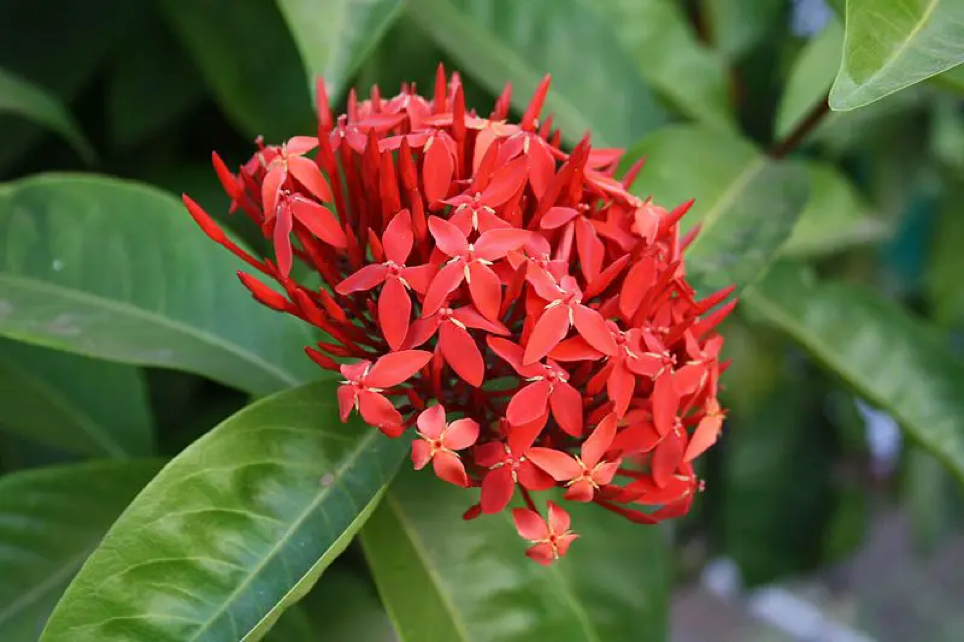
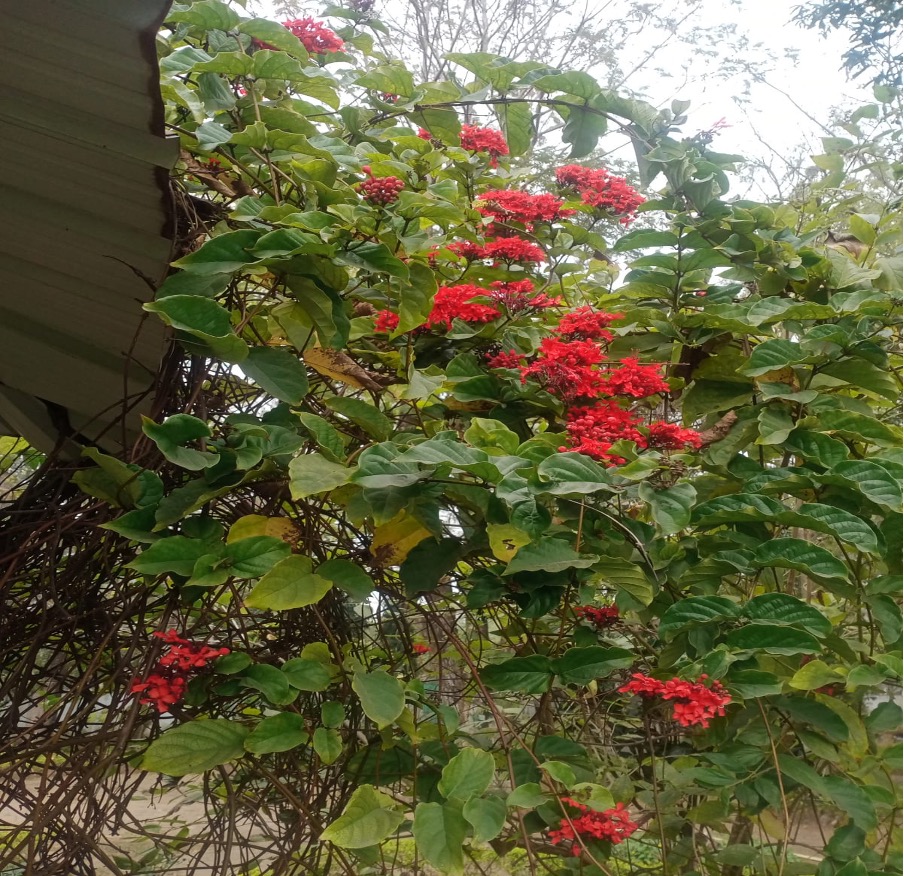
A few days ago, imperceptibly but surely, this stout creeper that has been clinging to a tall frangipani tree, burst into a flamboyance of an extra-ordinarily bright hue. Its crown was laden with crimson -orange-red flowers and seen from a distance it offered a sight both celestial and elevating.
The Frangipani is still not in bloom. It is waiting patiently to display its splendour a little later, but as a faithful and loyal companion is doing all it can, to showcase the brilliance and vibrance of its soulmate by offering her his own tall shoulders around which his companion is so delicately perched.
On a sun dappled afternoon, as I stand close to the two embracing lovers, the opulent cluster of the burning red, finds an ethereal contrast against a handful of yellowish white elegance, on Frangipani’s leafless frame.
Ixora may largely carry an appearance of a humble shrub, but at times it transforms itself into a small tree and occasionally into a creeper, as the one in front of my eyes. And it may not have the grandeur and magnificence of many other trees in ordinary times, but once in bloom its beauty, appearance and refulgence are captivating beyond imagination.
Botany
A shrub, small tree or at times a creeper, Ixora comes in bright red, orange, pink, yellow and white colours. The red colour is the most common colour. It mostly blooms in Spring and Summer, but it can display its splendour in winters as well.
It is a member of the Rubiaceae family, a family that boasts of such distinguished members as Coffee. Though a single genus, it is unusually large consisting of about 550 species of shrubs and small trees. And it is a popular flowering plant among gardeners because of its rounded shape, showy flowers, and attractive, glossy foliage.
It grows up to 200 cm (7 ft) in height. The plants possess leathery leaves, ranging from 3 to 6 inches in length, and produce large clusters of tiny flowers mostly in the summer. Small, tubular, in vibrant shades of red, its flowers form a dense rounded clusters that are 2–5 inches or 5-12 cm in diameter.
Though native to the tropical and subtropical areas throughout the world, its centre of diversity is in the Tropical Asia. Ixora also grows commonly in subtropical climates in the United States, such as Florida where it is commonly known as West Indian jasmine.
Ixoras love the tropical sun. They are their happiest when they get 8-10 hours of direct to partial light in a day. While ixoras can live easily in indirect light, flowering will be infrequent and in smaller clusters. Needing sun even if for a while, it can survive on a nominal supply of water and is a low maintenance plant.
Ixoras prefer acidic soil and are suitable choices for bonsai. It is also a popular choice for hedges in parts of Southeast Asia. It likes moist, but well drained soil and dislikes alkaline company that makes it lose its brilliance.
The Name
The creeper that is described and discussed here is one of the more popular varieties of Ixora, namely Ixora coccinea.
The genus name comes from the Sanskrit word “Ikvana”, which is the name of a Malaysian deity, or it was derived from the name “Iswara”, which represents a Malabar deity. George Don, the famous Botanist writes that Ixora is a name of “a Malabar idol, to which the flowers of some of the species are offered.”
The common names like “Jungle Flame” and “Flame of the Woods” comes from its bright red colour. Also known as West Indian Jasmine, this amazing flowering plant attracts positive energy and good fortune. It is planted near the entrance door for good luck.
Ixora is also known as jungle geranium, iron tree, jungle flame, lipstick plant, golden shower tree, and the jewel of the east. In various part of India, it is called by many names. Bakara Chethi (Malayalam), Ixora, Pink Ixora, Red Ixora, Kullai Rangan (Bengali) Rugmini रुगमिनी (Hindi) Rukmini/Pendgul Sedaram Sinduram Vedchi (Tamil) Vetchi are some of such names.
Other common names across the world include viruchi, kiskaara, kepale, rangan, kheme, ponna, chann tanea, techi, pan, siantan, jarum-jarum/jejarum, cây trang thái, and cruz de Malta, among others.
It has the distinction of being the National Flower of Suriname, where it was doubtless carried by the immigrant Indians centuries ago. In Sri Lanka, where it is immensely popular, they call it Rangan.
(To Be Continued…..)
 scribo ad LX