Exploring the Spicy World of Red Ant Chutney

Food is more than just sustenance; it is an emotion, a passion, a philosophy and a language, all rolled into one that touches and ensnares our senses. And it brings all of us together. It is, they say, the most preferred topic of human conversation, irrespective of cultures. That it is the most essential requirement for human survival, makes it the most researched and the most revered. And its forms and derivatives are endless. The experimentations carried out, and innovations done with it, are indeed a saga of human survival and its incessant desire to seek joy and nourishment. The novelty and the diversity, of food, therefore is unmatched. “One cannot think well, love well, sleep well, if one has not dined well.”, said Virginia Woolf echoing a universal consensus.
India’s culinary tradition is as rich and as diverse as the country itself. From the sweet delicacies of the East to the fiery curries of South; from the savoury snacks of the West to the opulent and unorthodox Mughlai offerings of the North, few regions in the world can boast of such amazing range of tastes and aroma. And amidst this culinary kaleidoscope, nestled and practically hidden in the heart of India, in the states of Chhattisgarh, Jharkhand, and Odisha, is a gastronomic gem that remains a well-kept secret in many parts of the country, a gem that sparks curiosity and titillates taste buds – the infamous Red Ant Chutney.
The Red Ant Chutney
The anticipation of a dish made of red ants likely conjures up sentiments closer to revulsion and incredulity. One can imagine the consternation on one’s face. Ants, that too the red ones; the creature that can leave you writhing in pain served as a dish? And yet, Red ant chutney or Chapda chutney is a much sought after food in Chhattisgarh’s Bastar region. Chapda or Chaprah means leaf basket and they are indeed the nests that ants make using the leaves of Sal tree.
Red Ant Chutney emerges as a fiery and inseparable part of the gastronomic journey of the curious and enterprising. Beyond its initial shock factor, this unique delicacy reveals a culinary marvel with deep-rooted cultural significance. Whether you’re savouring it in the tribal villages of Bastar or experiencing it on Gordon Ramsay’s menu, Red Ant Chutney invites you to a highly seasoned adventure—a celebration of tradition, flavours, and the unexplored.
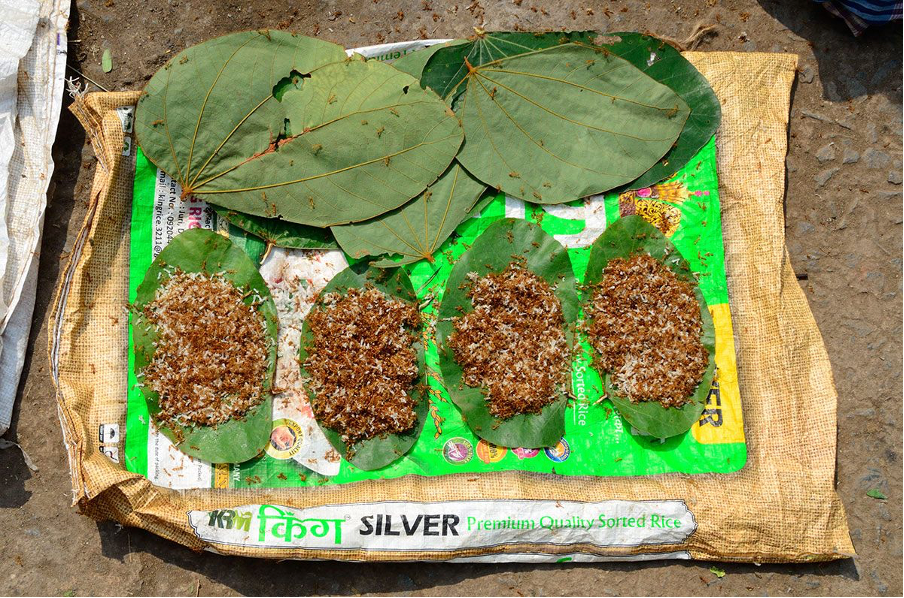
On Sale-A Roadside view
As you explore the markets of Bastar in Chhatisgarh, Chaibasa in Chhotanagpur, or even neighbouring Odisha, the sight of women selling small leaf packets might intrigue you. Within these unassuming packets lie the gateway to an unparalleled culinary adventure, and a key to this fiery, flavourful find— Red Ant Chutney. Harvested from the forests around these areas, the red ants are sold in local markets in small packets made of Sal leaves. Hailing from the Eastern regions of India, these fiery insects are transformed into a chutney that has become an integral part of local palates. The preparation involves crushing the ants, larvae, and eggs, creating a paste enriched with tomatoes, garlic, and chilies. For the locals, eating them with just salt provides the most authentic experience. A true venture and an authentic sojourn to these beautiful forested areas find the ultimate expression when shedding one’s inhibitions one puts this spicy, tangy, shearing chutney to one’s tongues. The after-effects are extra ordinary. Variously celebrated as Chapda, Chaprah or Demta, the dish never ceases to surprise you and often leaves behind a delightful after-taste.
Culinary Alchemy: From Nests to Palate
However, the process of preparing this delicacy is filled with a lot of hurdles. Nests of these red ants are surrounded by protective rings of male ants, who guard the egg-laying females. Even at the slightest of provocation, the male ants attack ferociously. Harvesters must suffer the excruciating pain caused by the painful bites of male ants. They first kill the males after a long struggle. Then adding them to their bags, they move on to the females and their eggs, which is a less formidable task.
The process of creating this unique delicacy is not for the faint-hearted. It is an uncommon adventure only for the intrepid and resolute.
Making Chaprah: A Laborious Yet Rewarding Process
The ants, eggs and larvae are then cleaned and separated from any unwanted particles. The mixture is then washed, and the excess water is drained out.
Fresh tomato, garlic and chillies are then added to the mix and a paste made with the help of a mortar and pestle. One can also use a mixer/grinder alternatively.
Putting a little oil in a pan, the pan is placed on fire. As the oil heats, chopped onions are added and sautéed occasionally tossing the pan, till they become brown and crunchy. To this golden brown is added the paste as described above. Give it a light toss, dry the mix in the heat and you are done.
Alternately you can just make a paste of ants, salt, and chillies to have something much quicker if you want to avoid the above process. The locals, often simply eat the mixture of ants, eggs, and larvae with salt which gastronomists insist as a must to experience the real feel and flavour.
A more elaborate preparation involves crushing and drying the ants and their eggs, followed by the addition of coriander, tomatoes, garlic, and ginger. The final touch involves the introduction of red chilies, resulting in a vibrant, orange paste that encapsulates the essence of Chhattisgarh.
The process of creating Red Ant Chutney is an intricate dance with nature. The red ants, however, form the core of this culinary delight. The orangish, brownish amalgam enriched with onions, garlic, ginger, coriander and red chilies when placed on your tongue transports you to an experience that can only be lived first hand, not vicariously learnt. A spicy symphony that sets taste buds ablaze, and leaves behind an indelible lingering after-taste.
(To Be Continued……)
 scribo ad LX