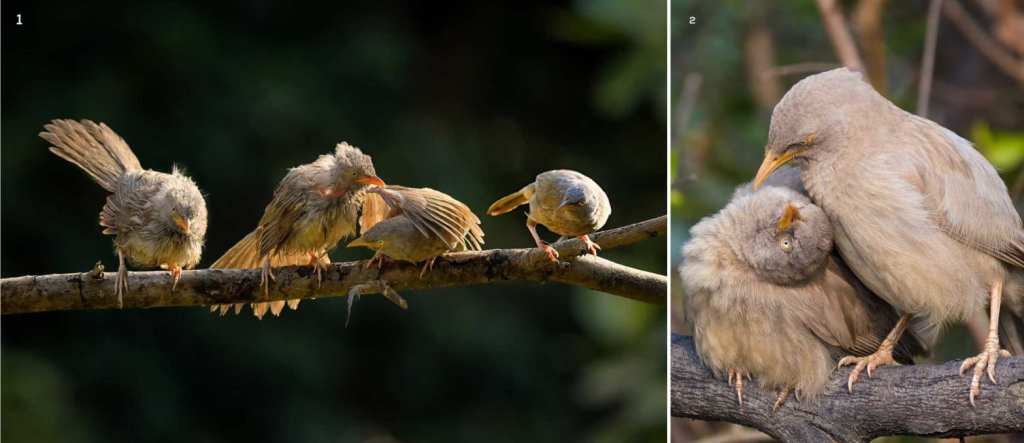
Wikipedia records an interesting story, attributed to Frank Finn, the British chronicler. Perhaps apocryphal, but it is tellingly evocative of Babblers’ place in nature’s scheme. No eulogy illustrates their place around us better than this amazing story.
“Some years back, a new Viceroy was being shown the wonders of his temporary kingdom, and among these the Taj at Agra held, of course, an important place. Arrived before the glorious monument of Eastern love and pride, the artless Aide-de-Camp was mute; the gilded staff were still as Kipling says, in anxious expectation of the comment of His Excellency. But this, alas when it came was merely the remark: “What are those funny little birds?”
The shock must have been the greater for the fact that the mean fowls thus honoured were it seems, of that singularly disreputable species which is commonly known in India as the “Seven Sisters” or “Seven Brothers,” or by the Hindustani equivalent of sat-bhai.
Yes, ‘Seven Sisters’ or in some cases, ‘Seven Brothers’ is the popular name of this popular bird and yet it is so unique that the new Viceroy took note of this funny little bird, even while standing in front of the mesmerising Taj.
The Argumentative Babbler
Babblers are the Indians among birds. They are perhaps the most argumentative, just like us. And just as this argumentativeness is recognised by scholars like Amartya Sen, babblers too have been christened the name ‘Argya’, which in Latin means ‘to argue’.
Curiously, the scientific name of some species of Babblers, like the “Turdoides” genus, might be confusing. “Turdoides” is derived from “turdo,” which means “thrush” in Latin, but it may evoke a different image to those not familiar with the scientific nomenclature.
In the Folklore
Babblers are neither the majestic eagles nor the wise owls, yet they hold a special place in local folklore. Within their habitat, unique stories and beliefs emerge, mirroring the cultural and ecological context of the communities that coexist with them. These narratives underscore the profound connections between humans and the natural world, underscoring the importance of every creature in the intricate web of life. And though not as widely covered in cultural and folklore traditions as some other birds, their place in the folklore remains unique.
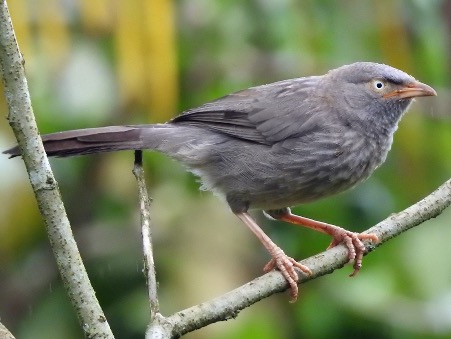
In Indian Folklore, Babblers are often associated with their chattering nature. They are sometimes seen as gossipy birds that carry messages between the natural world and the spirit world. In some Indian folklore, it is believed that if Babblers are chattering around your house, they are bringing good news or visitors. The Indian folklorist Saratcandra Mitra recorded a belief among the Lushai-Kuki people that during a solar eclipse, humans could transform into jungle babblers.
In Burmese Mythology Babblers are considered sacred birds. They are believed to bring good luck, and their presence near a home is thought to
protect the inhabitants from harm. Some indigenous communities in Southeast Asia have their own unique stories and beliefs about Babblers. In the Philippines, specifically in Visayan folklore, Babblers are believed to carry messages from the spirit world. Their presence or calls are sometimes interpreted as omens, signifying different things depending on the context. Babblers are also known to be present in Australian Aboriginal territories.
These stories often emphasize the close-knit and communal nature of these birds, which resonates with the communities that observe them in their natural habitats, clearly offering valuable insight and unique understanding of local fauna, including birds like the Babblers.
A Testament to Nature’s Balance
Babblers are a testament to the intricate balance of life within the forest’s embrace. They are not just birds; they are nature’s joyful custodians. With their vibrant plumage and spirited demeanour, they bring life to the forest, and with their ecological role, they ensure its well-being. So, the next time you hear the melodious chatter of these avian wonders, remember that they are not just singing for joy but also for the harmony of the wild.
The omnipresent babblers deserve much better and deeper attention. Behind their seemingly angry glares are soft, social beings who have developed a wide vocabulary to better engage with each other. Babblers may not be the most attractive and colourful avian specimen, but their lives display the complexities of an avian life in all its glory and sophistication. It’s a pity that it has not found a recognition it so richly deserves.
They are a great symphony, not the one composed by man but the one conducted by nature itself. How truthfully the lines below reflect the exuberance and social nature of these charming birds of home and the wild.
“In the forest's lively, leafy hall,

Babblers gather, one and all.

With muted feathers and voices clear,

They fill the woods with sounds we hear.


Chattering, chirping, in merry throng,

Their communal spirit sings a song.

Nature's orchestra, a joyful sound,

In unity, they dance around.


From branch to branch, they flit and play,

Bringing light to the forest's day.

Babblers, dear, in plumage fine,

A treasure in the woods they shine.”
 scribo ad LX