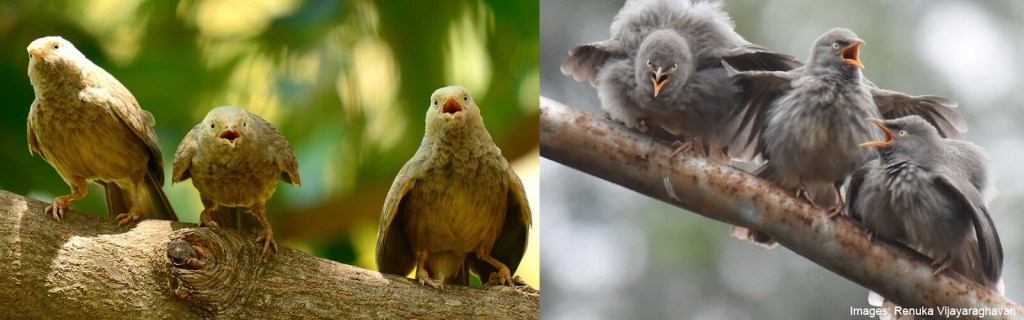
As the dawn breaks and the sun rays stretch their golden luminescence through the leaves of tall trees and dense bushes alike, , the Babblers awaken with an infectious enthusiasm. Their energetic movements are a testament to the pulse of life that thrums through the heart of the forest and the fields. They flit from branch to branch, their tiny bodies a whirlwind of activity. In their vibrant dance, they symbolise the spirit of the wild, where every moment is a celebration of existence.
Environmentally Significant
Yet, it is not just their exuberance that makes the Babblers an integral part of the natural world. Their chatter, often considered noisy by some, is, in fact, a vital thread in the grand design of environmental purity and sanctity. Their voices resonate through the forest, a constant reminder that life teems in every corner, that nature’s heartbeat remains steady and eternal.
The Babblers are the custodians of their woodland realm. They pick insects from the bark, keeping in check nature’s delicate balance. In their diligent foraging, they ensure that no pest threatens the sanctity of the forest. They are the unsung heroes of the underbrush, the guardians of biodiversity. In the grand scheme of nature, Babblers are more than just enchanting birds; they are custodians of the environment. By foraging for insects and dispersing seeds, they contribute to the health and purity of their habitat. Their intricate nests and communal living demonstrate the power of cooperation in the wild.
In the Babblers, we find not just a bird but a symbol of exuberance, of community, and of the vital role every creature plays in maintaining the purity and sanctity of our environment.
A Vocabulary One Must Envy
And while Babblers may be considered noisy by some, their vocal expressions are essential to the forest ecosystem. Their calls serve as an early warning system, alerting fellow inhabitants to the presence of predators. This cooperative approach to survival is an example of their profound social significance.
Whether they chirp, twitter or tweet, they vocalisation has reached an evolution hardly seen in any other bird species. Perhaps it has a lot to do with the highly organised and coordinated social structure and the attendant social communication. Research done at IISER-Mohali shows that with increasing social complexity in a species, the complexity of calls also develops and rises. There is more information encoded in complex calls, and this allows receivers to respond in a more nuanced manner. For instance, a soft four-note call by a member of a foraging group (known as a “flight call”) signals that it’s time for the group to move on. A loud single note (contact call) from a panicked lone bird indicates it has been left behind; the others respond with the same note, calling back and forth until they locate the straggler. A chorus call is employed when two groups are in conflict, chasing each other through the trees, sometimes even engaging in physical fights. A shriek from the sentinel high above is met with immediate dispersal into the foliage.
This specialisation and sophistication in calls has not been seen in any other bird species. There are birds that are far more musical and melodious but none demonstrating such diversity.
A Cooperative Social System
In several other behavioural aspects also, babblers are far more sophisticated. Allogrooming(where members of a flock groom each other), communal roosting, and cooperative brood care distinguish them glaringly. Their large families are fragmented into smaller groups during the breeding season; these nuclear units consist of a dominant breeding pair and a few “helpers”that assist in raising the offspring. Such a cooperative social system in which some birds give up their chance to breed, to help raise the offspring of others is rare in the wild.
And yet despite their evolved intelligence and community cohesion, they are still exploited by other species like the common hawk-cuckoo and the Jacobin cuckoo. They parasitise Babbler nests and lay their eggs there. While babblers typically chase cuckoos away on sight, these parasites still find windows of opportunity while the host is away. Whether this exploitation is a symbol of a poor power of discrimination or whether this phenomenon is indeed an act of benevolence, remains a moot question.
In a world where silence is often misconstrued as the absence of life, the Babblers stand as a reminder that noise is the song of existence. Their chatter is the chorus of nature, an unbroken chain that weaves together the past, the present, and the future. It is a reminder that in the grand theatre of life, every role, every voice, has a purpose.
 scribo ad LX