
Nature’s Noisy symphony
Nestled in near wilderness, this magnificent home offers one of the most verdant and soothing settings for an opulently peaceful life. Sitting in its wide and open veranda, I see the tall and majestic canopies reaching out for the skies while an orchestra of a melange of sonorous calls fills the air. And there is a vibrant animation all around, of flights and flutters, as birds of diverse denominations register their unmistakable presence. Amid this harmonious ensemble, one avian species commands the stage – the Babbler. Their relentless energy, their ceaseless chatter, and their animated dance through hedges and bushes define their unique presence in this natural theatre.
Unveiling the Babbler’s Charms
Three unmistakable features distinguish these remarkable birds. First, their boisterous burst of chatter, a never-ending conversation that fills the air. Second, an endless energy and animation that defines their congregation, creating a living spectacle. Lastly, their expressive eyes, greyish orbs with a bright, unwavering gaze, as if they are watching your every move. These eyes are the most captivating part of their anatomy.
Clad in a palette of earthy tones, Babblers blend seamlessly into their forest home. Their collective spirit is a testament to the beauty of community living. They gather in raucous assemblies, their voices rising in joyous unison, celebrating the unity of their clan. In their chatter, there’s a profound social message, a reminder that in the colourful and musical symphony of life, every note matters.
The Mosaic of Babbler Diversity
Babblers are a diverse and intriguing group of birds, each species exhibiting unique characteristics, habitats, and vocalizations. From the gregarious Jungle Babblers to the melodious Yellow-throated Babblers, these wandering wonders enrich the tapestry of avian life. Some common Babbler species include:
- Jungle Babbler (Turdoides striata): Predominantly found in the Indian subcontinent, these birds sport striking chestnut-brown plumage with a white throat and breast. Highly social, they forage on the forest floor or in sparse vegetation, always moving as a flock. Their constant, energetic vocalizations earned them the nickname “Seven Sisters.”
- Yellow-billed Babbler (Argya affinis): Native to the Indian subcontinent, Yellow-billed Babblers are similar in size and shape to Jungle Babblers but have a yellow bill and light-colored plumage with a distinctive dark eye patch. They frequent gardens, open woodlands, and scrub habitats, and like their counterparts, are highly social.
- Large Grey Babbler (Argya malcolmi): Found in the northern and central regions of the Indian subcontinent, these Babblers flaunt predominantly grey plumage with a black cap and a white throat. They are known for their cooperative breeding behavior, often seen in noisy groups searching for insects and fruits.
- Yellow-throated Babbler (Stachyris rufifrons): Inhabiting Southeast Asia’s dense forests, particularly in hilly terrain, these Babblers boast a distinct yellow throat and chest with a brownish upper body. Their melodious calls set them apart from other species.
- White-crested Laughingthrush (Garrulax leucolophus): Despite the name “Laughingthrush,” these birds are considered part of the Babbler family. Found in the Himalayan region and parts of Southeast Asia, they feature a distinctive white crest on their head and a chestnut-colored body. White-crested Laughingthrushes are known for their varied vocalizations, including melodious whistles and calls.
Taxonomic Insights
Originally described by French zoologist Charles Dumont de Sainte Croix in 1823, the Jungle Babbler was known as Cossyphus striatus. However, a 2018 molecular phylogenetic study led to its reclassification under the resurrected genus Argya.
Habitat and Description
Babblers are true forest dwellers, thriving in a variety of habitats, from dense, tropical rainforests to subtropical woodlands and scrublands. Their spirited presence graces the landscapes of Asia, from the foothills of the Himalayas to the verdant jungles of Southeast Asia. They are loyal to their territory, not known to migrate.
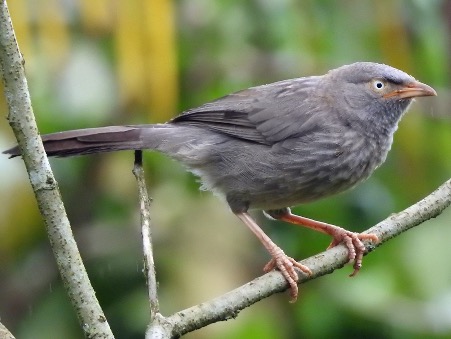
With short rounded wings and weak flight, the sexes are identical, cloaked in drab brownish-grey plumage with a yellow bill. The jungle babbler can be distinguished from the white-headed babbler by a dark loreal zone between the bill and the eye and the lack of a contrasting light crown. The calls of the two species are distinct, with the Jungle Babbler’s calls being harsh and nasal, while the white-headed babbler’s calls are high-pitched.
Young birds possess dark irises, which gradually transition to a pale creamy colour as they mature. This transformation occurs as muscle fibres develop in the iris, rendering the dark basal colours invisible and cream-colored.
Breeding and Nesting
Within their forest enclaves, Babblers form tightly-knit communities, and their breeding habits are a testament to their social nature. During the breeding season, intricately woven nests appear, often hidden amidst the foliage. The female Babbler lays a clutch of eggs, and the entire community takes part in incubation. This communal approach extends to rearing the young, ensuring every Babbler plays a vital role in nurturing the next generation.
Diet and Foraging
Babblers have an eclectic palate, feasting on a wide array of food items, from invertebrates and small insects to fruits and berries. Their diet not only keeps the forest floor pest-free but also aids in plant life propagation through seed dispersal. They are nature’s gardeners, actively contributing to the ecological balance of their habitat.
Life Span and Behaviour
The average life span of Babblers typically ranges from 5 to 7 years, though in the wild, it may be shorter due to predation and environmental challenges. Their spirited behaviour is a sight to behold as they flit from branch to branch with boundless energy. Babblers possess a distinctive, melodious chirp, and their communal conversations create a symphony of sound in the forest. This joyful chatter is not just a manifestation of their exuberance; it’s their way of communicating and reinforcing social bonds within the group.
Nature’s Joyful Custodians
Inhabiting the heart of untamed woodlands, Babblers play a vital role in maintaining the ecological balance of their habitats. From tightly-knit communities to diverse diets and melodious conversations, these birds contribute to the vibrancy of the natural world. Each Babbler species, whether the sociable Jungle Babbler or the melodious Yellow-throated Babbler, adds its unique note to the symphony of life in the forest.
To be concluded…
(In the second part, we will explore their environmental and cultural significance.)
 scribo ad LX