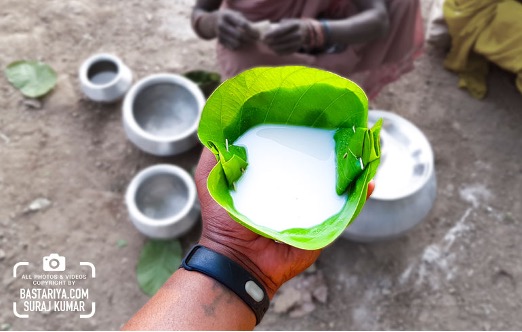
Salphi, a fleeting muse of intoxication, dances gracefully in the lush forests of Bastar, leaving no lingering trace of its presence. Crafted as a delicate brew, fermented instantaneously, the ivory liquid refreshes and rejuvenates.
Salphi’s Ephemeral Symphony
Salphi is as ephemeral as the morning mist that often shrouds the Bastar forests and its intoxication, light and refreshing, seldom leaves a lingering after-effect. It is as natural and organic as any beverage made by nature. The moment the sap begins to drip from the expertly made cut in the branch of the Salphi tree and begins pouring slowly into earthen pots tied to the branch, the yeast in the air begin to work its magic on the white liquid. The fermentation starts instantly and continues abated, some of the yeast getting collected at the base of the container, further augmenting the fermentation process.
Salphi, does not have the longest of shelf lives. Among the alcoholic beverages it has perhaps the least inclination to survive and be counted. While it is a great merit as it is seldom reported to have even slightly harmed the consumer, a delayed consumption, however, can lead to stomach disorder.
Salphi is best enjoyed within one hour of its collection. This requirement has given rise to a beautiful ritual in Bastar. The collection of Salphi sap is typically carried out at dawn or sunset. The sap collected at the dusk, enlivens the evenings, infusing the Ghotul life with a sense of excitement, exuberance, and energy. The act of collecting Salphi becomes a celebration, connecting the tribespeople with the rhythms of nature.
Salphi and Its Close Cousin, Mahua:
Salphi shares the spotlight with another extraordinary beverage – Mahua. While Salphi captivates with its ephemeral charm, Mahua offers a different allure. Mahua is crafted from freshly collected Mahua flowers, and its fermentation process is slower and more deliberate. The result is a brew that is arguably more potent and longer-lasting.
Mahua’s extended shelf life makes it a preferred choice for special occasions, such as marriages. Unlike Salphi, which nature has designed as an instant drink, Mahua has received more attention and patronage over the years. It has transformed from a humble tribal drink into an emerging international brand.

Salphi and Mahua: Local Vs. Global
The story of Mahua’s rise is a testament to the changing landscape of government policy. Once infamously banned, it has now gained recognition and support from both state as well as private enterprise. Trifed, the Government of India’s Tribal Agency, initiated ambitious efforts to export Mahua products. The Government of Madhya Pradesh declared it a Heritage Wine and even introduced courses to enhance its production technologies.
One individual who played a pivotal role in Mahua’s transformation is Desmond Nazareth, the founder and managing director of Desmondji_Agave India. His unwavering commitment to Mahua led to the establishment of DJ Mahua, a distillery that has gained immense popularity. Nazareth’s vision extends beyond the distillery; he aspires to make Mahua India’s national spirit, a goal that seems increasingly attainable.
“Salphi: Beyond the Horizon”
As we celebrate Mahua’s journey from obscurity to fame, it’s hard not to wonder if Salphi, too, could undergo a similar transformation. Salphi’s ephemeral nature and reliance on natural fermentation may have contributed to its exclusivity, but it also presents challenges.
One of the enduring challenges is extending Salphi’s shelf life. Unlike Mahua, which can be stored for longer durations, Salphi demands immediate consumption. Its unique aroma, while cherished by the tribespeople, may deter those unaccustomed to it. This characteristic could be a barrier to preserving and promoting Salphi as a broader beverage.
The inhabitants of Bastar, the tribal communities, are not known for their entrepreneurial spirit. Commerce and profit are not high on their list of priorities. This may explain the localized nature of Salphi’s consumption. Happiness, in these parts, is immediate and unadulterated, mirroring the essence of Salphi itself.
However, for those with an adventurous spirit and a passion for preserving indigenous treasures, Salphi presents an enticing enigma, waiting to be unravelled. Creative minds and skilled vintners could explore ways to make Salphi more accessible and appealing to a wider audience.
For connoisseurs of fine beverages, Salphi presents an enticing enigma, worthy of discovery beyond Bastar’s borders.
Salphi’s enigmatic allure must extends far beyond the confines of Bastar. It awaits a Nazareth to lift it to heights and exclusivity that it richly deserves and qualifies for.
Salphi’s Enigmatic Allure
In Bastar, Salphi transcends its role as a mere libation; it emerges as a symbol of deep-rooted culture and the bounty bestowed by nature upon its tribal denizens. As we celebrate the kaleidoscope of indigenous beverages that adorn India’s heritage, let us raise a toast to Salphi—an elixir that encapsulates the traditions of Bastar and the munificence of nature. Whether one savours its distinctive flavour or reveres its cultural significance, Salphi, beyond doubt, embodies the heritage of Bastar, an inheritance awaiting exploration and celebration.
Edgar Allan Poe, the great master of horror and thrill, used to say this about ‘Ale’,
‘“Fill with mingled cream and amber,

I will drain that glass again.

Such hilarious visions clamber.

Through the chamber of my brain —

Quaintest thoughts — queerest fancies

Come to life and fade away;

What care I how time advances?

I am drinking ale today.”
Salphi does all this to simple men and women of Bastar, perhaps more.
This spumescent effervescent liquor bringing unadulterated and pristine joy to an equally remarkable community known for their innocence and simplicity, enriching, and vibrating their lives with pure delight and ecstasy, remains one of the most abiding gifts to this land of virgin and vibrant forests.
 scribo ad LX