Celebrating Unity in Diversity
On the day following Raksha Bandhan, Chhindwara, the heartland of India observes, a unique and captivating festival known as भुजलिया, Bhujalia or Bhujaria. It unfolds an enchanting tradition. Its origins, although not steeped in antiquity, still weaves a tapestry of tradition, unity, and harmony that has thrived for over half a century. Characterized by vibrant rituals, spirited processions, and a cross-cultural blend of elements, it has come to represent a living testament to the rich heritage of the region.
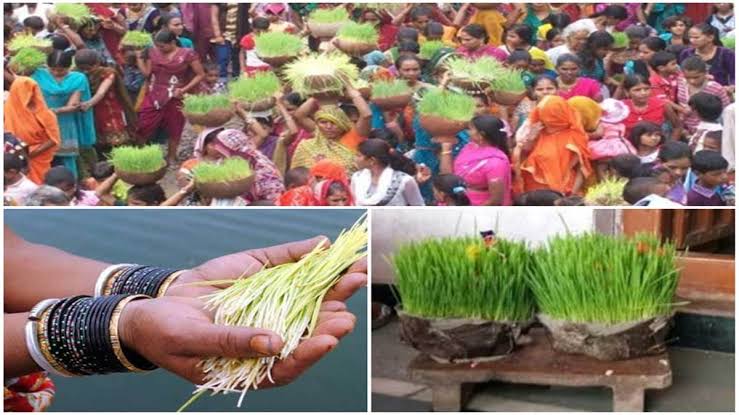
The Bhujaria
The very essence of this festival finds its embodiment in the centrality of ‘Bhujaria’ – the tender shoots of wheat that households raise about a week before the festival. These delicate symbols of faith have evolved to become the heart and soul of the festival. At the epicentre of the celebration are the women, a radiant assembly, each cradling earthen pots nurturing these wheat sprouts. This living artistry in motion forms the nucleus around which the procession takes form, meandering through the labyrinthine streets of the town.
The origin of the festival remains shrouded in mystery. But given the history of the place, it may be safe to surmise that Bhujalia, perhaps birthed as a monsoon’s farewell, to be celebrated in the concluding days of the rainy season. However, the rather recent transition that placed the festival on the day following Raksha Bandhan remains enigmatic. This alteration could have been spurred by the burgeoning influence of the non-tribal populace, interwoven with the adaptable nature of the indigenous tribals who accommodated these shifts without any reservation.
Tribal Traditions
But it decidedly was a tribal phenomenon to begin with, a ritual of thanksgiving and prayer to elements for a good monsoon and a good crop. Rooted in the pagan tradition of the tribal culture, the festival at its core, beckons for the blessings of elements, a fervent plea for a bountiful harvest. It thus seeks a symbiotic relationship with the gods who in their culture govern their fate and future.
As the years wove the fabric of time, the procession metamorphosed from its tribal cocoon into a kaleidoscopic synthesis of cultures, reflecting the town’s evolving identity. What commenced as a pure tribal ritual gradually welcomed diverse symbols and practices, mirroring the burgeoning tapestry of the community. The present-day manifestation embraces an elaborate spectacle – a grand procession that reverberates with tribal rhythms, echoes of folk music, and a captivating showcase of local heroes.
A Captivating Sight of Energy and Enthusiasm
The streets pulse with life as warriors, clothed in traditional attire, showcase their martial prowess to the resonating rhythm of drums. This vigorous display is often accompanied by a symphony of sound from public address systems, uniting the modern with the traditional. The resultant effect is confusing but eminently entertaining. Amid this spirited panorama, perennial heroes emerge—Alha and Udal, the legendary brothers whose valorous tales resonate through the procession. Another luminary takes the form of Prithvi Raj, the Rajput King, a poignant link to history. A local touch is lent by presenting the personification of Chandravali,who at a time of distress sought the blessings of a Sadhu, who in fact was Udal spending his banishment in disguise.
Winding through the town’s arteries, the procession beckons forth curious onlookers whose cheers infuse the air with anticipation. Its final act unfolds by a serene water body, called Bada Talab, where the tender wheat plants, the Bhujaria, are lovingly submerged, a prayer whispered to the gods for a plentiful harvest. Culminating in staged skirmishes among the warriors, this segment has caught the eye of local politicians who now offer prizes, adding another layer of allure to the festivities.
Universal Festivity
Yet, Bhujalia’s most astonishing aspect is its universality—a celebration unbound by class, religion, or social strata. Embracing all, it weaves a tapestry of unity, as members from various communities greet the procession, rejoicing in its vibrant passage. Even in Muslim-dominated areas, the streets resound with cheers as the procession passes by, marking a remarkable display of communal harmony. Over years, it has found place in the local custom when people offer Bhujaria as they greet each other this day. Youngsters place it at the feet of elders and seek their blessings.
“Bhujalia festival represents our country’s culture and heritage. Many tribal dances and acts of tribal culture are performed here. I have been participating in this festival for the last 50 years “ shares a prominent Bhujalia Committee member, encapsulating the festival’s significance. “The major highlight of this festival in Chhindwara is that people from every religion celebrate this festival. This is an example of communal harmony.” Says Vinayak Varma, the district police chief who manages this tumultuous crowd.
Symbol of A Syncretic and Composite Culture
The exuberance, infectious as it is, finds its roots in the liberal camaraderie and shared jubilation, perhaps spurred by the participants’ indulgence in alcohol. Yet, beneath the surface, the festival’s hallmark lies in the harmonious undercurrent that flows through the celebrations. It casts a radiant aura upon the festivities, an embodiment of the syncretic and composite culture of the land.
In the tapestry of life, where threads of tradition, unity, and evolution intertwine, Bhujalia festival stands as a vibrant stroke. It encapsulates the spirit of a community embracing diversity, sharing joy, and invoking blessings for the future. As the procession winds its way through time, it leaves behind footprints of celebration, unity, and an enduring legacy.
 scribo ad LX