Nature’s Raw Splendour
“Never say there is nothing beautiful in the world anymore. There is always something to make you wonder in the shape of a tree, the trembling of a leaf.”
— Albert Schweitzer
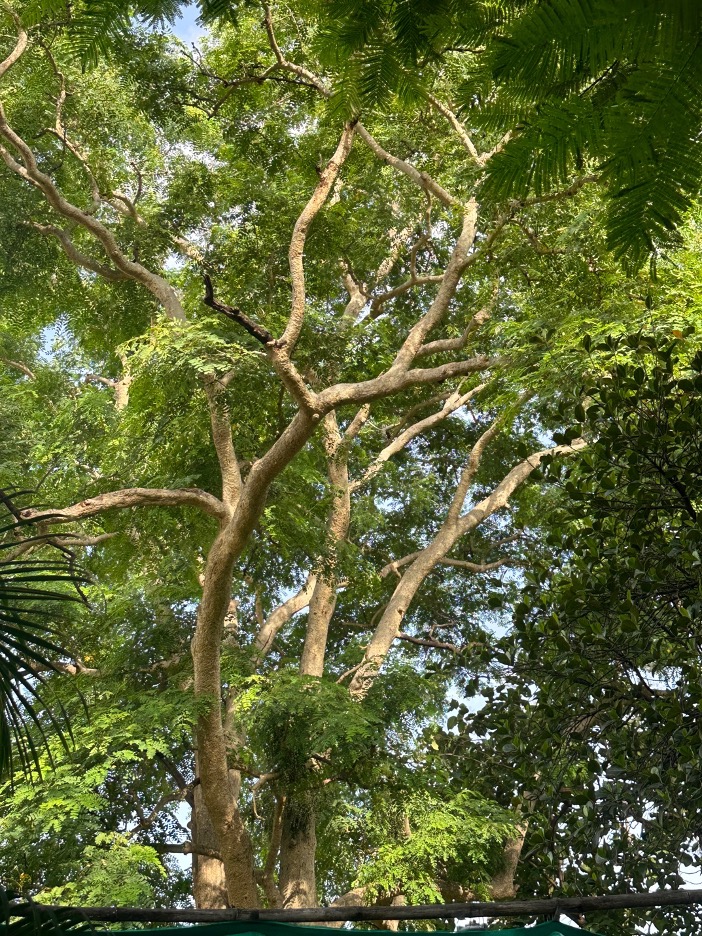
Photo courtesy: Shobha Varma
Simply described by botanists as the ‘tall Albizia’ and by far the tallest Albizia in Central India, the White Siris (Albizia procera), also known locally as Gurar, Kinhi and Chichi, commands an unmissable and exceptional majesty and is a tree of extraordinary grandeur.
In the company of stalwarts such as the sprawling Banyan, the luxuriant Pipal and the rich Mango, not to mention the dainty Gulmohar and the robust Rubber, this magnificent specimen of arboreal beauty and masculinity towers over everything around it. Over eighty feet tall, it is grander than the great, more regal than the royal and unsurpassed in its elegance.
A Thing of Beauty
The wise claim that both nothing and everything are perfect in nature. Trees contort in weird ways but never cease to be beautiful. The Siris is particularly beautiful – straight stance, towering height, and magnificent proportions – its leaves and tender branches kiss the lofty skies, weaving a poetry of uncommon opulence and cadence. Proudly overlooking the vegetation, it dwarfs, it engenders a mesmerising magic and an inspiring awe that whets a strangely disquieting curiosity in the beholder.
Love at First Sight
In its early summer incarnation, its leafless frame and light bark brilliantly reflect its grandeur. On a closer look, its smooth, greenish pallor reveals the indentations of its past coat, shyly displaying a comely pattern of horizontal lines, an embellishment radiating beauty and grace.
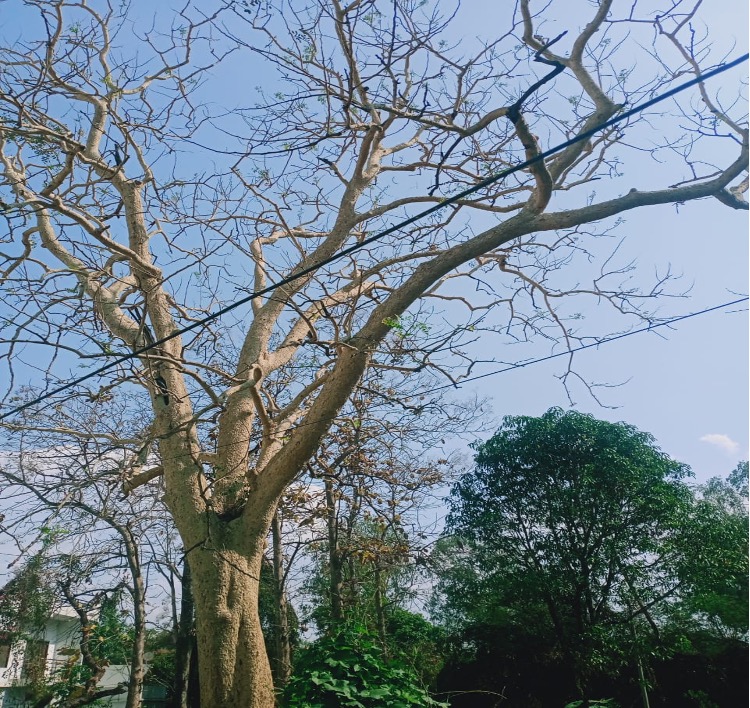
Photo Courtesy: Shobha Varma
When I first saw the Siris in late March, it had shed all its leaves and stood like a benevolent white giant, its claw-like branches spread like so many limbs. Its creamy bark glistened in the soft afternoon sun. Like a towering sage spreading his benign gaze all around, it seemed to assuage the casual onlooker of the safety of the place under its watch. Even the Banyan and the Pipal, sighing with wisdom, acknowledged its commanding presence. My eyes felt riveted to the magnificence of its fabled frame, an exceptionally regal and beautiful specimen of the wondrous craft of elements.
A Journey for Regeneration
The rains came and by early July, I saw the Siris slowly, almost imperceptibly, burgeoning. First, it covered itself with the tender tiny greenness of millions of leaves. Then, they shed their silvery appearance and become bigger – their hairy and softer form grew up to forty-five centimetres and divided into pairs of side-stalks. Finally, the leaflets, up to eleven pairs per side-stalk, grew and framed the contours of the branches, covering them with a rich, verdant luxuriance. A large, oval gland near the base of the common leafstalk completed the metamorphoses.
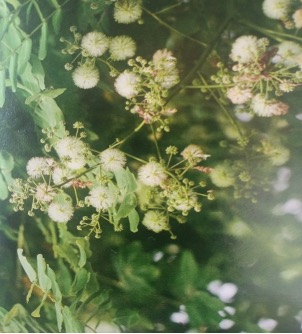
Silvery Flowers
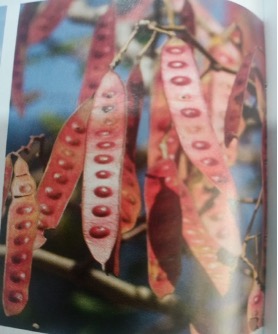
And Coppery Pods
By August, the Siris had started flowering. These were no ordinary flowers. The white cloud like flowers first appeared at the ends of branches and soon covered the whole tree, clothing it with a soft sheath of translucent white. Arranged in powder-puff heads, they appeared in large clusters of fifteen to twenty flowers. Each puff was made of many solitary flowers, extremely tiny. They lacked the usual stalk, petal, or sepals with only thread-like stamen about ten millimetres long.
In another month, the flowers will start giving way to fruits. Resembling a blister pack of medicinal pills, with six to twelve of them arranged in a long pod of ten to twenty centimetres in length, they will be pale brown when young and will get darker as they mature. By December, the tree will appear transformed into a bright and beaming coppery red, as the fruits overwhelm its aspect. The fruits begin will dropping March onwards, completing a cycle of generation, and making way for a new life.
The Healing Tree
One of the most enduring generosities of nature is to bestow upon almost all its creations a healing power, of which the Siris is a superior example. It is not only cultivated as a fast-growing agroforestry tree for fodder, fuel, and timber, but its bark, leaves, and flowers are a rich source of traditional medicine. The bark is rich in tannins and is pounded to make a fish poison. A decoction of the bark is used to treat rheumatism and stomach aches and is mixed with salt as a medicine given to buffaloes.
The Siris is one of those trees that nature has chosen to replenish its own exhausting nutrient stock. It has a symbiotic nexus with Azotobacter, the nitrogen fixing bacteria, and thereby, acquires a preferred niche in its mysterious scheme.
In certain regions, the Siris is used to manage fever and combat malaria. From healing wounds to combating anxiety and sleep disorder, from relieving gastro-intestinal discomfort to curing skin infections, the medicinal uses are multiple and diverse. While scientific evidence in favour of these miraculous properties may be inadequate, generations of multiple societies have benefited from their faith in the Siris for ages.
Life’s Lessons
I have stood under the Siris during all times of day and night. In early mornings, I have witnessed the celestial spectacle of the sun-dappled ground as it is slowly lit up by the gentle sunrays as they filter through the thick canopy and have felt filled with a rare bliss; I have seen the sun slowly advance in the sky and acquire that strong and sharp luminescence that suffuses the earth with energy and purpose; I have seen the grandeur and majesty of the tree reveal itself as it stands tall; and I have seen it in the mellowing light of the sun casting many hues on its frame, giving me a strange sadness. On a full moon night, as the tree seems caressed by a moist cool breeze, it sways its tender branches in a rhythm that only nature can produce.
Longingly have I witnessed this beautiful specimen of silent strength and splendour as I undergo tumultuous wave of emotions. I think of those who may have planted this tree many years ago. I recall what Canadian farmer Nelson Henderson had said, over half a century ago: “the true meaning of life is to plant trees, under whose shade you do not expect to sit.”
The thought gives me energy and purpose and fills me with joy and bliss. It is not mere inspiration that has spontaneously swelled within me, but a whole philosophy, a silent message, also reveals itself: “learn character from trees, values from roots, and change from leaves.”
********
 scribo ad LX