“Trees are poems that the earth writes upon the sky.”
— Kahlil Gibran

What can one write about a tree as common as the Indian Rubber Tree? That it is an ornamental tree and rated high for its richness of foliage and luxuriance is common knowledge. It is beautiful and big, but it is banyan that we remember more when we think of a big tree. It is from the same family as Peepal but it is nowhere deemed as religious as Peepal. It is home to a variety of birds but when one imagines a tree teeming with birds, it’s the Pakar that comes to one’s mind. Once upon a time, it may have been a source of rubber (of a much inferior variety) till man discovered rubber tree (Hevea brasiliensis) in the early 20th century. The name ‘rubber’ stuck to it but the virtue did not.
But as Antoine de Saint-Exupéry, the famous French writer, would make us believe, a tree is more than first a seed, then a stem, then a living trunk, and then dead timber. It is a slow, enduring force straining to win the sky. One could not agree more. To me, they never fail to fill me with wonder and spark my imagination. Our cultural compass has revolved around trees. History bears testimony to this truth. Writers, philosophers and even the odd politician have found inspiration in the branches and leaves of trees around them.
So, I find the Rubber Tree good for my soul. It is essential to the air I breathe. And it provides a majestic example of strength and perseverance in the face of adversity.
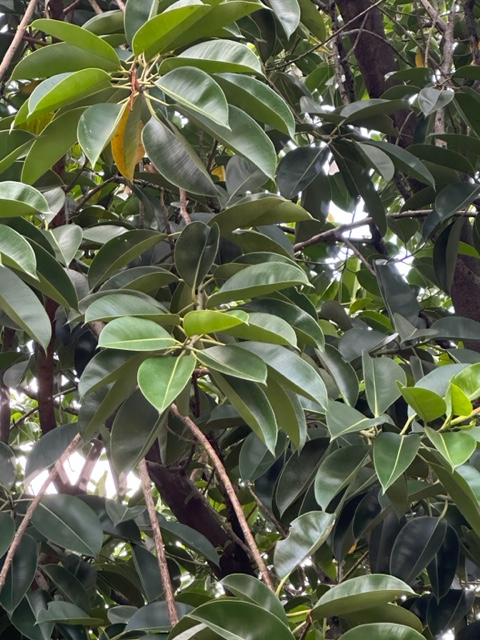
Its stately frame, strong and erect, sending robust branches in all directions; its leaves, broad and beautiful, glistening in soft sunlight; its many roots, those spreading on the ground like many lazily slithering pythons in all directions, some others brown and young, some darker and old, hanging from the branches above and straining to reach the ground to find a firm niche ;and which one day will eventually grow into another of its many trunks supporting a sprawling superstructure, at once big, beautiful and majestic.

On a clear morning the sun-dappled shade and on a rainy day the mesmerising music of rain drops slipping through its sensuous frame offer a sight that can bring joy and brightness to even the saddest heart. And on a silent afternoon when its big brown leaves fall on the ground twirling and dancing on the way, I am reminded of what Shira Tamir had observed “Anyone who thinks fallen leaves are dead has never watched them dancing on a windy day.”
This rare reward of a sumptuous feast to the eyes and a manna to the soul, is a pleasure, privilege, and delight of the most sublime order.
And as I quietly observe the life’s drama of unmatched intensity and untold variety being played incessantly on and around this tree, I find uncommon sustenance and strength. I watch the squirrels dance up and down its massive trunks, I find the Golden Oriole and Tree Pies roosting in its thick foliage, I hear the lonely Brain fever Bird weave the magical stains of his lusty call that occasionally gets a matching reply from the melodious Koel perched on the neighbouring mango tree. And the noisy babble of babblers that overpower every other music in the evening and mornings. I hear the sweet and sonorous and somewhat subdued songs of Bulbuls; and at times the screeching sharp and vibrant rush of parrots who rest for a while in the depths of its verdant canopy that hides them so well, only to depart noisily soon after.

I think it was Albert Schweitzer who said “Never say there is nothing beautiful in the world anymore. There is always something to make you wonder in the shape of a tree, the trembling of a leaf.” I cannot imagine a sight that evokes this sentiment so poignantly, so clearly, so vividly.
The Plant or Tree
India rubber plant, (Ficus elastica), also called India rubber tree, is a large tree of the family Moraceae, once an important source of an inferior natural rubber. It was largely replaced as a source of rubber by the unrelated rubber tree (Hevea brasiliensis) in the early 20th century. The India rubber plant is native to Southeast Asia and is commonly grown as an indoor pot plant elsewhere. The young plants, very popular as a household possession are durable and grow well under less-than-ideal indoor conditions.

The full-grown tree presents a canopy of exceptionally green and thick canopy created by its large, thick, oblong leaves up to 30 cm (12 inches) long and fig like fruits in pairs along the branches.
An Ornamental Plant
Ficus elastica is grown around the world as an ornamental plant, outside in frost-free climates (though it also tolerates light frosts) from the tropical to the Mediterranean and inside in colder climates as a houseplant, even in a place as far as Hawaii even though the species of fig wasp required to allow it to spread naturally is not present there.
Presently, most cultivated plants are produced by vegetative propagation. This can be done by cuttings or by layering. In cultivation, it prefers bright sunlight but not hot temperatures. It has a high tolerance for drought, but prefers humidity and thrives in wet, tropical conditions. Many ornamental hybrids (such as Robusta and Decora) have been derived from Ficus elastica with broader, stiffer, and more upright leaves than the wild form. Many such hybrids exist, often with variegated leaves with marbled grey, cream, and white leaves or with green leaves having white or yellow margins.
What does the Science say?
For centuries, this tree served the local communities as a source of latex that has its own uses in ancient times. It produces a white, milky latex that is a source of natural rubber. All parts of the plant contain an abundant milky white latex, which has been tested for use in the manufacture of rubber, but without economic and technical results; commercial rubber is in fact produced from the sap of Hevea brasiliensis.
Of late, this latex was analysed for its phytochemicals as an intermediate energy source. The tree produces a high quantity of protein and oil (24.5 and 6.1% respectively). The polyphenol content was found to be 4.2%, and hydrocarbon content 2%. The gross calorific value of the plant sample was much higher than that of methanol, but comparable to anthracite coal. These are interesting findings and have created a renewed interest in the latex produced by it.
This species also contains high levels of ortho-dihydroxy phenols which may be related to disease resistance to some pathogens. It also possesses compounds with antimicrobial activity and a range of pharmacological activities. Ficus elastica has several chemical constituents, other than rubber, which have potential uses and warrant further study.
Yet, this tree even without its scientific value evokes the love and admiration of all those who have ever come in its contact.
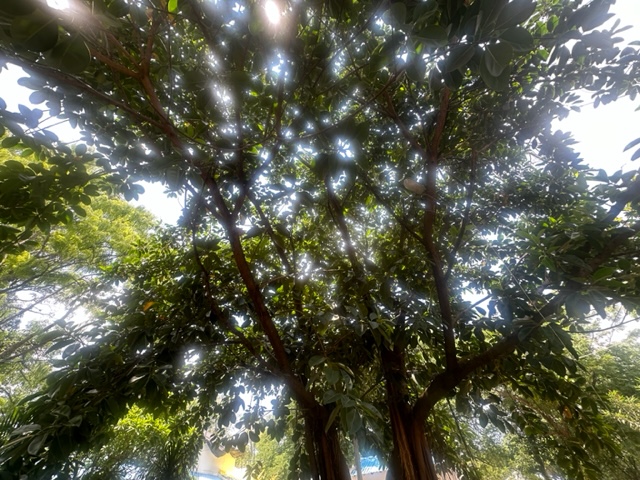

Trees – The Soul and Culture of A Place
For those of us, who find no excitement in life, for whatever reason, should look at a tree, any tree. Green or colourful, luxuriant, or sparse, fleshy, or woody, even one which has shed all its leaves. And one will find, soon, a purpose and a message and an energy that resuscitates a moribund life.
Nature has offered so much to us if only we could use our faculties to notice these great gifts. Riveted to my perch from where I regale myself with such incredible beauty and celestial serenity, culture of this environment courses through me, a culture that speaks aloud through its trees and vegetation.
W.H.Auden, one of the most influential British-American poet, found the soul of a place reflected in its trees,
“The trees encountered on a country stroll
Reveal a lot about that country’s soul…
A culture is no better than its woods.”
Sitting quietly, blissfully, and looking at this wonder crafted in element, my heart is filled with gratitude and pride, for the nature, for the trees, for the place and for my culture.
Alone, by myself!
The Tree bends to caress me
It hugs my soul!
 scribo ad LX