Mahua may be commonly associated with an indigenous liquor, uniquely fragrant and pleasantly intoxicating but its uses are far too many, and its place in many tribal societies of India irreplaceable. Among its many roles, the one where it becomes their saviour in times of extreme scarcity and hunger is perhaps the most extra-ordinary. It is a saviour of the poor in severly punishing times. It is mahua that saved thousands from starvation during droughts, famines and epidemics that assailed, scorched and grievously roiled the land under colonial rule.

The Green Gold in a Preserving Palm
The Saviour
In an essay titled ‘Famine in Bengal: A Comparison of the 1770 Famine in Bengal and the 1897 Famine in Chotanagpur’, historian Vinita Damodaran has this to say about mahua: “Not only were the fruits made use of as articles of food, but the fleshy corolla constituted a staple article of diet for the poor for several months of the year.” Scottish botanist Sir Charles Watt, in ‘A Dictionary of the Economic Products of India’, quotes a former Collector of Monghyr (now Munger in Bihar state) to say, “During a period of scarcity which prevailed in Bihar in the year 1873-74, the Mahwa crop, which was usually abundant, kept thousands of poor people from starving; and all famine officers will recall its peculiar odour as they passed through the villages where it had been collected.”
“Santhal’s manna in the wilderness, that fell like bread from heavens” is how author James Merry MacPhail described Mahua in his 1922 book ‘ The Story of the Santals’. In one chapter of the book,’The Cycle of Seasons’, he refers to the pale green carpet formed on the forest floor by fallen mahua flowers that signalled the beginning of the festive mahua season when the entire population devoted itself to the serious business of gathering the precious flowers: “Eat a little mahua, they said, and you will not feel hungry for a long time.” Mahua for tribals was as existential as the wheat or rice for the other world.
An old folk song from Chhattisgarh, documented by British-born Indian anthropologist and tribal activist Verrier Elwin in 1946, goes:
Hai there is nothing one can say
The Dhobi left his work of washing clothes
The Rawat forgot his Doha songs
The boys threw stones at every house
We cooked gruel of sawa, even the kutki was finished
I fall at thy feet, O Mahua, it was you who saved our lives…
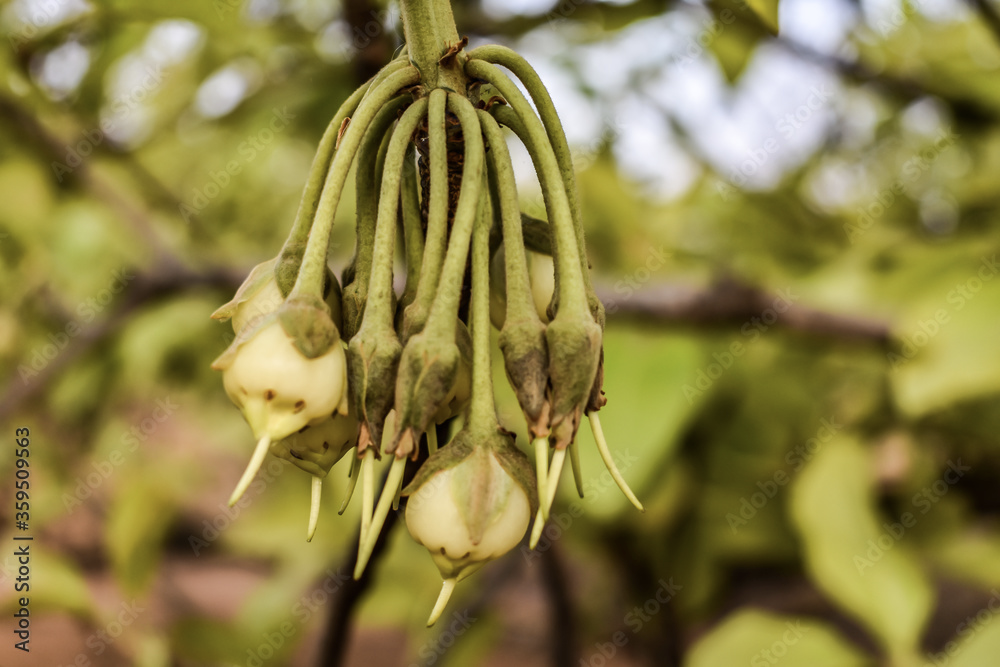
Mahua Flower-Waiting to drop on ground
The Curse of Colonisation
In course of less than a century, a free and fine gift of the nature that the tribals took for granted and which provided them with both nutrition and sustenance soon became a regulated commodity under British subjugation. The colonial exploitation of native resources to create a market for British products was ruthlessly and blatantly imposed on a law- fearing and peace – lovings population.
The problem came to a head when the colonists classified mahua as a dangerous intoxicant and criminalised its collection or possession by indigenous communities through prohibitive laws like the Mhowa Act of 1892. Watt writes, “With a view to regulating the trade in mahua spirit the Bombay Government have passed certain legislative measure which have had the effect of having a State monopoly of the purchase of the flowers.” The driving agenda of the colonialists was to curb the local liquor industry and secure the Indian market for imported liquor. But a downstream effect of their laws was a rise in diseases, especially cholera, among rural and forest populations.
By the end of the 19th century, the foods that forest communities depended on depleted considerably. The mahua tree, once protected by indigenous communities that considered themselves its custodians was scourged by colonial capitalism. “Once, they could have lived comfortably on a diet of mahua flowers and roasted sal seeds supplemented with small fish and water chestnuts,” writes Damodaran. “Many of the mahua trees were now in the private hands of the landlord or reserved forests. The central and eastern plateau, where once the best sal forests had been found, were denuded and only small scrub jungle remained.”
The Forest Act of 1865, enlarged in 1878, gave the government the power to control and regulate the extraction of forest produce. Under these laws, the colonial government granted timber and mahua contracts to contractors, who were given the exclusive right to extract mahua and other forest produce from designated areas. This led to the displacement of tribal communities who had traditionally depended on these resources for their livelihood. The contractors often exploited the tribal communities, paying them very low wages for their labor and charging exorbitant prices for the mahua they sold.
The impact of these laws was devastating for tribal communities, who were left without a source of income or livelihood. Many were forced to migrate to cities or work in exploitative conditions on plantations or as laborers. The loss of traditional livelihoods and the destruction of forests also had long-term environmental consequences, disrupting the delicate balance of ecosystems.
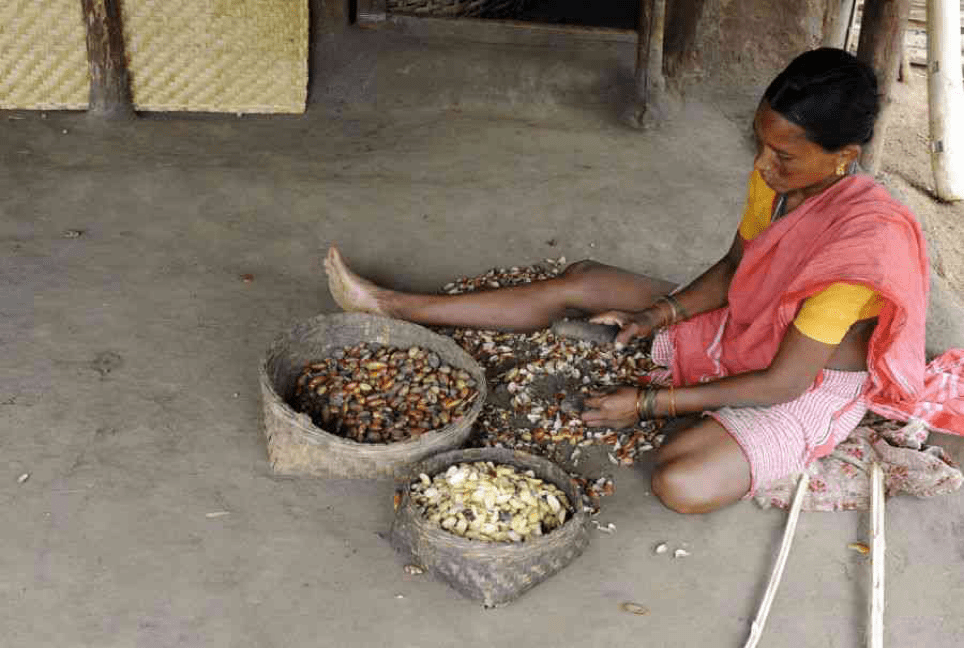
Contended Creativity
The Redemption
After India gained independence in 1947, the government implemented a series of reforms aimed at addressing the injustices of colonial-era policies. The Forest Conservation Act of 1980 was enacted to protect forests and regulate their use, and the Forest Rights Act of 2006 was passed to recognize the rights of forest-dwelling communities and empower them to manage and protect their traditional lands.
The current policy with regards to the collection and sale of Mahua flowers and fruits by tribals in India is governed by the Forest Rights Act of 2006. Under this Act, forest-dwelling communities have the right to collect and sell non-timber forest produce (NTFP), including Mahua, from the forests they have been traditionally using. This is subject to the condition that the collection and sale should be done in a sustainable manner and should not damage the forest ecosystem.
The government also provides support to the tribal communities for the collection and sale of Mahua. This support includes setting up collection centers, providing training on sustainable collection practices, and facilitating the sale of Mahua at a fair price. The government agencies like the Tribal Cooperative Marketing Development Federation of India (TRIFED) and State Forest Development Corporations also purchase Mahua from the tribals and provide them with a support price.
Apart from government agencies, there are also private buyers who purchase Mahua from the tribal communities. These buyers include traders, processing units, and other entities involved in the manufacture of Mahua-based products.
Employment and Economis
Nearly three-fourth of entire tribal households or approximately 7.5 million individuals in the country are involved in collection of mahua flower. The collection and trade of mahua flowers provides full time employment to thousands of persons every year.
According to a paper published by the Centre for People’s Forestry, the estimated national production of mahua is 0.85 million tonnes, whereas the total production potential is 4.9 million tonnes. Average trade value of mahua flowers in the state of Madhya Pradesh alone is around 5,730 metric tonnes, while it is 2100 metric tonnes in Odisha, and about 13,706 quintals in Andhra Pradesh, translating to millions of rupees.Tribals generally barter mahua for daily grocery items. If this value which is considerably higher than the actual value of mahua traded, is taken into reckoning, its economic value far exceeds what is captured in statistics.
Export of Mahua is still nominal. Its volume was 101.03M metric ton in 2021 estimated at USD 96.25 million.
Flower Collection
Mahua Collection
Flowering of Mahua occurs over four to six weeks(March to May). However, the collection of flowers takes place only for 15-20 days. Average annual yield of a mahua tree is about 50 kg per tree. An average person can collect about upto 70 kilograms of dry flowers in a good flowering season. That means that the natural yield of Mahua is often not harnessed fully.
Mahua collection season is no less than a festivity. The area itself wears a celebratory look with mahua trees laden with the heady aroma of the green white soft flowers. The fragrance of the flowers is everywhere and the entire population seems to have come out to pick flowers. For the adivasi community, the mahua harvesting time is one of reunion with family members who may have left the villages in search of livelihood elsewhere. “There is a grand homecoming in the Mahua season,”
Long Way to Go
It took close to three score years even after independence for legitimacy to come to tribals on an asset that had belonged to them since eternity. The colonial insensitivity and the overriding commercial interest of the Britishers reduced the masters and owners of a property to that of a supplicants and licensee.
Today, while this natural and long-denied legitimacy has been restored, many challenges remain. The mechanism for ensuring a fair price is still far from adequate and perfect. And while the market price is generally higher than than the MSP, tribals still have to face several hurdles before they are able to get a fair return on their labour and efforts.
There is now, however, a definite effort to promote sustainable harvesting and processing practices to ensure that its extraction does not harm the environment or the communities that depend on it. Better collection techniques, better preservation, better technology to extract the oil and other derivatives, are getting attention, priority and state support. And though tribals do not need education on how to take care of their sylvan heritage, they certainly would gain from the modern methods of prolonging the life and productivity of Mahua trees.
As it happily happens, the tribals continue to adore and respect Mahua with an unmitigated abandon. The children continue to sing in the Bijapur District of Chhattisgarh, as they do in thousands of other villages.
Oh mahua tree,
Oh mahua tree
How beautiful you are,
Oh! mahua tree
The mahua flowers are falling
Red, red flowers
Like a red shower of rain
Oh mahua tree,
Oh mahua tree
How beautiful you are,
Oh! mahua tree.
(To Be Continued….)
 scribo ad LX