“The blood-red gleam of nonpareil
Amidst thy glare is hid so well
That none can know ‘tis bowered there
With scarlet flash of tanager;—
Nor,—faraway, in heat of day——
A crimson stain against the green—“
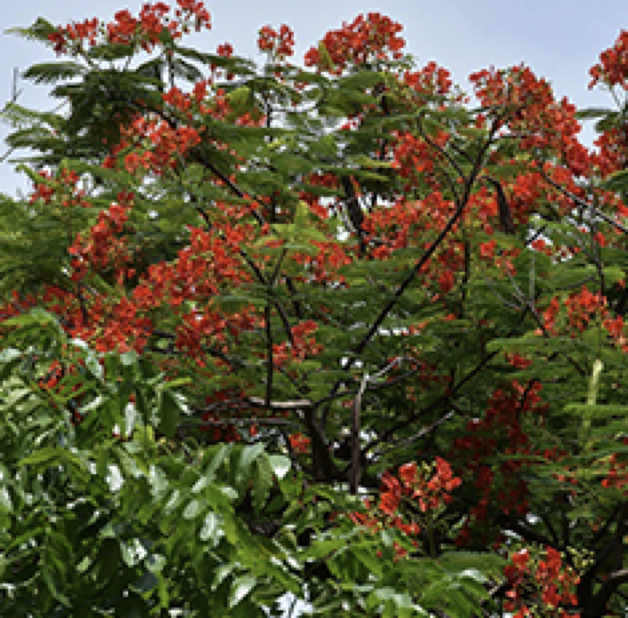
Arguably one of the most beautiful and attractive arboreal inflorescences in the world; and decidedly so in tropical countries, few flowers can match Gulmohar in their colour, brightness, richness and flamboyance. When in full bloom it appears as a crown of a thousand burning torches of leaping and dancing orange-red flames. Many mistakenly call it ‘Flame of Forest’, an epithet actually coined for Palash- Butea frondosa, though it more than justifies this comparison. When fully covered with bright flowers, it presents a sight truly ethereal, almost surreal.
Whether its account of its beauty, vibrant colours, and the contrast it presents with the surrounding, few trees can claim to have such universal appeal and adoration as Gulmohar. It is the official tree of many cities and its association with students and schools in Thailand earned a nickname of ‘Pupil’s Tree’. It is associated with beauty and valour, courage and charisma, and shall surely provide a stiff competition to any claimant for the most popular trees in the world.
Delonix regia – Royal Indeed
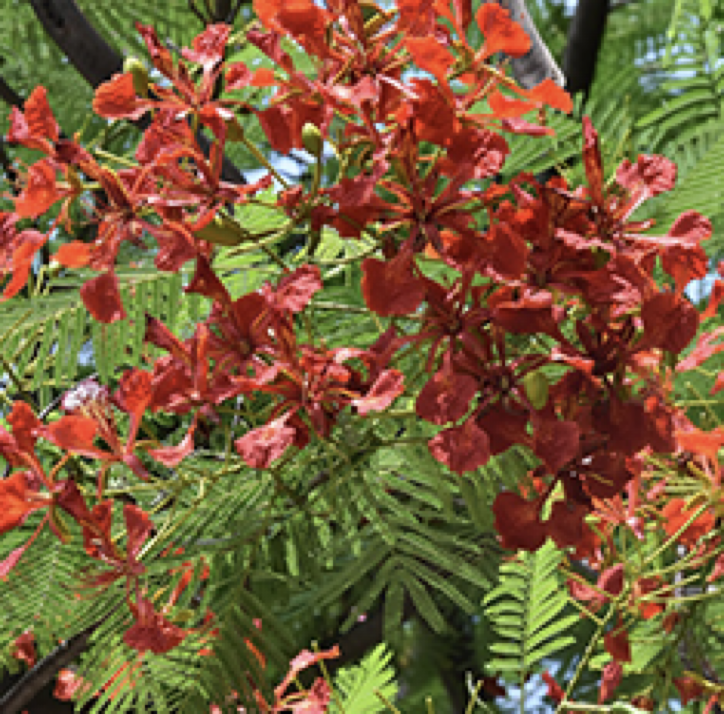
The Gulmohar tree, (botanical name Delonix regia) also known as the Flame Tree, Royal Poinciana, Flamboyant, Phoenix Flower, even Flame of Forest (though erroneously), is a tropical tree native to Madagascar. Discovered in the early 19th century by botanist Wensel Bojer, Gulmohar is a flamboyant tree in flower – some say the world’s most colourful tree. For several weeks in spring and summer it is covered with exuberant clusters of flame-red flowers, 4-5 inches across. They are striking: have four spoon shaped spreading scarlet or orange-red petals about 3 inches long, and one upright slightly larger petal (the standard) which is marked with yellow and white. The delicate, fern-like leaves are composed of small individual leaflets, which fold up at the onset of dusk. Gulmohar gets 30-40 ft tall, but its elegant wide-spreading umbrella-like canopy can be wider than its height.
The Indian Gulmohar
Gumohar is naturalised in India and is widely cultivated as a street tree. The tree can grow up to 12-15 meters in height, with a broad, spreading crown and a trunk diameter of up to 1 meter. The bark is light brown, moderately smooth and is creased where branches fork.
The large, bright red, orange or yellow flowers in turn give way too long, slender seed pods that contain small, black seeds. These pods remain suspended from the tree for a long time. The tree is also valued for its hard, durable wood, which is used for construction, furniture, and boat-building.
Culturally, the tree is often associated with the summer season, and its vibrant flowers are a common sight in many cities and towns. Deemed an important part of Indian culture and mythology, it is often featured in literature and art. In some parts of India, the Gulmohar tree is known as the “Mayflower” or the “Flame of the Forest”, and when in full splendour is second to none in beauty, radiance and dazzle.
And Elsewhere!
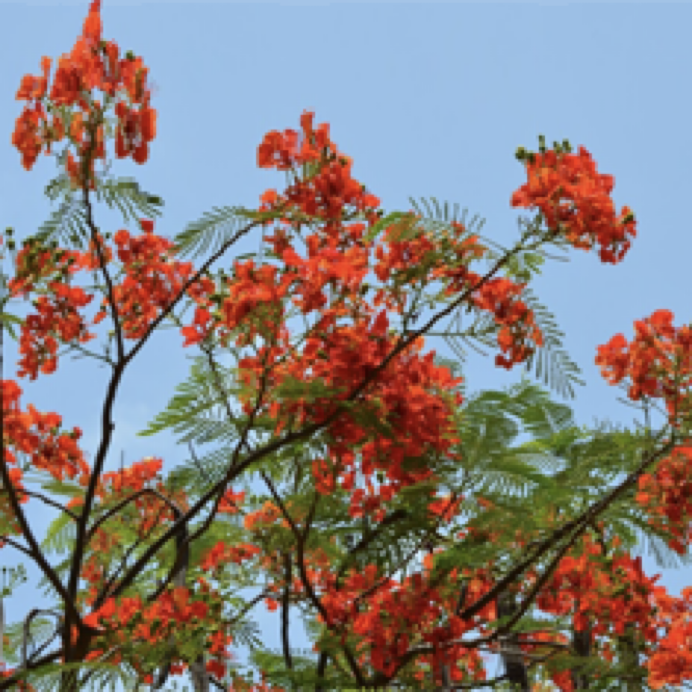
Across countries, the Gulmohar tree is valued for several reasons. Its vibrant flowers and attractive foliage makes it an ideal and favoured ornamental tree, while it’s hard, durable wood is highly valued for its commercial uses. In the Caribbean, the tree is known as the “Flamboyant” and is a popular ornamental tree. In Brazil, the tree is often planted as a shade tree and is valued for its attractive foliage and flowers.
It stands as a stately symbol of beauty, elemental energy, strength, and vitality.
Cultural Connection
The state of Kerala in India boasts of the most dazzling and enchanting display of Gulmohar flowers. Here, it is called kaalvarippoo which means “the flower of Calvary”. There is a popular belief among Saint Thomas Christians of Kerala that when Jesus was crucified, there was a small royal poinciana tree nearby his Cross. It is believed that the blood of Jesus Christ was shed over the flowers of the tree and this is how the flowers of royal poinciana got a sharp red colour. It is also known as Vaaga in many areas of Kerala.
Its blossom is the national flower of St. Kitts and Nevis, and in May 2018 the royal poinciana was adopted by the city of Key West as its official tree. Known locally as semarak api, Delonix regia is the city flower of Sepang, Selangor, Malaysia too.
Vietnam celebrates this tree in may ways. Its flowers often referred to as ‘Pupil’s Tree’ because of their abundance in school premises and their fascination among the students. Sadly a time came when many of these tree were cut or pruned down because it fell and killed one student. However, it remains a popular urban tree and is called Phượng vỹ, or “phoenix’s tail”. One of the cities in this country Hải Phòng is nicknamed Thành phố hoa phượng đỏ (“City of red poinciana”).
And elsewhere too, particularly in tropical countries it is ingrained in common culture and beliefs. In Philippines, its flowering is a harbinger of rainy season, the coming of flowers an occasion for much joy and jubilation.
‘Poinciana’ Song
Gulmohar has stirred the passions, and fired the imagination of many a poet and musician. The famous song “Poinciana” was inspired by the flaming inflorescence of this tree in Cuba. Sung by legendary Nathaniel Adams Coles (March 17, 1919 – February 15, 1965), known professionally as Nat King Cole, the song became a sensation. Nat Col first came to prominence as a leading jazz pianist. He owes most of his popular musical fame to his soft baritone voice, which he used to perform in big band and jazz genres. The song is a passionate expression of love so endearingly crafted through the images of this beautiful tree and its flamboyant flowers and the strains of which one can feel waft through as one stands close to it.
Blow…tropic wind…
Sing a song…through the trees.
Trees…sigh to me…
Soon my love…I will see.
Poinciana,
Your branches speak to me of love.
Pale moon is casting shadows from above.
Poinciana,
Somehow I feel the jungle beat
Within me, there grows a rhythmic, savage
beat.
Love is everywhere, its magic perfume fills the air.
To and fro, you sway, my hearts in time, Ive learned to care.
Poinciana,
Though skies may turn from blue to gray,
My love will live for ever and a day.
Blow….tropic wind,
Sing a song through the trees.
Trees…sigh to me
Soon my love… I will see.
Poinciana…
The Scarlet Bloom of Deepest Dye
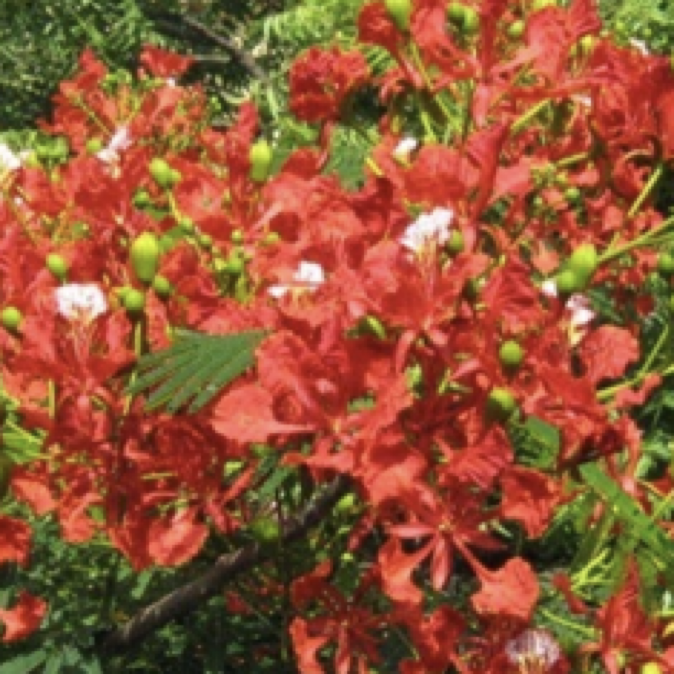
As I stand below this tree early in the day, soaking its bright colour and infectious energy, I remember American poet George E. Merrick’s beautiful lines from his poem,’ The Royal Poinciana in Bloom’. Written in 1920 in Florida, the poems evokes the image and the sentiment of this beloved tree so vividly, so universally.
Scarlet bloom of deepest dye,
That with the summer sunset vie
In flashful boast, thy thick-massed flame:—
Lo! Thou hast put its wealth to shame:
For all out-done, the tropic sun
Recalls his tint-skilled fays of fire,—
Glowing rich in envy as they fly.
From very flame one can’st thee tell.
Above thy growth of tender green,—
That in thy pride can’st not be seen—
The throbbing pulse of flames’ desire
Seems urging tongues of crimson higher;
—As spray-wove gleams o’er molten streams;—
Or combing surges breaking low
Upon a sea of fire.
 scribo ad LX