Introduction
A swathe of sylvan magnificence, the heavily wooded official residence of the Superintendent of Police (SP), Chhindwara, is lent unique majesty by the sheer number and variety of trees that embellish the property. A simple walk in its groves is an indulgence in the lap of nature, making one oblivious to the dust and din that doom urban lives.
The range of trees adorning and beautifying this house is impressive and exhaustive, the diversity of the flora simultaneously amazing and captivating, including hugely sprawling overhangs, heavily canopied arbors and sparsely endowed shrubs. There are tall and stately palms, clumps of ramrod-straight bamboos, and giants like Banyan, Pipal, Pakar and Rubber. There are fruit trees and timber trees and trees to add colour, gaiety and vibrance. It is paradise for those who delight in the nature’s warmth and find its redolence intoxicating.
Spoilt for Choice
Let me begin my exploration of my fascinating neighbourhood inhabitants by describing one that pleases our senses and refreshes our soul with its beauty, fragrance, grace and resplendence.
While the flaming Gulmohar in the vicinity offers an incarnation of fire, a gigantic flame of red and orange in full bloom, there is another that contrastingly offers the calm and cool of the element of water. It captures nature’s delicate beauty and pristine fragrance like a glowing young maiden radiating dignity and grace – the incomparable Frangipani.
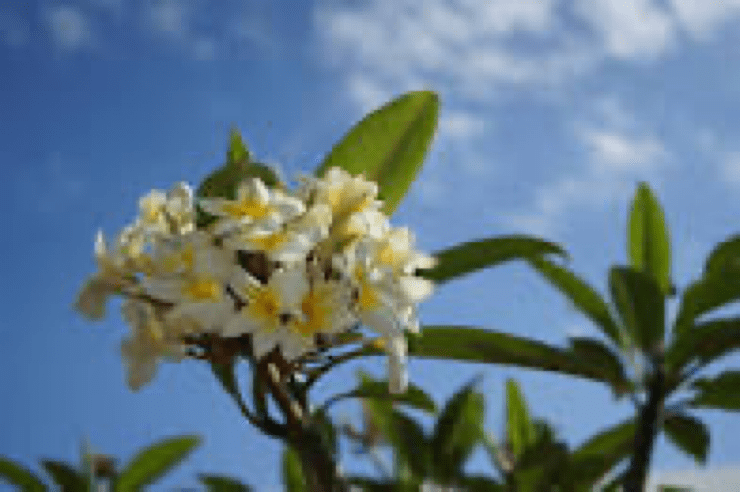
The Frangipani
The Frangipani, also known as Plumeria, is a tropical plant belonging to the Apocynaceae family. Known in India as the Gulchin and Champa, it was likely native to Central America or the Caribbean, but it has been grown for centuries here. The Portuguese brought it to Europe in the 16th century, where it remains one of the most popular plants grown in homes.
It is a small tree, not growing usually taller than 20 feet with a15 feet spread. Some classify it as a shrub. It has a thick, succulent stem, and its leaves are large, glossy, and dark green.
The tree produces fragrant flowers of various colours – white, yellow, pink and red. The fragrance is sweet with some notes of spice. While it is a deciduous plant shedding leaves during dry weather, it flowers throughout the year.
Laden with clusters of small flowers in full bloom, the Frangipani is a luxuriant sight. Flowers cluster in threes and fives at the ends of branches, with each flower having five petals. The flowers have an oily scent that most people find pleasant, though some deem it overpowering.
The Frangipani also produces fruit, similar in appearance to a banana. The outer part of its fruit is yellow, while the inner part is red. It can be eaten fresh or dried for later use. Interestingly, Frangipani flowers can be safely eaten and are indeed used as an ingredient in several different dishes.
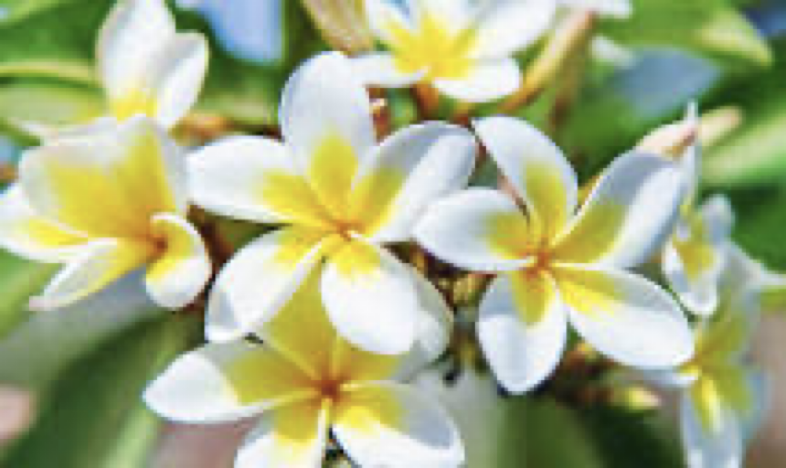
Flower of Parts
Frangipani have been used since ancient times to make perfumes and incense as well as for decoration. They have also been used as medicine by traditional healers as they contain compounds called coumarins with anti-inflammatory properties, and are said to relieve tinnitus, inflammation, headaches, and back discomfort.
Frangipani oil is believed to soothes nerves and muscles, and have astringent, purifying and aphrodisiac properties. The Frangipani essential oil also makes an effective ingredient in aromatherapy.
Frangipani is much adored by women where it grows locally as the flowers makes a natural and graceful ornament that embellishes their beauty; it also has cosmetic properties, rejuvenating skin and its rich and invigorating oil is claimed to make them ‘look younger from the inside’.
However, there is a mild toxicity associated with this charming flower. The milky sap of the Frangipani is a skin irritant and can cause causing blisters and rashes; ingestion of the bark or sap can result in vomiting and diarrhoea. But harnessed properly, the sap can also be used to make rubber, glue and a variety of medicines.

And the Cultural Connection
Culturally, the Frangipani tree has a significant connection to many countries and cultures. It is often associated with Hawaii, where it is the state flower and represents love, devotion, and new beginnings. In Indian culture, the Frangipani tree is associated with Lord Vishnu and is often used in religious ceremonies. It is also associated with Goddess Saraswati because of its predominantly white colour and fragrant inflorescence. In many other cultures, the Frangipani tree is a symbol of beauty, grace, and immortality.
Conclusion
The SP bungalow in Chhindwara boasts of ornate Palms and Arucarias that majestically beautify the whole campus; some of the best timber trees in the world are here; offering delicious fruits in turn are the mango, jamun, guava and mulberries while the amla, eucalyptus and neem purify the environment and nourish ones health. The gulmohars, jacarandas, kachnars and amaltas cover themselves in a riot of vibrant bright colours and suffuse the ambience with joy, vigour and vivacity. It is nature’s majesty, resplendence and pulchritude at its best.
But despite this stiff competition, the beautiful frangipani with its rich cultural and religious connotations, exquisite flowers and heady fragrance make a beloved plant that represents both divinity and romance at the same time.
These lines by poet Edward Ibeh eloquently sum up the calming charm that it casts:
“Wondrous frangipani…
You mesmerise me so.
Like a fan, I twirl you
Between my fingertips;
Striking yellow-white hue!
Wondrous frangipani…
You’re the most eye-catching
Of all the spring flowers;
A captivating sight
After April showers.
Wondrous frangipani…
Beautiful as a tree;
Lovely in women’s hair.
Stirred by a gentle breeze,
Your scent wafts in the air.
Wondrous frangipani…
Catnip to bumblebees;
Hordes of butterflies, too.
Show-stealer in gardens;
Gift to a day brand new!”
 scribo ad LX