The residence of the Superintendent of Police, Chhindwara is a sprawling house spread over nearly seven acres. Heavily wooded, this colonial construction has been the official residence of the SP for nearly a century. Constructed some time in the early 1900s, it has seen expansions and embellishments by successive SPs, but the essential character of this beautiful bungalow encircled by open verandas remains intact and fully preserved.
The Avian Neighbourhood
Among the assets that enrich this ensorcelling abode is the rich diversity of avian visitors that frequent, inhabit and enliven the sylvan surroundings. The sonorous music of their chirping and calls resonate in the air and provide soothing relief from the increasing cacophony of an urbanised neighbourhood.
Among the host of such birds, some draw your attention instantaneously; a few due to their peculiar calls and others because of their arresting appearance, and some on account of both. The three that I propose to deal with at some length are the Tree-Pies, the Orioles and the Flycatchers.
I am tempted though, to begin the description of my rendezvous with these friends by first talking about the Bharadwaj Bird, the harbinger of good luck and pleasant tidings. But it will be fair to reserve its description for a full article, a treatment it richly deserves.
The Paradise Flycatcher
I must begin the interesting encounters with these magnificent avian friends by first describing what I believe is the best display of purity and innocence, beautifully feathered in white, like a gentleman with unmatched sartorial elegance. Embellished and bedecked with blue eye rings, the finest white tuxedo, and fancy trailing ribbons, the adult male of this species is a real showstopper.
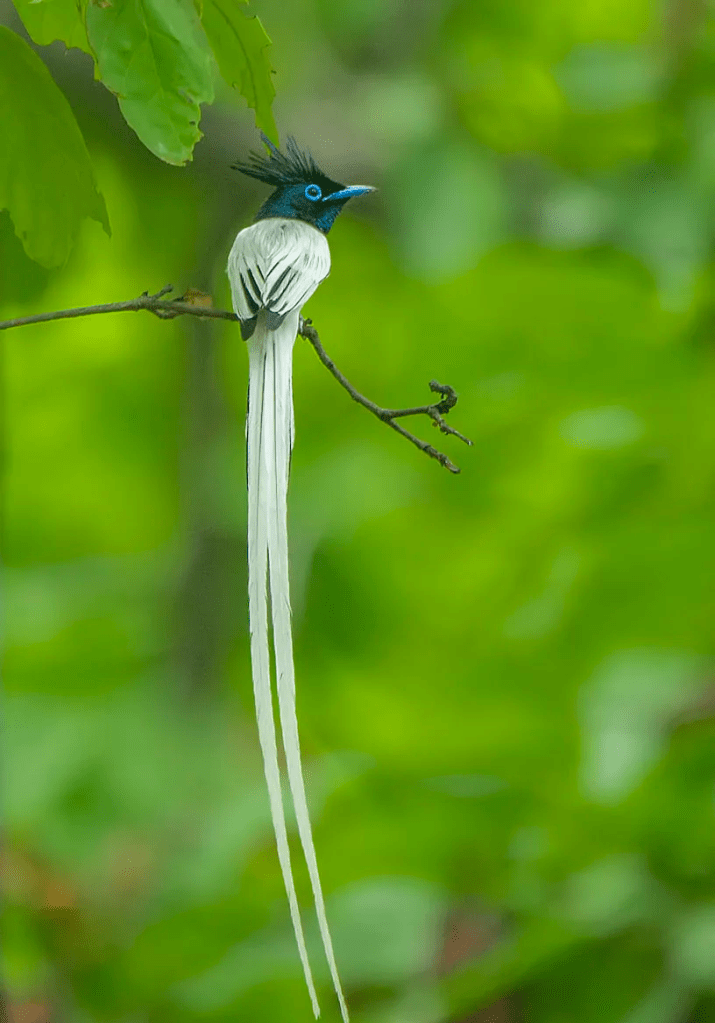
Also known as the Doodhraj or the Shah Bulbul, the Paradise Flycatcher is a small to medium-sized bird that belongs to the Monarchidae family. It is known for its distinctive long tail feathers that trail behind it in flight. There are several species of Paradise Flycatchers found in different parts of the world, but they all share some common characteristics.
The male Paradise Flycatcher has a striking appearance, with a bright blue or black head, a white or buff-coloured body and a long, flowing tail that can be over twice the length of its body. The tail feathers are thin and delicate and are used by the male during courtship displays to attract females. The female is less showy, with a duller brown or grey plumage and a shorter tail.
Paradise Flycatchers feed on insects, which they catch on the wing. They are also known for their graceful and acrobatic flight, as they dart and swoop through the trees in pursuit of their prey.
In some cultures, the Paradise Flycatcher is believed to have symbolic or mystical properties. In India, however, it is often associated with love and romance, and is sometimes referred to as the “Lovebird”. It remains a symbol of beauty, freedom and grace everywhere, admired universally for its graceful appearance and aerial abilities.
Golden Oriole
The other outstanding specimen of avian beauty and grace that inhabit this picturesque house is the Golden Oriole. It is a medium sized bird that belongs to the Oriolidae family. Known for its striking, bright-yellow plumage, particularly vibrant in the male, it has an arresting sight. The female is generally duller in coloration, with more olive-green tones. But both have black wings and a black tail. The male additionally has a distinctive black throat patch.
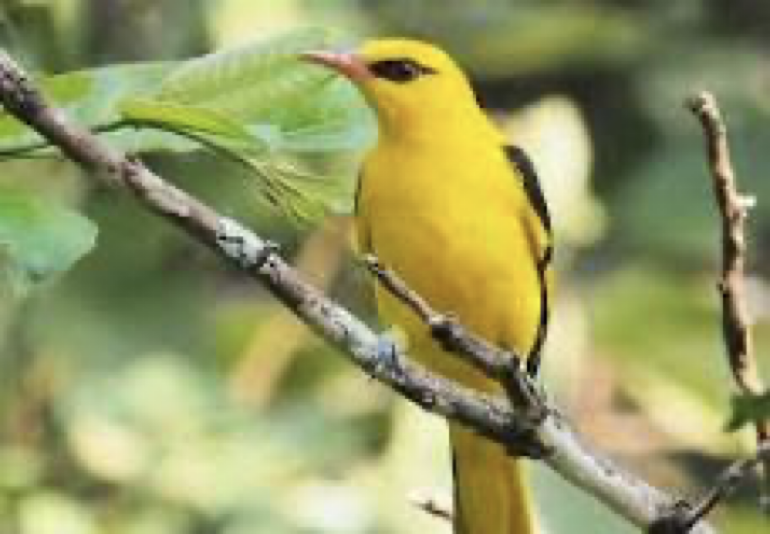
Golden Orioles prefer forested habitats with tall trees. They feed on insects, fruits and nectar, and are known for their beautiful flute-like song, which is often heard during the breeding season.
The Golden Oriole, in many cultures enjoy some symbolic or cultural significance. In Europe, it has been associated with royalty and nobility and was sometimes kept as a pet by wealthy individuals. In some parts of Asia, it is believed to bring good luck and prosperity, and is sometimes depicted in art and literature.
In Indian culture, the Golden Oriole has particular significance. Some erroneously refer to it as the “Bulbul”, which is an entirely different though equally charming bird. But its association with Radha, the divine consort of Lord Krishna is what makes it special. The bird is often mentioned in poems and songs about love and romance, and is sometimes used as a metaphor for the beauty and grace of one’s beloved.
The Tree-Pie
Almost similar in size and body contours, The Indian Tree-Pie, also known as the Grey Tree-Pie, belonging to the family of crows, is a bird species known for its striking black, white and grey plumage. Found in a wide range of habitats, including forests, woodlands, gardens and urban areas, it feeds on a variety of insects, fruits and small animals, and is known for its loud, chattering call. It is particularly active and agile in morning hours and cannot fail to draw your attention.
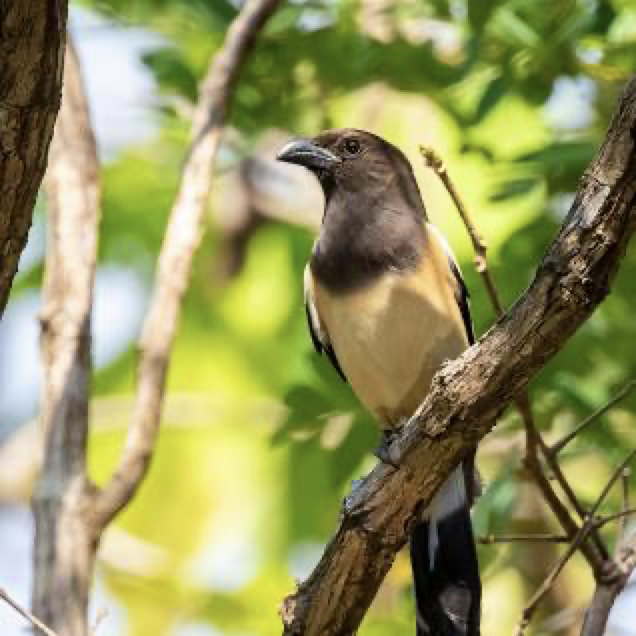
Indian Tree-Pie has specific cultural significance, particularly in Hindu mythology. It is known as the “Harud” in the Kashmiri language and is associated with the arrival of spring and the celebration of the festival of Holi.
Legends say that the Indian Tree-Pie is the messenger of the god of love, Kamadeva, and would carry messages between lovers. In some regions of India, the bird is believed to bring good luck and prosperity, and is sometimes so depicted in art and literature.
These three beautiful birds whose charm and charisma is not only uncommon but profoundly pacifying, pleasingly bring a vibrant calm and serenity to our surroundings as only the birds can do. The soothing sense of restfulness that their presence around you ensures is alas!, a diminishing bliss.
These encounters are salubrious and rejuvenating and add nourishment to the soul. The hours spent in tracking these bewitching beauties is never tiring and the fleeting glimpses they provide more than compensate for the time given in their pursuit.
 scribo ad LX