Lebanese cuisine often invokes the landscape, the people, the flora and fauna of their homeland, their seasons and their festivals. And a people who have been victims of a civil strife for several decades, when displaced from home, passionately adhere to memories, the tastes, the colours, the aromas, the textures of their homeland and what better than the food that they cook and share.
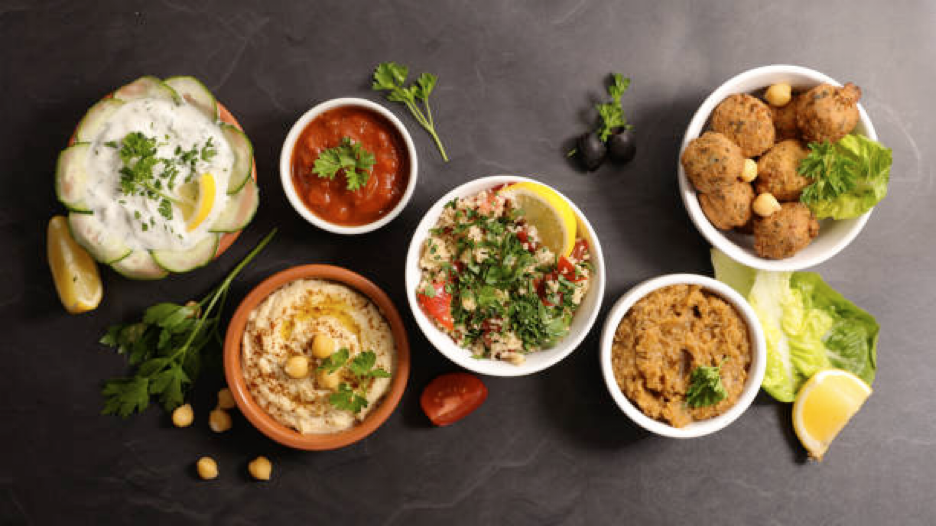
A Typical assortment of Lebanese Spread
Traditional Lebanese Dishes
Lebanese cuisine across globe is identified with Hummus, Falafel, Tahini and the versatile Pita bread. But there is much more to this cuisine, that offer a fine gastronomic experience.
Falafel is a deep-fried mixture of ground chickpeas or fava beans, onions, garlic, and spices like cumin, coriander, and cardamom. It’s one of the most popular street foods throughout the Middle East, where it’s often served in a pita with a mound of cucumbers, tomatoes, pickled vegetables, and tahini or hot sauce.
Hummus is a lemony, garlicky dish of mashed chickpeas and tahini, most often eaten as a dip and served with pita bread or vegetables. Lebanese hummus is often topped with veggies and sumac, and one Lebanese style of hummus, “hummus awarma,” features pine nuts and minced meat on top.
Pita, one of the most popular Lebanese breads, is a leavened flatbread known for its puffy inner pocket. Pita bread is often served with baba ganoush, falafel, hummus, and assorted mezze. Another popular bread is Manakish, a thin, foldable flatbread with subtle indentations made to catch drippings of za’atar and olive oil or labneh.
Mezze
The tapas of Spain, mezeluri of Romania and aperitivo of Italy, they all so uniquely represent their respective cuisine. The Lebanese equivalent is Mezze – an array of small dishes placed before the guests creating a spectacle of colors, flavors, textures and aromas.Meze, mezza or mezzo is a tradition of Levant, Turkey, Greece, Iraq, the Balkans, the Caucasus and Iran. A mezze may be served as a part of a multi-course meal or form a meal in itself.
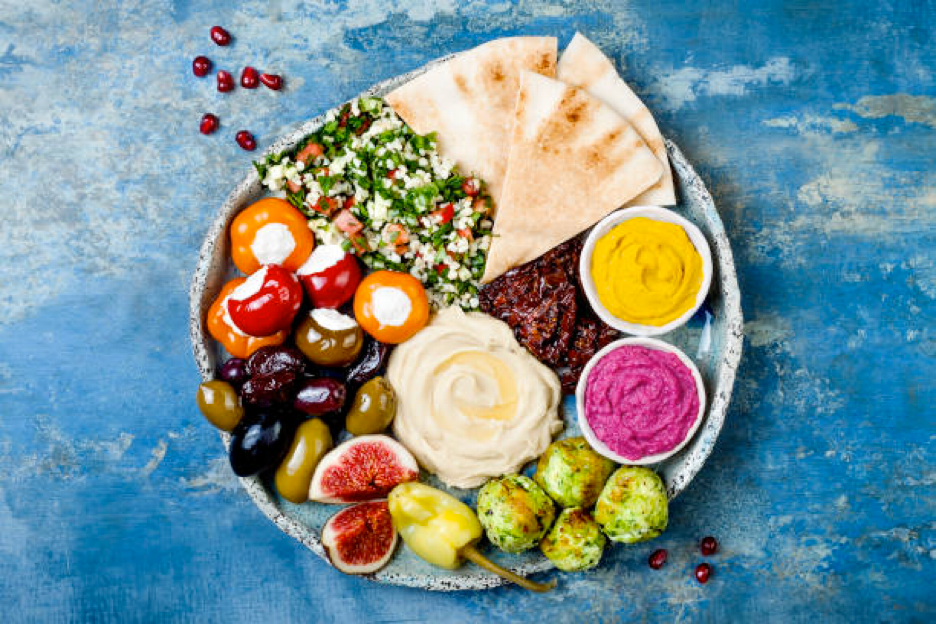
Mezze may be as simple as raw or pickled vegetables, hummus, baba ghanouj and bread, or it may become an entire meal consisting of grilled marinated seafood, skewered meats and a variety of cooked and raw salads and an arrangement of desserts. The assortments of dishes forming the mezze are generally consumed in small bites using a piece of flatbread.
A typical mezze will consist of an elaborate variety of 30 or so hot and cold dishes,
Salads, Kafta and Kibbeh
Fattoush and Tabbouleh are the most common salads.Fattoush is a chopped green salad with a smattering of fresh vegetables like tomato, cucumber, and radishes mingling with toasted bits of pita bread that resembles panzanella. Fattoush is typically served with a tangy dressing made with sumac and pomegranate molasses.
Tabbouleh is a Middle Eastern salad of finely chopped fresh herbs, tomatoes, green onions, and cracked bulgur wheat.
Kafta, also known as kofta outside of Lebanon, these oval-shaped, grilled kebabs will be familiar to meatball lovers: Seasoned with herbs, onion, and spices, kafta are most commonly made from ground beef, though they can also be made with chicken or lamb. Kafta can be served in a pita with all the fixings, over rice pilaf, or as a part of a mezze spread.

Kebabs and accompaniments
Kibbeh is a combination of cracked bulgur wheat and a seasoned mixture of kafta. These stuffed meat croquettes can be fried or baked and served alongside a yogurt or tahini sauce, and an assortment of salads and side dishes. Nicknamed Lebanon’s national dish, there is also a beloved raw version, kibbeh nayeh, a dish in the same spirit of steak tartare that’s served with flatbread.
Another popular attraction is Baba ganoush, also known as baba ghanouj, roasted eggplant dip served as an appetizer, or mezze, in Middle Eastern and Mediterranean restaurants all over the world. The cooked eggplant is combined with tahini, olive oil, and other seasonings like garlic, za’atar, and sumac.
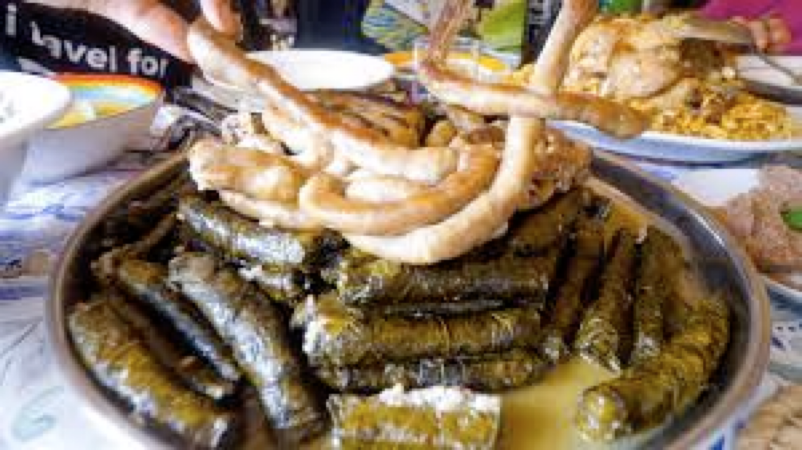
A Grape vine Delicacy
Grape leaves are a unique ingredient of Lebanese cuisine. Warak enab,
also known as dolmas or stuffed grape leaves, has been a staple dish
throughout the Middle East for centuries. The stuffed appetizer features a hashweh, or filling, of meat, rice, cooked vegetables, or a combination thereof, wrapped in cured, briny grapevine leaves.
And Shawarma remains one of the most popular dishes in Middle Eastern cuisine. The ingenuity of lamb or chicken shawarma is famous worldwide; slow-roasted on a rotating, upright spit, shawarma (the progenitor of Mexican al pastor, thanks to the wave of Lebanese immigrants who arrived in the country in the late nineteenth century) is sliced thin to order and served as a sandwich with a variety of fresh toppings.
And the Dessert
Although simple fresh fruits are often served towards the end of a Lebanese meal, there is also dessert, such as baklava and coffee. When sweets are not available, fruits are typically eaten after meals, including figs, oranges and other citrus fruits, apples, grapes, cherries and green plums (janarek). Although baklava is the most internationally known dessert, there is a great variety of Lebanese desserts.
Baklava is a pastry made from layers of thin, flaky phyllo dough brushed with clarified melted butter and baked, then soaked in hot sugar syrup (either simple syrup or honey syrup). One of the most well-known and beloved Lebanese sweets, the crisp dessert is commonly made all over the Middle East, North Africa, and the Balkans, with each region putting its own spin on the treat.
Another popular Lebanese sweet is kanafeh, which is made with shredded strands of phyllo dough (giving it a vermicelli-esque texture) soaked in a similarly fragrant sugar syrup and layered with soft cheese.
And serving Traditions
In Lebanon, very rarely are drinks served without being accompanied by food. Arak is an opaque anise-flavored distilled spirit known as the national liqueur of Lebanon. Arabic for “perspiration,” arak is diluted with two parts water and served on ice alongside traditional mezze.
An assortment of coffees are usually offered after meals.
The manner in which Lebanese foods are served is also a major component of this type of cuisine. Rather than one main dish and a few sides, many meals often consist of three or four smaller dishes, which are often similar to appetizers, or one large dish with several appetisers alongside. Although forks, knives, and spoons are used regularly, most meals are served with flat bread, which is often used in place of an eating utensil.
(To Be Continued….)
 scribo ad LX