The First Feast
The travellers on Mayflower were not all pilgrims.
Of the 102 passengers on the Mayflower, there were 50 men, 19 women and 33 young adults and children. Just 41 were true Pilgrims, religious separatists seeking freedom from the Church of England. The others were considered common folk and included merchants, craftsmen, indentured servants and orphaned children—the Pilgrims called them “strangers.”

The Mayflower
The Pilgrims had signed a contract with a Virginia Company, chartered by King James I, to settle on land near the Hudson River, which was then part of northern Virginia. But when the Mayflower landed in Massachusetts instead of Virginia, discord began before the colonists even left the ship. Discontent led to a mutiny like situation. To quell the rebellion before it turned out of control, Pilgrim leaders set out to create a temporary set of laws for ruling themselves as per majority agreement.
On November 11, 1620, 41 adult male colonists, including two indentured servants, signed the Mayflower Compact, although it wasn’t called that at the time. A well-educated pastor William Brewster is credited to have drafted it.
The text of the Mayflower Compact read,:
‘In the name of God, Amen. We, whose names are underwritten, the Loyal Subjects of our dread Sovereign Lord King James, by the Grace of God, of Great Britain, France, and Ireland, King, defender of the Faith, etc.:
Having undertaken, for the Glory of God, and advancements of the Christian faith, and the honor of our King and Country, a voyage to plant the first colony in the Northern parts of Virginia; do by these presents, solemnly and mutually, in the presence of God, and one another; covenant and combine ourselves together into a civil body politic; for our better ordering, and preservation and furtherance of the ends aforesaid; and by virtue hereof to enact, constitute, and frame, such just and equal laws, ordinances, acts, constitutions, and offices, from time to time, as shall be thought most meet and convenient for the general good of the colony; unto which we promise all due submission and obedience.
In witness whereof we have hereunto subscribed our names at Cape Cod the 11th of November, in the year of the reign of our Sovereign Lord King James, of England, France, and Ireland, the eighteenth, and of Scotland the fifty-fourth, 1620.’
In pursuance of this compact, on November 21 1620 they elected John Carver as their first Governor. Carver survived the brutal winter but succumbed coming year in April, making way for William Bradford to assume the governorship. The fortune of the new settlers began to take a turn after that. Under his leadership, Plymouth Colony started to thrive.
As more and more settlers arrived and colonized the surrounding areas, a General Court was established. Each town elected representatives to attend the court, thereby creating an early representative government.
Guided by the native Sequinto , the settlers took to agriculture with diligence. Driven by a desperation to survive and succeed, the outcome was remarkable. As the fruits of their labour matured in the fields, the time was ripe for rejoicing. And beholden to natives, thanking them by organising a feast for them seemed in consonance with their Christian values.
The First Thanksgiving Feast
The traditional Thanksgiving feast, inter alia, includes stuffed and roasted Turkey, Cranberry Sauce, Mashed Potatoes, Pumpkin Pie. But what exactly happened in the first feast and what was the exact bill of fare, has evoked both curiosity and research.
The 1621 Thanksgiving celebration marked the Pilgrims’ first autumn harvest, so it is likely that the colonists feasted on the bounty they had reaped with the help of their Native American neighbours. Local vegetables that likely appeared on the table include onions, beans, lettuce, spinach, cabbage, carrots and perhaps peas. Corn, which records show was plentiful at the first harvest, might also have been served, but not in the way most people enjoy it now. In those days, the corn would have been removed from the cob and turned into cornmeal, which was then boiled and pounded into a thick corn mush or porridge that was occasionally sweetened with molasses.
The Pilgrim chronicler Edward Winslow noted in his journal that the colony’s governor, William Bradford, sent four men on a “fowling” mission in preparation for the three-day event:
“Our harvest being gotten in, our governor sent four men on fowling, that so we might after a special manner rejoice together, after we had gathered the fruits of our labors; they four in one day killed as much fowl, as with a little help beside, served the Company almost a week.”
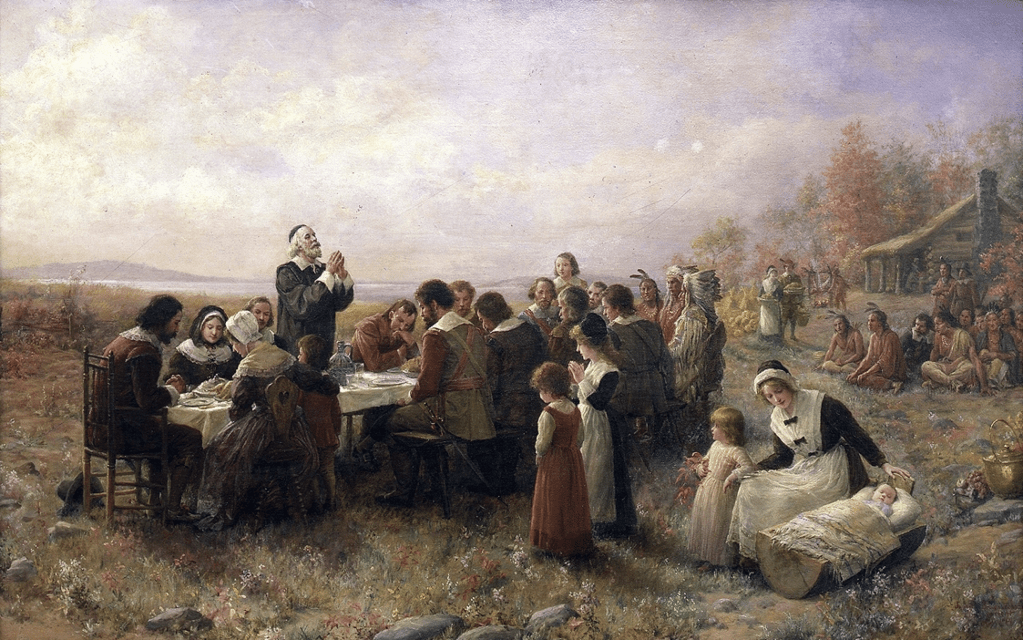
The First Thanksgiving at Plymouth by Jennie Augusta Brownscombe
Traditional Turkey
In “On Plymouth Plantation,” Bradford’s famous account of the founding of Plymouth Colony, he writes: “there was great store of wild turkeys, of which they took many, besides venison, etc.” Wild—but not domestic—turkey was indeed plentiful in the region and a common food source for both English settlers and Native Americans. But it is just as likely that the fowling party returned with other birds we know the colonists regularly consumed, such as ducks, geese and swans. Instead of bread-based stuffing, herbs, onions or nuts might have been added to the birds for extra flavour.
Turkey or no turkey, the first Thanksgiving’s attendees almost certainly got their fill of meat. Winslow wrote that the Wampanoag arrived with an offering of five deer. Culinary historians speculate that the deer was roasted on a spit over a smouldering fire and that the colonists might have used some of the venison to whip up a hearty stew.
Fruits
Fruits indigenous to the region included blueberries, plums, grapes, gooseberries, raspberries and, of course cranberries, which Native Americans ate and used as a natural dye. The Pilgrims might have been familiar with cranberries by the first Thanksgiving, but they wouldn’t have made sauces and relishes with the tart orbs. That’s because the sacks of sugar that traveled across the Atlantic on the Mayflower were nearly or fully depleted by November 1621. Cooks didn’t begin boiling cranberries with sugar and using the mixture as an accompaniment for meats until about 50 years later.
Fish and Shellfish
Culinary historians believe that much of the Thanksgiving meal consisted of seafood, which is often absent from today’s menus. Mussels in particular were abundant in New England and could be easily harvested because they clung to rocks along the shoreline. The colonists occasionally served mussels with curds, a dairy product with a similar consistency to cottage cheese. Lobster, bass, clams and oysters might also have been part of the feast.
Potatoes
Whether mashed or roasted, white or sweet, potatoes had no place at the first Thanksgiving. After encountering it in its native South America, the Spanish began introducing the potato to Europeans around 1570. But by the time the Pilgrims boarded the Mayflower, the tuber had neither doubled back to North America nor become popular enough with the English to hitch a ride. New England’s native inhabitants are known to have eaten other plant roots such as Indian turnips and groundnuts, which they may or may not have brought to the party.
Pumpkin Pie
Both the Pilgrims and members of the Wampanoag tribe ate pumpkins and other squashes indigenous to New England—possibly even during the harvest festival—but the fledgling colony lacked the butter and wheat flour necessary for making pie crust. Moreover, settlers hadn’t yet constructed an oven for baking. According to some accounts, early English settlers in North America improvised by hollowing out pumpkins, filling the shells with milk, honey and spices to make a custard, then roasting the gourds whole in hot ashes.
By all accounts, lobster, seal and swans were on the Pilgrims’ menu.
Cuisine
Historians have suggested that many of the dishes were likely prepared using traditional Native American spices and cooking methods. Because the Pilgrims had no oven and the Mayflower’s sugar supply had dwindled by the fall of 1621, the meal did not feature pies, cakes or other desserts, which have become a hallmark of contemporary celebrations.
The Guest List at the First Thanksgiving
At the first Thanksgiving, colonists were likely outnumbered more than two to one by the Native Americans in attendance. Winslow writes: “many of the Indians coming amongst us, and amongst the rest their greatest king Massasoit, with some ninety men.” In fact, the Indigenous people at the feast would have been familiar with the tradition of “thanksgiving” since it was central to their regular spiritual practices—to give thanks for natural bounty.
The preceding winter had been a harsh one for the colonists. Over seventy percent of the women who had travelled on the Mayflower had perished that winter, leaving only around 50 colonists to attend the first Thanksgiving. According to eyewitness accounts, among the pilgrims, there were 22 men, just four women and over 25 children and teenagers.
A Tradition is Created
Pilgrims held their second Thanksgiving celebration in 1623 to mark the end of a long drought that had threatened the year’s harvest and prompted Governor Bradford to call for a religious fast. Days of fasting and thanksgiving on an annual or occasional basis became common practice in other New England settlements as well.
Over years the tradition became wide spread and widely accepted. Deepened and widened with the passage of time, Thanksgiving has come to occupy a unique station in American communal life.
In 400 years, however, the rituals and practices sanctify the festival with colours and considerations that camouflage the original spirit significantly. What has brought that about?
(To be continued)
 scribo ad LX