A Magical Mélange of Assailing aromas and Fanciful Flavours
Part II
A Food Tradition Anchored in Agriculture
The rich and varied Thai culinary tradition naturally owes its development and diversification to Thai way of life that essentially revolved around agriculture.
Thailand may have become an export led economy today and the share of Industrial activity may be almost 40% of its GDP, it was predominantly an agrarian economy for centuries. Siam, the land Thailand was earlier known by, was a region of fertile lands and plentiful water. Agriculture was its mainstay and its culture and traditions essentially rooted in agricultural practices and customs. Its festivals and rituals, lores and fables, fears and trepidation were all in one way or the other a celebration or obeisance to nature as evolved through agriculture over ages.
Plentiful and affordable food got ingrained in the tastes and aromas that began to symbolize Thai food. Later, rapid urbanization created local demand and subsequently opportunities in food service provided the much needed impetus. As Thailand became a favourite tourist destination, the street food was both patronized and promoted by the foreign visitors.
India in Thai Cuisine
In a well-regarded book titled ‘India’s Benevolence to Thailand’, Thai monk Venerable Buddhadasa Bhikku’s has this to say about India’s contribution to Thai cuisine, ‘Thai people learned how to use spices in their food in various ways from Indians. Thais also obtained the methods of making herbal medicines from the Indians. Some plants like sarabhi of the family Guttiferae, panika or harsinghar, phikun or Mimusops elengi and bunnak or the rose chestnut etc. were brought from India.’ His offers many details of India’s influence on Thai cuisine.
It’s not surprising, given the fact that Buddhism travelled to and was embraced by the people in Thailand, the intimate cultural and religious ties brought in their wake a lasting and comprehensive influence that were sweeping in scope and magnitude. There, exists, therefore, a strong affinity between the two food traditions.
Gastronomic Diplomacy
Thai cuisine is also a very successful example of gastronomic diplomacy, of which Thailand was one of the pioneers and first practitioners. The Royal Patronage; and integrating the Thai food in the tourism promotional strategies of the government have played a very salient role in globalizing Thai cuisine.
The globalization of Thai Food is a conscious strategy. In a major offensive in Gastro diplomacy, the Government of Thailand in 2002 launched its ‘Global Thai’ campaign increasing the number of Thai restaurants around the world and popularizing dishes like Pad Thai and Pad See Ew. In US for instance it has begun to enjoy a popularity comparable to Italian, Chines and Mexican though the eating establishments may be fewer.
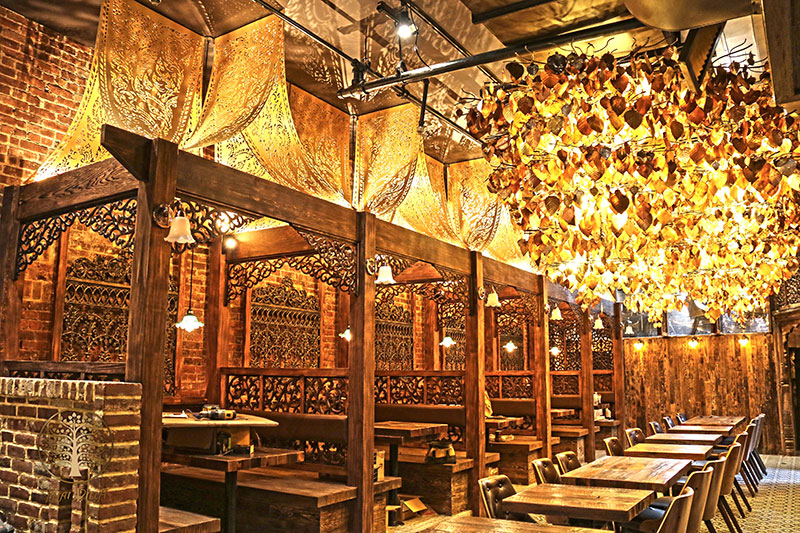
Thai Villa at E 19th Street
One place that enjoys considerable reputation and standing is ‘Thai Villa’ on 19th Street of Manhattan.
The website of Thai Villa proclaims that at Thai Villa, one can savour flavourful dishes rarely served outside of Thailand. Thai Villa specializes in sophisticated, little-known cuisine such as Shrang Wa Goong, Kaeng Hung Ley and Kun Tok, originally prepared for Thai royalty in generations past. Their avowed mission is to conserve Thai royal cuisine and of course, to present classical Thai dishes as great food for enjoyment.
The menu features a bit pompously a special section on the Rare and Secret Recipes from the Thai Royal Kitchen. They call it ,’Privileged’. They also serve Authentic and Local Thai Street Food, which they call Classics. The privileged Entrées include Royal Pad Thai, Muk Kong Kai Kim and Red Ran, while the privileged appetizers list Mieng Yum, Kao Tang Na Tung, and Ray Rai Nah Phu.
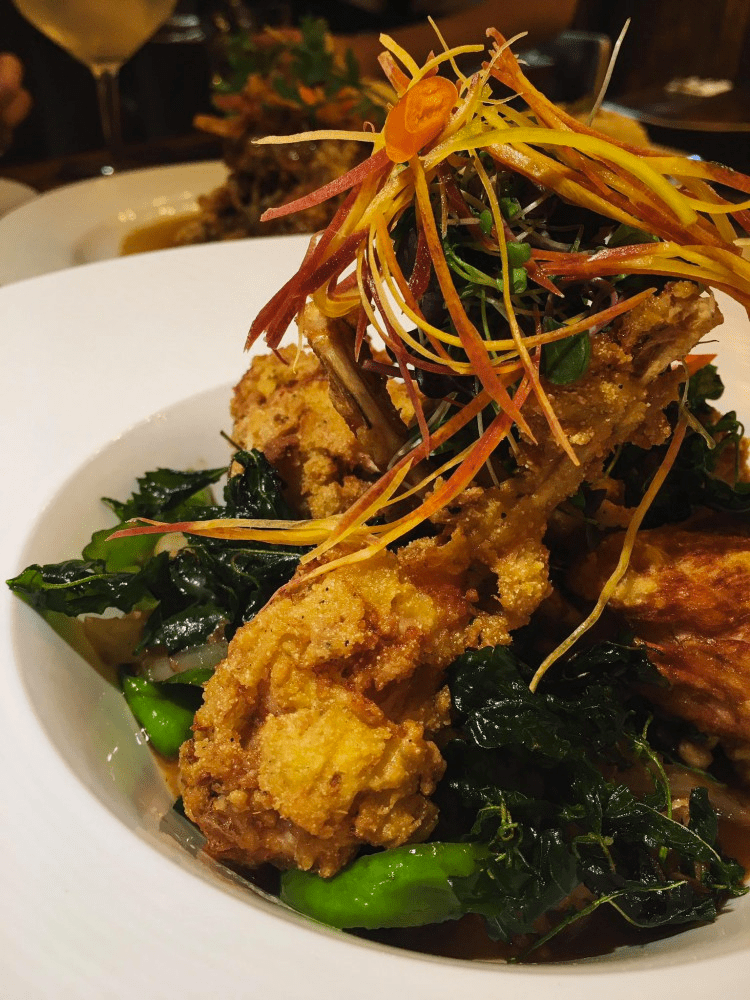
Thai Royal Cuisine
Thai royal cuisine traces its history back to the cosmopolitan palace cuisine of the Ayutthaya kingdom (1351–1767 CE). Its refinement, cooking techniques, presentation, and use of ingredients were of great influence to the cuisine of the central Thai plains. Thai royal cuisine has been influenced by the Khmer royal cuisine through the Khmer palace cooks brought to the Ayutthaya Kingdom during its conquests of the Khmer Empire. Thai royal cuisine has become very well-known from the Rattanakosin Era onwards.
There are many types of Thai royal cuisine such as ranchuan curry, nam phrik long rue, matsaman curry, rice in jasmine-flavoured iced water or khao chae, spicy salad, fruit, and carved vegetable.
Typically, Thai royal cuisine display characteristics that are close to the basic food prepared by general people. However, Thai royal cuisine focuses on the freshness of seasonal products. Other than that, it is crucial that the way in which Thai royal food is cooked, should be complex and delicate.

La Loubère, an envoy from France during the reign of King Narai, recorded that the food at the court was generally similar to villager food. What makes Thai Royal cuisine different is its beautiful presentation. For example, they served fish and chicken with the bones removed, and the vegetables were served in bite-sized portions
An Experience To Savour
The dalliance with the flavours, the aromas and the texture was an olfactory stimulus and a palate-tingling experience. Even if one largely confined oneself to more conventional dishes notwithstanding the temptation to focus on only Royal Kitchen preparations, the exposure was both enlightening and delightful. The dishes that enriched our taste buds included tom yum kung (a sour shrimp soup), khao phat (fried rice), Ped Ron( Deep fried duck with batter-fried egg plant served in tamarind sauce), and Green Curry. Som tam (green papaya salad), essentially a street food and an all-time favorite at this place, turned out to be excellent.

The dessert was, however, a disappointment. American influence weighed heavily on what was on offer, Kay New Peuak, More Kheng Brûlée with Coconut, Choco-Thai-Tea Lava Cake and Trio Sherbet, each having a strong local content and presentation. We chose Kay New Peuak and for good measure added Banana Crepe with coconut ice cream, our choices dictated by the ensorcelling orchids placed alongside the dishes. Typical sweet snacks, collectively called khanom, and other sweets, such as khanom bueang and khanom khrok (somewhat similar to Dutch poffertjes), did not appear to be on offer.
As we stepped out in the cool autumn afternoon after this 90 minute gastronomic excursion, the mood was buoyant. The only disappointment was what Thai chef McDang, who himself descended from the royal family, so frankly described, “ the difference between royal Thai cuisine and regular Thai cuisine is fiction. The only difference between the food of the palace and that of the common people is the former’s elaborate presentation and better ingredients.”
Isn’t it also true of so many other differences?
 scribo ad LX