“From Newton and Darwin to Edison and Einstein, from Alan Turing to Steve Jobs, we have led the world in our commitment to science and cutting-edge research.”– Barack Obama (placing Turing among the trans-Atlantic pantheon of innovation and discovery)
Have you ever wondered what does the half- eaten apple, the symbol of Apple Inc. signify, and what could be the possible origin for such a symbol?
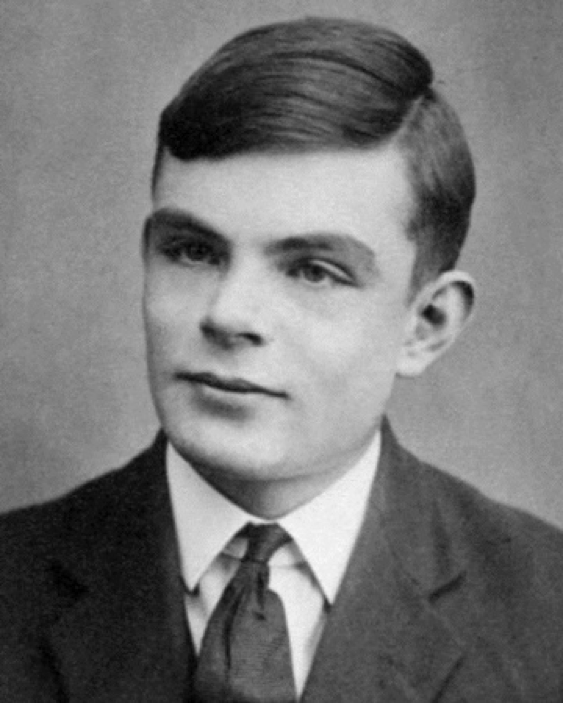
One story, likely apocryphal, relates to the legendary computer scientist Alan Turing, widely regarded as the father of Artificial Intelligence and credited with developing Turin Machine, one of the most important early models of a computer.
His illustrious life lit up by the brilliance of his mind and exceptional range of interests, ended unhappily as he committed suicide at a young age of 41. He ate an apple laced with cyanide poison, the half- eaten apple lying near his dead body. Whether Steve Jobs, by choosing the half eaten apple as the icon of his enterprise, was paying a tribute to this genius, is conjectural but that he was an admirer of Alan Turin remains a fact. Many still believe that this outstanding hero deserved this tribute, possibly a lot more.
Father of Artificial Intelligence
An English mathematician, logician and cryptographer, Alan Turing was responsible for breaking the Nazi Enigma code during World War II. His work gave the Allies the edge they needed to win the war in Europe.
His genius embraced the first visions of modern computing and produced pioneering and seminal insights into what today is known as “Artificial Intelligence(AI).” His position as the most influential code breakers of World War II, remains un-assailed and is believed to have hastened the Allied victory.
Regarded by many as the progenitor pf AI, Turing believed that “the computer would offer unlimited scope for practical progress toward embodying intelligence in an artificial form,”. But his interests were even more varied and extensive. Among his enthusiasms were his work on various scientific themes, including morphogenesis, the theory of growth and form in biology.
His life and contribution have since been recognised and even made into a fascinating film. His most authentic biography remains “Alan Turing: The Enigma” written by Andrew Hodges, a mathematician at the Mathematical Institute at Oxford University. The book sheds interesting light on the man, his genius and his eccentricities.
Master Cryptographer
His numerous contributions spanned the domains of science, mathematics, cryptology, biology and neurology, each of his contributions path-breaking in unique ways. However, his lasting legacy for which the world shall ever remember him, was his genius for decrypting coded messages. During World War II Turing worked at the UK’s code-breaking headquarters at Bletchley Park. Here he played a pivotal role in breaking coded German messages through the Enigma machine, many of which helped the Allies win several crucial battles. One estimate puts the number of lives saved by Turing’s work at as many as 14 million.
At the top-secret wartime operations of Britain’s code-breakers at Bletchley Park, a sprawling estate north of London, he oversaw and inspired the effort to decrypt ciphers, which had once seemed impenetrable and which Germans regarded as unbreakable.
At the time, German submarines were prowling the Atlantic, hunting Allied ships carrying vital cargo for the war effort. The convoys were critical for building military strength in Britain. Only by charting the submarines’ movements could Allied forces change the course of their convoys, and for that they relied on the cryptologists of Bletchley Park to decode messages betraying the Germans’ deployments.
Their greatest initial challenge was figuring out the method of encryption of the German Enigma device, which was invented 20 years earlier by Arthur Scherbius, a German electrical engineer who had patented it as a civilian machine to encrypt commercial messages. The machine worked by entering letters on a typewriter-like keyboard and then encoding them through a series of rotors to a light board, which showed the coded equivalents. The machine was said to be capable of generating almost 159 quintillion permutations.
A Polish mathematician had been studying the Enigma machine and had provided vital details after Hitler’s forces invaded Poland in 1939. Enlisting his help, Turing and another Cambridge-educated mathematician, W.G. Welchman, the Bletchley Park code breakers, greatly expanded and accelerated those early efforts. Using a huge contraption called the Bombe, they mimicked the operations of the Enigma machine to break its codes. The rest was history.
Olympic Level Marathon Runner
While his secret ties to Britain’s post-war code breakers were at the top of his passions, his other consuming interest was long-distance running. He loved running. He used to run the 10 miles between the two places where he did most of his work, the National Physical Laboratory and the electronics building on Dollis Hill, beating colleagues who took public transportation to the office.
In 1948, his best marathon time was 2 hours 46 minutes 3 seconds — only 11 minutes slower than the Olympic winning time that year.
When one of his running club members asked why he trained so vehemently, he replied, “I have such a stressful job that the only way I can get it out of my mind is by running hard.”
A multi- faceted genius
Turing’s most notable recognition today is as a computer scientist. In 1936, he developed the idea for the Universal Turing Machine, the basis for the first computer. And he developed a test for artificial intelligence in 1950, which is still used today. Much of this work was related to creating machines that could learn and “think”, but some of it came out of simple curiosity about the world.
He developed a new field of biology out of his fascination with daisies. There is a famous sketch of Turing as a boy “watching the daisies grow” foreshadowing Turing’s ground-breaking work in 1952 on morphogenesis, which became a completely new field of mathematical biology. It was a mathematical explanation of how things grow — a great mystery to science.
Like most geniuses, he was never considered bright in his school days. His choice of science as a subject, disappointed his mother who wanted her to pursue classics, the preference of the best in those times. His grades were consistently poor. His English teacher wrote in his report, “I can forgive his writing, though it is the worst I have ever seen, and I try to view tolerantly his unswerving inexactitude and slipshod, dirty, work, inconsistent though such inexactitude is in a utilitarian; but I cannot forgive the stupidity of his attitude towards sane discussion on the New Testament.”
He obviously misjudged, grossly.
And to make matters worse, he used to stutter while speaking. Much later, a famous BBC interviewer called him impossible to interview because of his constant stammering.
His sexuality- His Nemesis
If his intellectual proclivities were ahead of times, his own way of life and his sense of pleasures and excitements were equally out of tune of those years. His liking for a life style and his sense of dress considered undignified those days were manifestation of his unusual personality. He will often be shabbily dressed and unkempt. He had become a hippie much before it became fashionable.
And as his genius in the field of computing and cryptology bloomed, he also began to explore his homosexual identity he had hidden when he proposed marriage in 1941 to Joan Clarke, a Bletchley Park cryptanalyst. He later withdrew the offer after explaining his sexuality to her, but the two remained friends.
About 10 years later, the police were investigating a burglary at his home when he admitted to having had a physical relationship with a man named Arnold Murray. In March 1952, Turing and Murray were charged with “gross indecency,” and both pleaded guilty in court. Murray was given a conditional discharge, but Turing was ordered to undergo chemical castration by taking doses of the female hormone estrogen to reduce sex drive.
He was denied any association with secret war time work he loved and was passionate about, as also from travels abroad. Excluded and embittered and having lost the only purpose of his life, he ate a cyanide laced apple, (perhaps to mask the bitterness of the poison). Officially, though, his death was termed as accidental poisoning. While a coroner deemed the death a suicide, the tell-tale apple at Turing’s side was never forensically examined.
Doubts on this official version were immediately raised, the most led by his mother Ethel Turing, and still rage.
Was he ashamed or apologetic about his sexual orientation? Far from it. When arrested and charged with “indecency”, he was defiant and did not deny the charges. “When he was arrested, the first thing he said was he thought that this shouldn’t be against the law,” Hodges writes, “He gave a statement that was unapologetic, that detailed what had happened.”
Chemical Castration notwithstanding, he did not allow the punishment either to dissuade him from work or limit his lively spirit.
“He dealt with it with as much humor and defiance as you could muster,” Hodges elaborates, “To his close friends, it was obvious it was traumatic. But in no way did he just succumb and decline. He really fought back … by insisting on continuing work as if nothing had happened.”
He mocked the law’s absurdity and in defiance even travelled abroad to Norway and the Mediterranean, where the gay rights movements were just beginning to take roots.
Exoneration, Pardon, and a Law
Turing was never fully recognized during his lifetime due to his homosexuality. Britain didn’t take its first steps toward decriminalizing homosexuality until 1967 and only in 2009 did the British government formally apologized to Turing. Queen Elizabeth II granted him a pardon in 2013, 59 years after a housekeeper had found his body at his home with a half-eaten apple by his side.
“We’re sorry — you deserved so much better,” said Gordon Brown, the then Prime Minister. “Alan and the many thousands of other gay men who were convicted, as he was, under homophobic laws were treated terribly.”
Turing fused his exceptional brilliance with uncommon eccentricity. While he straddled comfortably in the abstruse realms of mathematics and cryptography, his station in social settings brought awkwardness to him and a vicious hostility from a society, disposed inimically towards the queerness of this genius
“He was a national treasure, and we hounded him to his death,” said John Graham-Cumming, a noted computer scientist.
The Alan Turing law under which today pardons the men convicted of homosexuality previously, is a rare tribute to a scientist and a mathematician but a feeble and forced compensation from a fickle and capricious society.
Alan Turing – Enigma of a Genius
 scribo ad LX