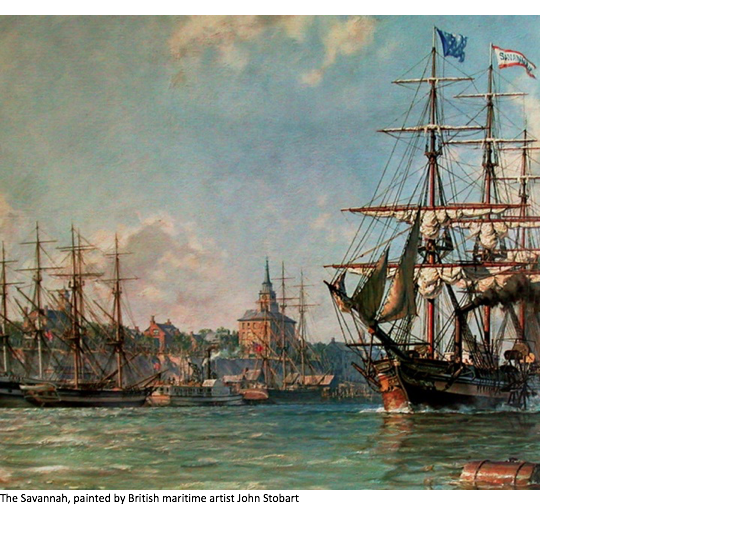
The First Ship to Cross Atlantic using Steam Power
Machines are an integral part of human existence. That they dominate us is a reality, that they will dictate us control us is a distinct and proximate possibility. Artificial Intelligence(AI), Robotics, and Internet of Things (IoT), the smart machines and intelligent gadgets, are to define the trajectory of our future growth. Whether this trajectory will sustain, improve the quality of lives and bring happiness, is something on which unanimity is elusive.
But these transformations are not very old, not even four hundred years old. Till we learnt, understood and then started using the power of steam, human life had continued in the same mould for thousands of years. Life was physically tough, the forces of nature had greater control of our lives but it was also simple and rooted in the diurnal rhythm and cycles of seasons, of summer, rain and winter, of snow, forests, mountains and deserts. But the genius of human thinking and its spirit of creativity remained unabated and the process of growth of civilization and culture continued. The pace of life was placid but was perhaps no less exciting, stimulating and rewarding.
An incredible development occurred in 17th Century. James Watt discovered steam power. This discovery led to as yet unknown applications, many amazingly transformative. One, such revolutionary application was the introduction of the steam engine. And once steam power became a source of energy that could be harnessed, it powered the Industrial Revolution. Before, steam power, most factories and mills were run either on water, wind, horses or even men.
The world changed immutably after steam power was invented and exploited to suit our purpose. The industrial use of steam power started with Thomas Savery in 1698. He constructed and patented in London the first engine, which he called the ‘Miner’s Friend’ since this pump could lift water from mines without human labor. In 1712 Thomas Newcomen introduced first practical steam engine employing a piston and cylinder. These engines were widely used in mining activities. By 1729 when Newcomen died, his engines had spread to France, Germany, Austria, Hungry and Sweden.
A transformational and fundamental progress in the evolution of steam engines was introduced by James Watt which improved the efficiency of the engine while incorporating many improvements. James Watt’s engines became commercially very successful and by 1800, his firm Boulton & Watt had constructed 496 engines. Another huge improvement was introduced by Cornish engineer Richard Trevithick resulting in high pressure engines exhausting in atmosphere paving the way for their application in massive industrial and transportation activities.
Well, within decades, the Industrial Revolution was truly and fully ushered in and the world was never to be the same again. It continued for 400 years and still does. We prefer to call it as Industry 4.0. However, as the Internet seems to have effortlessly crept into our lives and existence, a new phase of human life on an altogether unexplored course inevitably has begun.
Savannah-A Ship in Distress
On 19th June, 1819, close to 200 years ago, an event happened. It not established the power of steam engines but also became a proud moment of our contemporary history.
A British rescue boat Kite stationed on the Ireland coast spotted a ship billowing thick dark smoke. It was immediately taken as a distress signal and Kite at once rushed towards this ship. But to its surprise, the smoke billowing ship turned away, billowing more smoke and a long triumphant hoot.
This, in fact, was no ship in distress; it was a ship in triumph:’ Savannah’ had set sail from Savannah, Georgia, on the first successful, unique but as yet un-attempted trans-Atlantic voyage. It was indeed celebrating a triumph and a landmark event- the first successful trans-Atlantic voyage made under steam propulsion.
Those were the times when steam engines had just been invented revolutionizing almost every aspect of human activity. Industrial Age had just set in. Factories and sites of mass production aided by machines which were in turn being run on steam, sprang all over the place becoming new symbols and centers of modernity and prosperity. Steam locomotives what we popularly known today as Railways became the new mode of mass transportation, revolutionizing the way human used to travel. Ships which were only using sails, started using steam as the propellant to steer the ships across seas and oceans.
Jubilation and Recognition
The voyage from Savannah, Georgia, USA was remarkable. It began on May 22,1819 and took 29 days and 11 hours to reach the Irish coast and even though it used the steam power for only 80 hours in this 29-day journey, it established the possibility that the ships can navigate through the power of steam engines. History has been made. One British newspaper ruefully declared,” Visionary Yankee ingenuity has stolen a march on British Empire sea leadership and at the same time has blazed the way towards a new means of travel between the Eastern and Western hemisphere.”
The US government loss no time in celebrating this great feat. US Congress passed the following resolution.: –
“On May 22, 1819, the steamship Savannah set sail from Savannah, Georgia, on the first successful transoceanic voyage under steam propulsion (sic), thus making a material contribution to the advancement of ocean transportation.”
“Therefore be it resolved by the Senate and House of Representatives of the United States of America in Congress assembled, that May 22 of each year shall hereafter be designated and known as National Maritime Day, and the President is authorised and requested annually to issue a proclamation calling upon the people of the United States to observe such National Maritime Day by displaying the flag at their homes or other suitable places and Government officials to display the flag on all Government buildings on May 22 of each year.”
The President promptly issued a proclamation urging people to celebrate this day by displaying the national flag at their homes and all government buildings.
The tradition and the celebrations have continued since then.
Stung by this loss of supremacy and not to be outdone, two British Steamship Companies sent rival ships SS Great Western, and the SS Sirius, to New York within a few days of each other.
Only this time both of them completed the voyage entirely on steam power.
 scribo ad LX