
The 1950s for the US was perhaps the best decade. Upbeat, economically and politically the world leader, champion of modernism and democracy, its citizens were enjoying a life style, affluence and freedom never experienced before. But along with also came the perverse and aberrant but pertinacious practices that inevitably transgress and destroys acceptable morality.
A newly found sense of emancipation for women also strengthened events and activities designed, endorsed and financed by the rich and deviant.
While it was an era dominated by atomic explosions, communist scares, McCarthyism and a paranoia often exaggerated, it will also be remembered for nuclear theme pageants. Beauty Contests were nothing new by then. However, among the most unusual, weird and interesting beauty pageants, the one held in Las Vegas first in 1952, takes the cake. Commonly marketed as nuclear theme pageants Miss Atomic symbolised American influence, display of power, emancipation (or Commodification) of women as also perversities associated with arrogance of affluence.
Las Vegas
Las Vegas, always known for showgirls and gambling, also became known for atomic bomb explosions in 50s. Nuclear Tests began in the state in 1951 at the Nevada Proving Grounds (now the Nevada Test Site), the approximately 1,375-square-mile site near the Nellis Air Force Gunnery and Bombing Range in Nye County, roughly 65 miles from Sin City. The first test, nicknamed “Able,” at the proving grounds was followed by approximately 100 more atmospheric nuclear trials at the site. A 680-square-mile atomic testing ground was established in 1950 by President Harry Truman just 45 miles from the centre of Sin City.
Las Vegas is a city that does not let a money-making opportunity pass. Promptly, it seized this unique distinction. It capitalized on the nearby explosions by hosting viewing parties of some of the nuclear test explosions. Packing in crowds on their rooftops and in their penthouse suites as primo seats from which to see the bombs’ glowing funnels and radioactive puffballs, the casinos promoted special “atomic cocktails” and “Dawn Bomb Parties.”
Atomic Bomb Beauty Pageant
But a bolder, more enterprising innovation was to have an Atomic Bomb Beauty pageant., Las Vegas decided to combine two of its major attractions—nuclear bombs and showgirls—into a “beauty contest”. They called it a cultural inspiration.
However, there never was an official Miss Atomic Bomb beauty pageant. Instead, beauty queens were given bomb-themed titles in glamorous and well publicised events.
There were only four “showgirl-turned-beauty-queens” and “there was no single Miss Atomic Bomb beauty pageant, and most of the queens were simply showgirls chosen for their “radiant … looks”. “The queens came about in an only loosely related manner: atomic-themed, usually of the mushroom cloud variety, costumes.” So, there were only four winners, the first Candyce King in 1952 and the last Lee Martin crowned in 1957. Brief but dazzling, the event celebrated the city’s two main attractions: nuclear bombs and showgirls.
The winners naturally were as quickly forgotten and faded from the public memory. Two of them, however, managed to have some lingering fame.
In 1955, Linda Lawson was declared the winner of the Atomic Pageant. Her victory coincided with the Operation Cue atomic tests, which were long delayed by high winds and weather, so she became known as “Miss-Cue”.
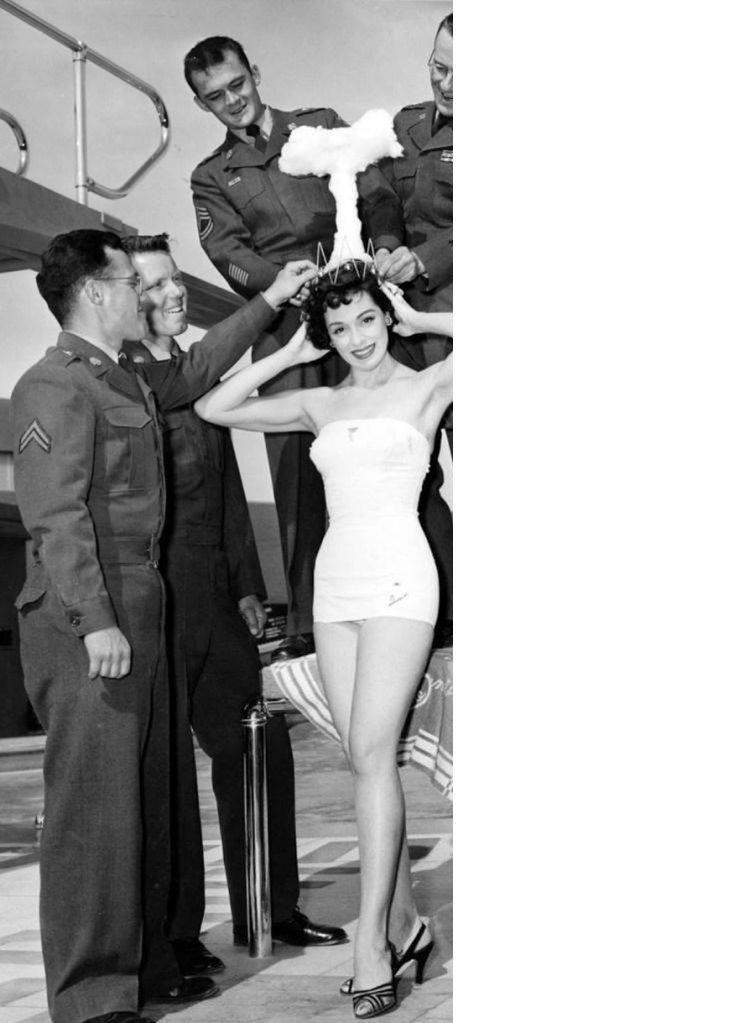
The last and most famous was Lee Merlin, crowned as “Miss Atomic Bomb“, coinciding with Operation Plumbbob, while wearing a cotton mushroom cloud on the front of her swimsuit. This showgirl at the famed Sands casino, has had some of the most sustained fame since a Las Vegas News Bureau photographer snapped this picture during some down time at a photo shoot.
The story goes that the photographer, Don English, of the Las Vegas Sun, attached the explosion-shaped cotton to Merlin’s bathing suit. The photo was published in 1957 and it has since appeared in numerous publications.
Two Interesting Asides
There are two interesting but not widely known connection between these nuclear explosions and their cultural aftermath.
One relates to the first atomic explosion conducted at the Bikini Atoll and the skimpy swim suit, designed by the French automobile engineer Louis Réard. Réard advertised his swimsuit as “smaller than the world’s smallest bathing suit.” Debuting this woman’s swimwear, Réard named it BIKINI, to commemorate the explosion held just a month ago. A born salesman, Réard issued ads declaring that no two-piece swimsuit could be considered a true bikini “unless it could be pulled through a wedding ring.” It was so bold for its times that no established model of repute was willing to advertise it. So, it fell to the lot of nineteen-year-old Micheline Bernardini, a nude dancer at the Casino de Paris — “a hotbed of extravagant costumes and topless dancers” —to be the first to wear what amounted to 30 inches of material in the bikini’s public debut at the chic Piscine Molitor in Paris.
“Attack of the 50 Foot Woman”
Another interesting aside explored the connection between the Atom bomb and sex. One manifestation of this enquiry saw a film like Attack of the 50 Foot Woman, produced by Allison Hayes in 1958. It presented a particularly concupiscent prospect, decidedly magnified and certainly more imagined than likely, but reflective of a perception that in later years Equal Rights Amendments would wreck.
Atom and Eroticism
The bikini may be the most enduring tradition linking atomic power and sex appeal, but it wasn’t the only one. The intimacy between atom and eroticism, inspired some serious research as well. Miranda Corcoran, a lecturer in 21st-century literature at University College Cork, Ireland examined how the atom and eroticism become intimately attached “In the post–World War II period, sex and power, both atomic and otherwise, were intimately linked.” says Corcoran, “If carefully controlled and kept in the right (i.e., American) hands, atomic energy could build a brighter future. Similarly, female sexuality was viewed as a potentially positive force. If it was controlled and kept within the confines of marriage, it could build strong families and, ultimately, a strong nation. If left unchecked, it could, like atomic power, prove infinitely destructive, corrupting both individuals and society, and leading to the decay of social order.”
A view point many today will vehemently contest!
Half Life
But just like radioactive fallout, even atomic pageants and their sylphlike winners had a half-life. By 1963 atmospheric nuclear tests had ended following Limited Test Ban Treaty. As the rival and hostile powers restrained themselves, the pageants also drifted and scattered into the cultural clouds, like mushroom columns themselves. However, the exuberance of sex and life; and its extraordinary expression continues in the collage of images whose brilliance and beauty as yet remains undiminished, reminiscent of the eternal flame of human imagination, passion, even perversity.
 scribo ad LX