“Ay, because the sea’s the street there; ‘tis arched by…what you call
Shylock’s bridge with houses on it, where they kept the Carnival!
I was never out of England-it’s as if I saw it all!”
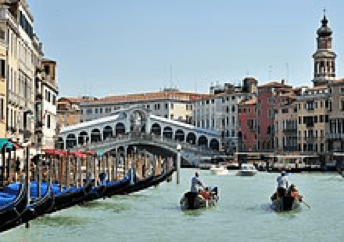
These lines from Robert Browning’s 1855 poem ‘A Tocatta of Gullapi’s’ speaks of none other than the Rialto bridge, much celebrated, vaunted and frequented – a bridge that exudes romance and gaiety, is identified with young lovers, and edifies the very spirit of Venice.
Venice as a city abounds in bridges of all shapes and sizes, some four hundred of them covering a hundred and twenty isles. And the Rialto, a stone-arch bridge, is the very epicentre of this remarkable town. It is a pedestrian bridge crossing the celebrated Grand Canal connecting the sestieri (districts) of San Marco and San Polo. The Rialto stands at a height of about 24 feet and is about 75 feet wide. At its longest, it is over a hundred feet.
First constructed between 1173 and 1181 as a pontoon bridge by Nicolò Barattieri, it has seen several reconstructions and renovations. It was first called Ponte della Moneta, because a mint stood near its eastern entrance. In 1255, it was replaced by a wooden bridge, and a market known as Rialto market begun to flourish on its eastern side.
The construction of this remarkable canal in its stone-arch form began in earnest in 1588 and took three years to complete. To support the wide stone arch in the soft alluvial soil, six thousand timber piles were driven under each abutment and the bed joints of the stones were placed perpendicular to the thrust of the arch. The new stone bridge retained the basic features of the old bridge. Two ramps lead up to a central portico, which can be raised to allow large ships to pass.
Till 1850, the Rialto was the only fixed bridge on the Grand Canal. Everywhere else people had to be ferried across on gondolas. The market once confined to its eastern side flourished into perhaps the most delightful place in Venice. Today, it forms a row of antiquated shops, studded with groceries, daily caches, and a fish market. Crowded at every hour of the day, the shoppers and tourists alike enjoy a view of the gondola-filled Grand Canal waterway, a sight as arresting and captivating as any.
Partly burnt in the revolt led by Bajamonte Tiepolo in 1310, the Rialto has also witnessed two massive collapses. Once in 1444, it collapsed under the weight of a crowd rushing to see the marriage of the Marquis of Ferrara. Another collapse followed 80 years later in 1524, but have since been prevented since the reworking of the bridge in 1588. It must be noted however that the engineering of the bridge was considered so audacious that architect Vincenzo Scamozzi predicted a certain future catastrophe.
The Rialto, however, defied its critics to become an architectural icon, the top tourist attraction in Venice, and above all, showcases even today the ingenuity and vision of 16th century Venice, a definitive center of renaissance culture and creativity.
 scribo ad LX