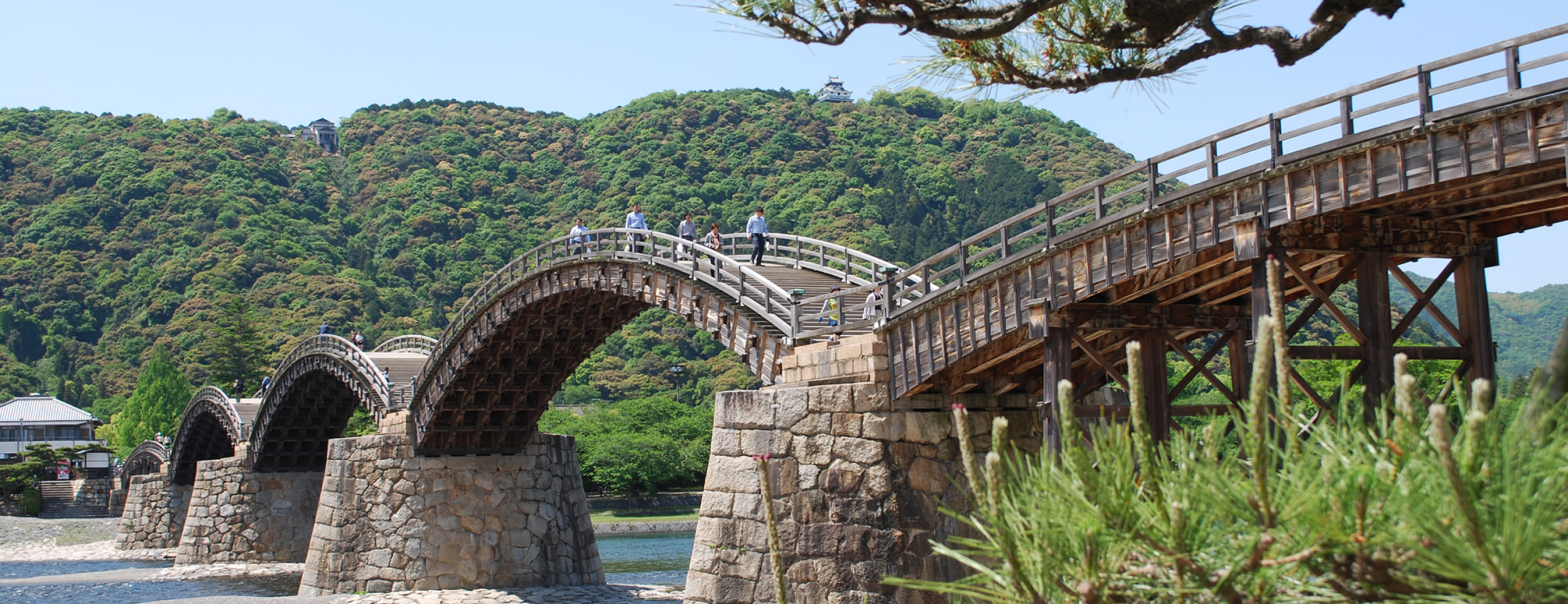
Built in the 1600s, Kintaikyō Bridge (popularly ‘Kintai’) in Iwakuni across the Nishiki river is arguably Japan’s most famous bridge. Its has five graceful arches set on four stone and two wooden pillars that languorously embellish the river’s 200-meter width as they span it majestically. But there is also a delicate tenderness in the structure, exuding beauty and grace.
River Nishiki is one of the fasted flowing rivers of Japan. Utterly untameable, violently independent and resenting any constraints in her forceful, rapid and breath-taking descent down the mountains, she tends to wash away bridges built on her. She did so numerous times since 1673 when the first bridge was erected across her.
The furious water of the Nishiki kept wreaking havoc with the bridges built on it till a more durable bridge was commissioned by Kikkawa Hiroyoshi, the third feudal lord of Iwakuni, whose statue stands at the entrance to nearby Kikko Park. The reinforced bridge kept standing until 1950, when Iwakuni was struck by a violent typhoon. Determined residents began a precise reconstruction of their cherished bridge and completed it in its current form in 1953.
In 2001, specially designed arches replaced the old ones without compromising the original design. The continuous, looping arches present a spectacular and captivating sight but also ensure absorption of the fury of the Nishiki when she is in a particularly foul or destructive mood.
Japanese zelkova and pine are joined to support the beautiful arches. Japanese cypress is lavishly used on the walkway and handrails of the bridge, and its supports are made of cypress, chestnut, and oak.
As one ventures to a vantage point at the back of the bridge, a delightful and delectable display of masterly woodwork is present to enthral the visitor. The beauty of six different kinds of wood interwoven in mesmerising pattern, complex yet graceful, is present to offer a sublime moment to the beholder.
The passage way straddled by these fetching curves are open only to pedestrians who as they walk over them soaking in every moment. This complexity of the Japanese craft captivates one completely as one crosses the river and moves on to the riverside to witness its magic in more detail. Interestingly, the entire bridge has been constructed without using any nails – utilising interlocking pieces of wood to maintain its sturdiness instead, later reinforced with sheets of copper.
Spring, summer, autumn, and winter all have their own beauty at Kintai Bridge, but the most spectacular of all is summer. A boat ride at night while enjoying the brightly lit bridge and watching traditional fisherman use cormorants to catch sweet fish is an enthralling experience. In August every year, six thousand fireworks colour the night sky, making the arches of Kintai Bridge float in a dreamlike milieu.
Kintai Bridge today is not merely a world famous tourist spot noted for its elegance and grace, but a modern symbol of a hoary tradition, enshrining within its architecture the very essence of the inimitable Japanese culture. Therein lies its resplendence and glory, and its cause for admiration for hundreds of years.
 scribo ad LX