“Of all the things
I can do
On this earth
I want to build
A bridge
From my heart to yours”
– Alexandra Vasiliu
Bridges symbolise connectivity. Over time, these passageways became an expression of architectural marvel and creative imagination, testament to impressive feats of human ingenuity and engineering, and a means of displaying beautiful works of art.
Many sturdy spans began to make their surrounding landscape more fetching by offering an aesthetic feast. Whether it was intricate balustrades, stone sculptures of animals and mythical creatures, or even decorative paint and tile work, bridges over time acquired an additional dimension of grandeur, elegance and eloquence of visual magnificence. The natural setting and sights and sounds offered to the beholder provided space for reflection and for enjoyment of the natural beauty on resplendent display. Bridges soon began to represent the best a human mind was capable of conceiving and creating.
According a hierarchy to the magnificence and opulence of bridges will be presumptuous, several of them a masterpiece in their own right; but while London Bridge, Brooklyn Bridge and the Sydney Harbour Bridge are among the most visited and most popular, there are many others that easily rival and even exceed the beauty and grandeur of these iconic bridges.
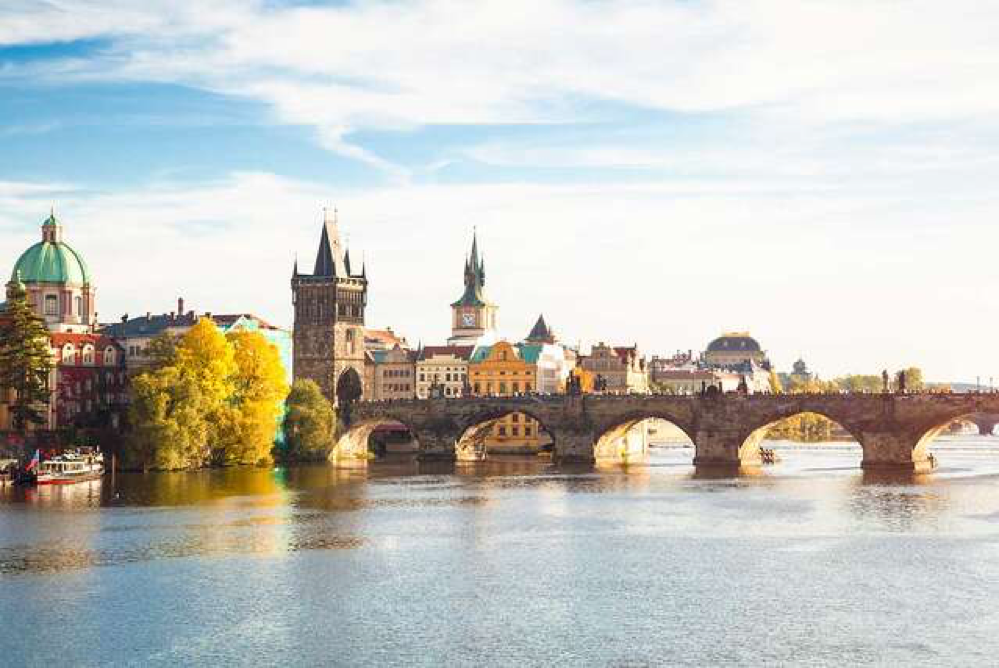
Charles Bridge in Prague, the capital of Czech Republic is one such bridge, offering one of the most spectacular sights for a visitor. Its beauty and fame are inseparably linked to the most glamorous era of Prague, and its claim of being the most beautiful bridge of Europe is overwhelmingly endorsed by the common visitors as much as by connoisseurs of beauty.
Charles Bridge
This ancient bridge across the Vltava river was built between the 14th and the 15th centuries, making it the oldest bridge in the city and the second oldest in Czech Republic. It was commissioned by Charles IV in 1357 when an earlier bridge standing at the same place was destroyed by floods in 1342.
Originally called Stone Bridge, as it was initially made from sandstone blocks, it took almost half a century to be completed. The construction was supervised by Peter Parler (‘Petr Parléř’ in Czech), the famous German-Czech architect. When completed in 1402, the bridge was 516 meters long, 9.5 meters wide, 13 meters high, and stood on 15 pillars.
For a long time known only as ‘Stone’ or ‘Prague’ Bridge, it was renamed Charles Bridge in 1870 to commemorate its patron.
Towers and Statues
Charles Bridge is dominated by two imposing and ornate Gothic towers standing on either ends of the bridge, lending a grandeur and majesty completely in consonance with the opulence of the bridge itself. But perhaps the bridge’s most beautiful feature is the thirty baroque-style statues that decorate its balustrade on either side, adding a distinguished feature that makes Charles Bridge stand out. Each statue is full of history and its own engrossing tale.
One of the most interesting statues is that of St. John of Nepomuk. It has huge religious significance, immortalizing the memory of John of Nepomuk (‘Jan Nepomucký’ or ‘Johánek z Pomuka’), one of the most prominent of Czech saints. It is commonly believed that touching the statue brings luck.
There is a sculpture of a famous mythical Bohemian knight Bruncvik (‘Bruncvík’) with a golden sword and lion at his feet. According to legend, Bruncvik once bravely helped a lion fight a huge dragon. The lion, of course, then became the knight´s friend. The statues of St. Vincent Ferrer and St. Procopius are also artistically remarkable statues created by the Czech sculptor Ferdinand Brokoff in 1712.
The sculpture group of St. Lutgarde is the most praised piece of art on the bridge, created in 1710 by Matthias Braun (‘Matyáš Braun’), perhaps the most famous of the Czech late baroque style sculptors. It shows the Czech saint and blind nun Lutgarde’s (‘Luitgarda’) vision of crucified Jesus.
Legends
The legends linked to this bridge are as fascinating as the bridge itself. One such legend relates that the builders decided to strengthen the bridge by adding raw eggs into the mortar. As there were not enough eggs in Prague, they had to be brought from every corner of the land and the inhabitants in one of the regions were afraid that the eggs would break during transportation and so they sent them boiled – to the great amusement of the whole of Prague.
Returning to the statue of St. John, it is believed John of Nepomuk was tortured to death after he refused to give away the confessional secret of the Queen and thanks to his silence, his tongue allegedly stayed preserved for hundreds of years after his death. Further according to legend, soon after his tortured body was thrown down from Charles Bridge, one of the bridge arches collapsed. After every attempt to fix the bridge failed mysteriously, one of the builders decided to make a pact with the Devil, offering the soul of the first person to step on the bridge. It is not on record who the poor unfortunate was, but the arch was repaired in due course.
Another legend tells of a cross that used to be placed at Charles Bridge. Allegedly, convicts sentenced to death were allowed to kneel under it and pray on their way to their execution. Curiously, a counter belief is that seeing this cross is a sign of coming tragic. But the resplendent charm of Charles Bridge’s dispels any scare that the above legends may suggest. It is a magnificent, charming historical building, often full not only with tourists, but also various artists, painters and musicians. It is truly ‘the Queen’ of Europe’s bridges.
 scribo ad LX